Launches
NO DATA0MISSIONS
The launch archive is still being mirrored, so this day has no launches listed yet.
ARCHIVE // DAY OF YEAR
Wikipedia records 11 spaceflight and astronomy events on August 25. Below are the pictures NASA published on August 25 in 6 different years — each one taken or released on this exact date.
0MISSIONS
The launch archive is still being mirrored, so this day has no launches listed yet.
11ENTRIES
Spaceflight and astronomy entries from Wikipedia's record of this date, oldest first — from 1609 onward.
6IMAGES
NASA's Astronomy Picture of the Day for August 25, one per year. Some are public domain and some belong to the photographer — each says which.
NASA’s Astronomy Picture of the Day, for this calendar date in each of the last several years.
2026
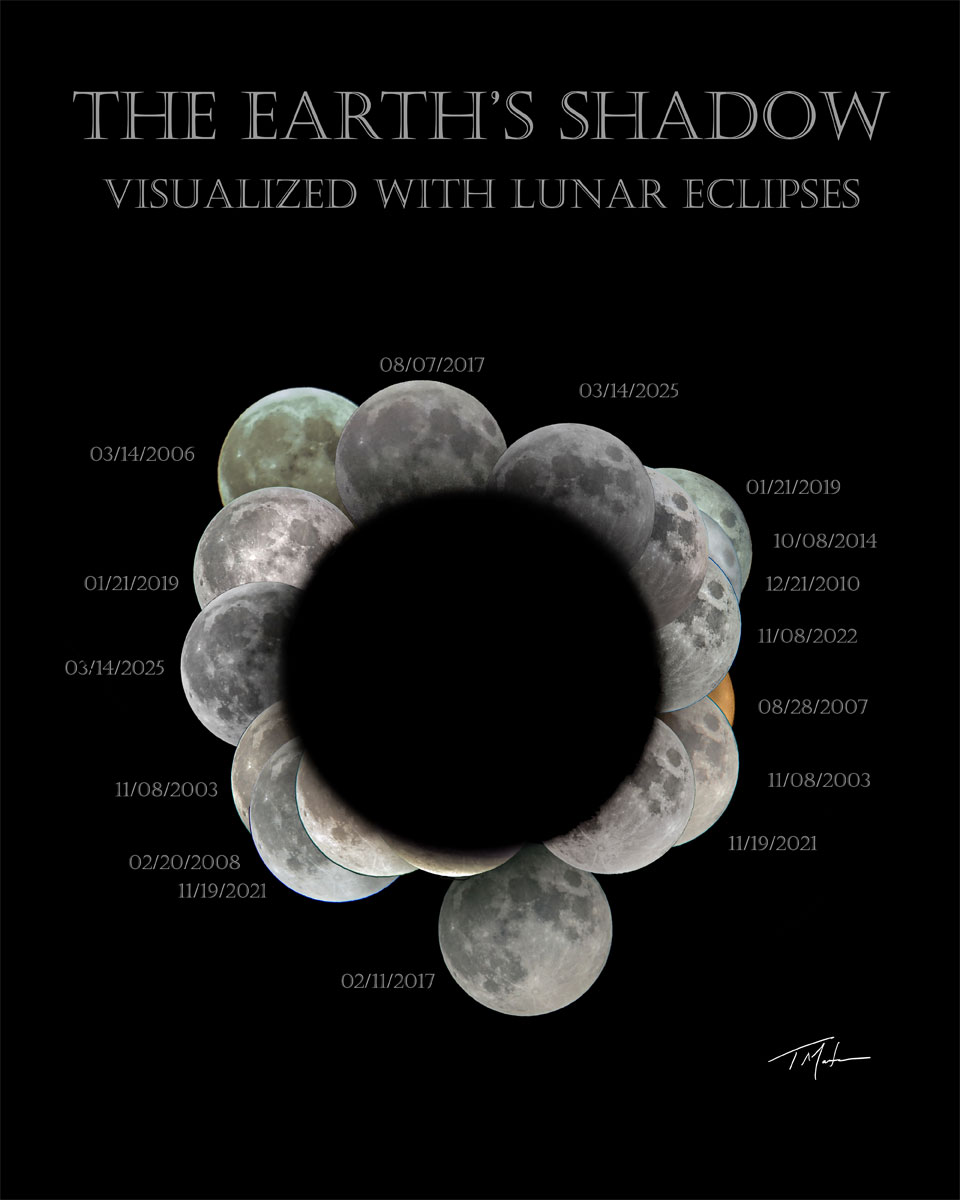
What’s creating this giant hole in space? This is not a black hole — it’s a shadow. It’s Earth’s shadow. Since at least the time of Aristotle, people have noted that Earth's dark shadow on the Moon during a partial lunar eclipse is circular -- although never a whole circle. Using modern digital technology, though, the images of multiple lunar eclipses can be combined to show Earth's complete shadow. The featured image compilation by a perseistent astrophotographer is constructed from 22 years of lunar eclipses. The Moon is not eclipsed every month (moon-th) because the Moon's orbit is slightly tilted relative to Earth's orbit. Close inspection of some lunar eclipse images shows a faint blue band where Earth’s atmosphere filters out more red sunlight than blue. Later this week, a new lunar eclipse will occur and will be best visible in parts of North and South America, Europe, and Africa. APOD's main NASA site is moving : From apod.nasa.gov to science.nasa.gov/apod
© Tim Martin — used with the credit NASA publishes

2025
Sometimes even the sky surprises you. To see more stars and faint nebulosity in the Pleiades star cluster (M45), long exposures are made. Many times, less interesting items appear on the exposures that were not intended -- but later edited out. These include stuck pixels, cosmic ray hits, frames with bright clouds or Earth's Moon, airplane trails, lens flares, faint satellite trails, and even insect trails. Sometimes, though, something really interesting is caught by chance. That was just the case a few weeks ago in al-Ula, Saudi Arabia when a bright meteor streaked across during an hour-long exposure of the Pleiades. Along with the famous bright blue stars, less famous and less bright blue stars, and blue-reflecting dust surrounding the star cluster, the fast rock fragment created a distinctive green glow, likely due to vaporized metals. Jigsaw Universe: Astronomy Puzzle of the Day
© Yousif Alqasimi & Essa Al Jasmi — used with the credit NASA publishes
2024
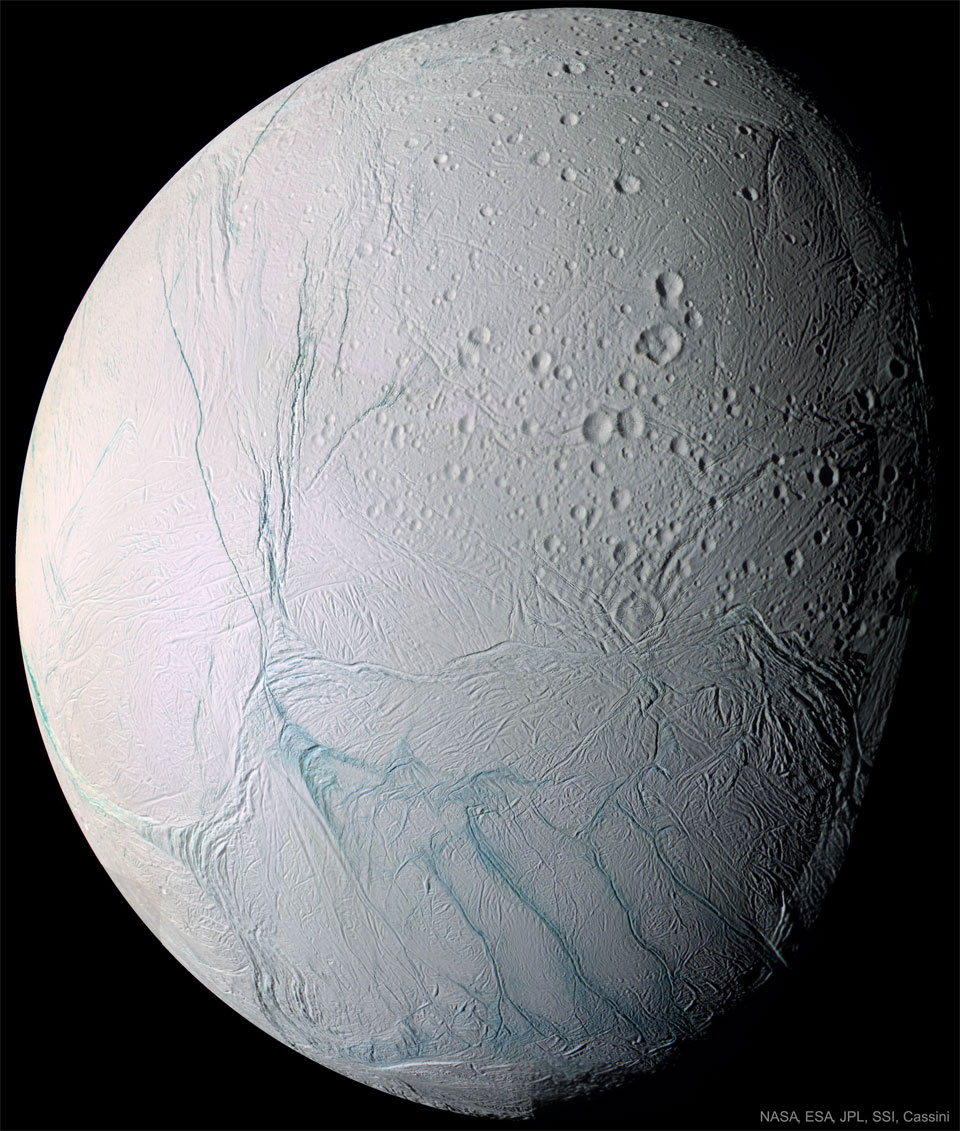
Do underground oceans vent through canyons on Saturn's moon Enceladus? Long features dubbed tiger stripes are known to be spewing ice from the moon's icy interior into space, creating a cloud of fine ice particles over the moon's South Pole and creating Saturn's mysterious E-ring. Evidence for this has come from the robot Cassini spacecraft that orbited Saturn from 2004 to 2017. Pictured here, a high resolution image of Enceladus is shown from a close flyby. The unusual surface features dubbed tiger stripes are visible in false-color blue. Why Enceladus is active remains a mystery, as the neighboring moon Mimas, approximately the same size, appears quite dead. An analysis of ejected ice grains has yielded evidence that complex organic molecules exist inside Enceladus. These large carbon-rich molecules bolster -- but do not prove -- that oceans under Enceladus' surface could contain life. Explore Your Universe: Random APOD Generator
NASA · public domain
2023
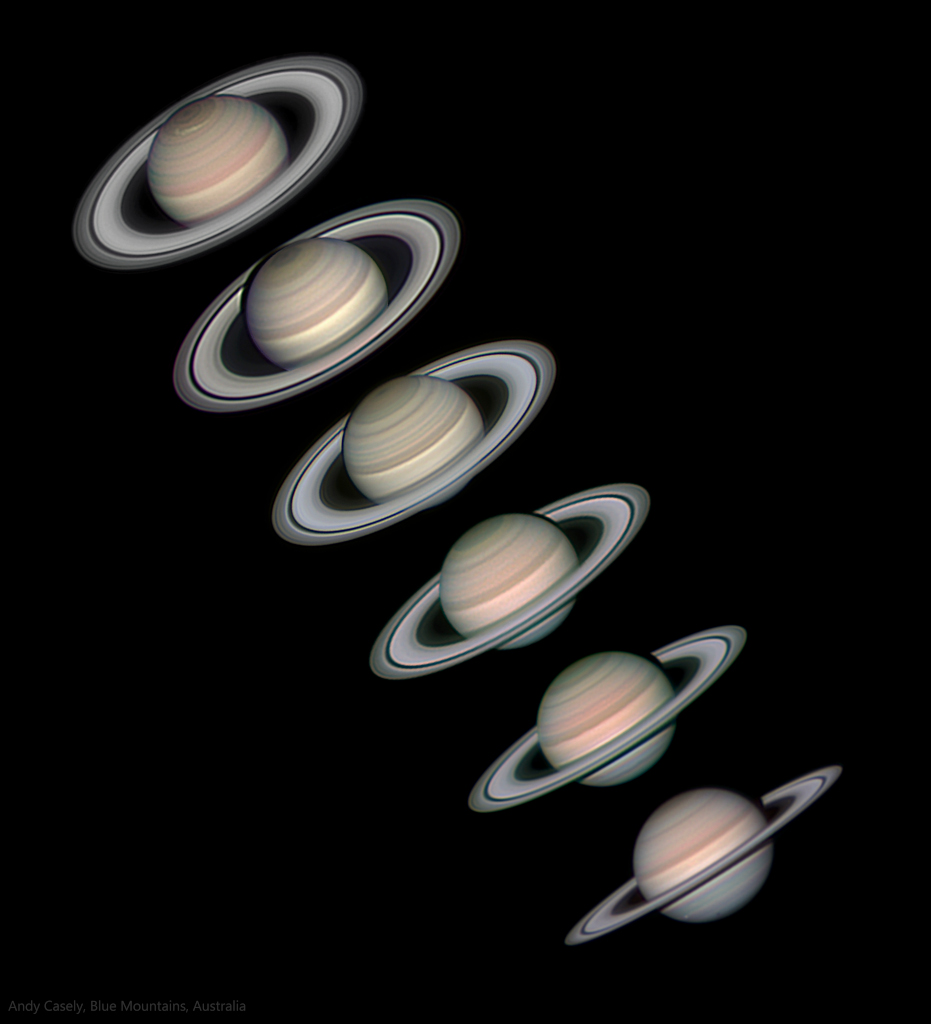
Ringed planet Saturn will be at its 2023 opposition, opposite the Sun in Earth's skies, on August 27. While that puts the sixth planet from the Sun at its brightest and well-placed for viewing, its beautiful ring system isn't visible to the unaided eye. Still, this sequence of six telescopic images taken a year apart follows both Saturn and rings as seen from inner planet Earth. The gas giant's ring plane tilts from most open in 2018 to approaching edge-on in 2023 (top to bottom). That's summer to nearly the autumn equinox for Saturn's northern hemisphere. In the sharp planetary portraits Saturn's northern hexagon and a large storm system are clearly visible in 2018. In 2023 ice moon Tethys is transiting, casting its shadow across southern hemisphere cloud bands while Saturn's cold blue south pole is emerging from almost a decade of winter darkness.
© Andy Casely — used with the credit NASA publishes
2022
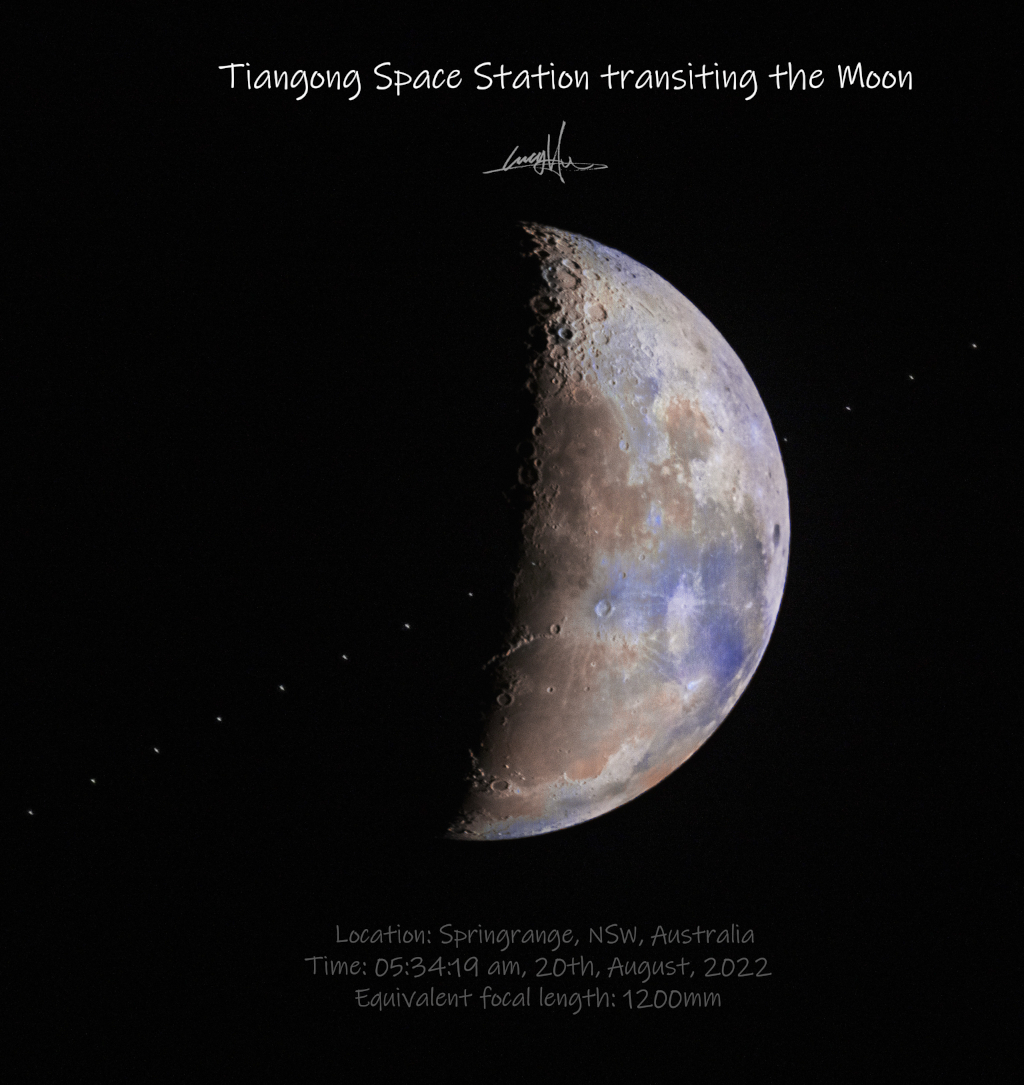
The rugged lunar south polar region lies at the top of this colorful portrait of a last quarter Moon made on August 20. Constructed from video frames and still images taken at Springrange, New South Wales, Australia it also captures a transit of China's Tiangong Space Station. The transit itself was fleeting, taking the space station less than a second to cross the shadowed and sunlit lunar disk. The low Earth orbiting Tiangong is at an altitude of about 400 kilometers, while the Moon is some 400,000 kilometers away. Subtle color differences along the bright lunar surface are revealed in the multiple stacked frames. Not visible to the eye, they indicate real differences in chemical makeup across the lunar surface.
© Lucy Yunxi Hu — used with the credit NASA publishes
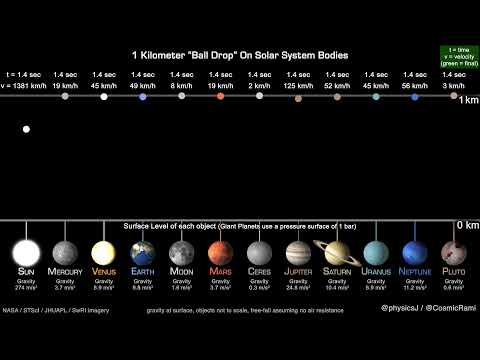
2021
Does a ball drop faster on Earth, Jupiter, or Uranus? The featured animation shows a ball dropping from one kilometer high toward the surfaces of famous solar system bodies, assuming no air resistance. The force of gravity depends on the mass of the attracting object, with higher masses pulling down with greater forces. But gravitational force also depends on distance from the center of gravity, with shorter distances causing the ball to drop faster. Combining both mass and distance, it might be surprising to see that Uranus pulls the ball down slightly slower than Earth, despite containing over 14 times more mass. This happens because Uranus has a much lower density, which puts its cloud tops further away from its center of mass. Although the falling ball always speeds up, if you were on the ball you would not feel this acceleration because you would be in free-fall. Of the three planets mentioned, the video demonstrates a ball drops even faster on Jupiter than either Earth and Uranus.
© James O'Donoghue (JAXA) & Rami Mandow (Space Australia); Text: James O'Donoghue — used with the credit NASA publishes

1609
Italian astronomer Galileo Galilei (pictured) demonstrated his first telescope to Venetian lawmakers.
Galileo Galilei ↗
1835
The first Great Moon Hoax article is published in The New York Sun, announcing the discovery of life and civilization on the Moon.
Great Moon Hoax ↗

1989
The NASA spacecraft Voyager 2 made its closest approach to Neptune and provided definitive proof of the existence of the planet's rings (pictured).
NASA ↗1989
Voyager 2 spacecraft makes its closest approach to Neptune, the last planet in the Solar System at the time, due to Pluto being within Neptune's orbit from 1979 to 1999.
Voyager 2 ↗
2001
American singer Aaliyah and several members of her record company were killed when their overloaded aircraft crashed shortly after takeoff from Marsh Harbour Airport in The Bahamas.
Aaliyah ↗2001
American singer Aaliyah and several members of her entourage are killed as their overloaded aircraft crashes shortly after takeoff from Marsh Harbour Airport, Bahamas.
Aaliyah ↗2012
The NASA space probe Voyager 1 became the first man-made object to enter interstellar space.
NASA ↗2012
Voyager 1 spacecraft enters interstellar space, becoming the first man-made object to do so.
Voyager 1 ↗Event text and thumbnails come from Wikipedia and are used under CC BY-SA 4.0. Images are drawn only from Wikimedia Commons, which does not accept non-free content — each thumbnail links to its file page, where its licence and author are recorded.
Launch records are from The Space Devs’ Launch Library 2. This archive is still being mirrored, so some days are incomplete. Pictures are NASA’s Astronomy Picture of the Day; NASA imagery is generally not subject to copyright, but individual APOD entries are frequently the property of the photographer, and each caption says which applies.
General-audience astronomy and spaceflight — none of it a textbook.
As an Amazon Associate I earn from qualifying purchases. Links here cost you nothing extra.
LISTING
Still the best single argument for why any of this matters, and it leaves the arithmetic in. For a reader who wants the science, not just the awe.
LISTING
The case for leaving Earth, written by someone unsentimental about how hard that is. Suits readers who want the argument rather than the poster.
LISTING
Hard-SF problem solving in The Martian's key — for anyone who liked the engineering more than the peril. The only novel on this list.
BROWSE opens an Amazon search, not a specific recommendation.
LINKS AMAZON.COM