Launches
NO DATA0MISSIONS
The launch archive is still being mirrored, so this day has no launches listed yet.
ARCHIVE // DAY OF YEAR
Wikipedia records 3 spaceflight and astronomy events on this date. Below are the pictures NASA published on August 27 in 6 different years — each one taken or released on this exact date.
0MISSIONS
The launch archive is still being mirrored, so this day has no launches listed yet.
3ENTRIES
Spaceflight and astronomy entries from Wikipedia's record of this date, oldest first — from 1962 onward.
6IMAGES
NASA's Astronomy Picture of the Day for August 27, one per year. Some are public domain and some belong to the photographer — each says which.
NASA’s Astronomy Picture of the Day, for this calendar date in each of the last several years.
2026
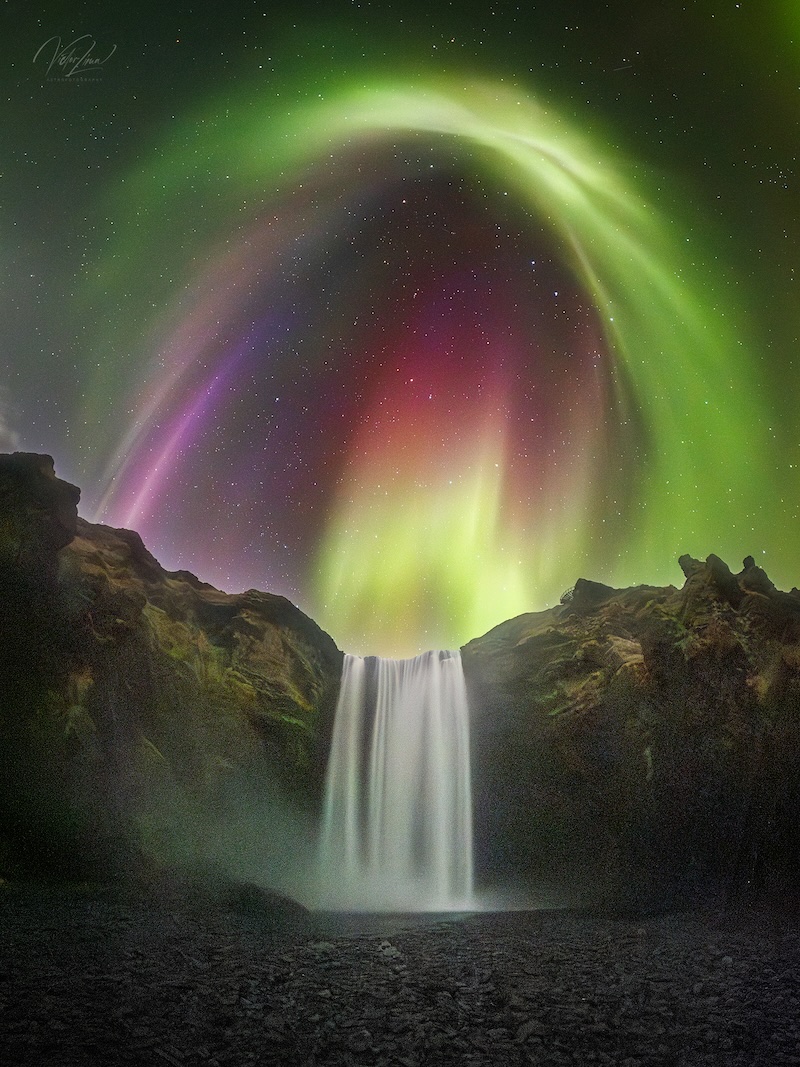
What a sight to behold, when a night sky became filled with colors that appeared to rain over the Skógafoss waterfall in Iceland. This image was taken in a single 5 second exposure by the photographer in April 2025. Seeing an aurora is on many people's bucket lists. But it is not easy. It requires high solar activity, dark and clear skies, and usually a viewing location at high latitude. That makes the northern lights more easily seen than the corresponding southern lights, simply because there is less landmass in the Southern Hemisphere, especially around the Antarctic Circle. Auroras are caused by charged particles from the solar wind that are captured by the Earth's magnetosphere and guided by the magnetic field to a region close to one of the poles, where they collide with gas particles in the atmosphere. Different colors indicate interactions with different gases at different altitudes, like oxygen (red and green) and nitrogen (blue and pink). APOD's main NASA site is moving : From apod.nasa.gov to science.nasa.gov/apod
© Victor Lima Text: Cecilia Chirenti (NASA GSFC, UMCP, CRESST II) — used with the credit NASA publishes

2025
That yellow spot -- what is it? It's a young planet outside our Solar System. The featured image from the Very Large Telescope in Chile surprisingly captures a distant scene much like our own Solar System's birth, some 4.5 billion years ago. Although we can't look into the past and see Earth's formation directly, telescopes let us watch similar processes unfolding around distant stars. At the center of this frame lies a young Sun-like star, hidden behind a coronagraph that blocks its bright glare. Surrounding the star is a bright, dusty protoplanetary disk -- the raw material of planets. Gaps and concentric rings mark where a newborn world is gathering gas and dust under its gravity, clearing the way as it orbits the star. Although astronomers have imaged disk-embedded planets before, this is the first-ever observation of an exoplanet actively carving a gap within a disk -- the earliest direct glimpse of planetary sculpting in action.
NASA · public domain
2024
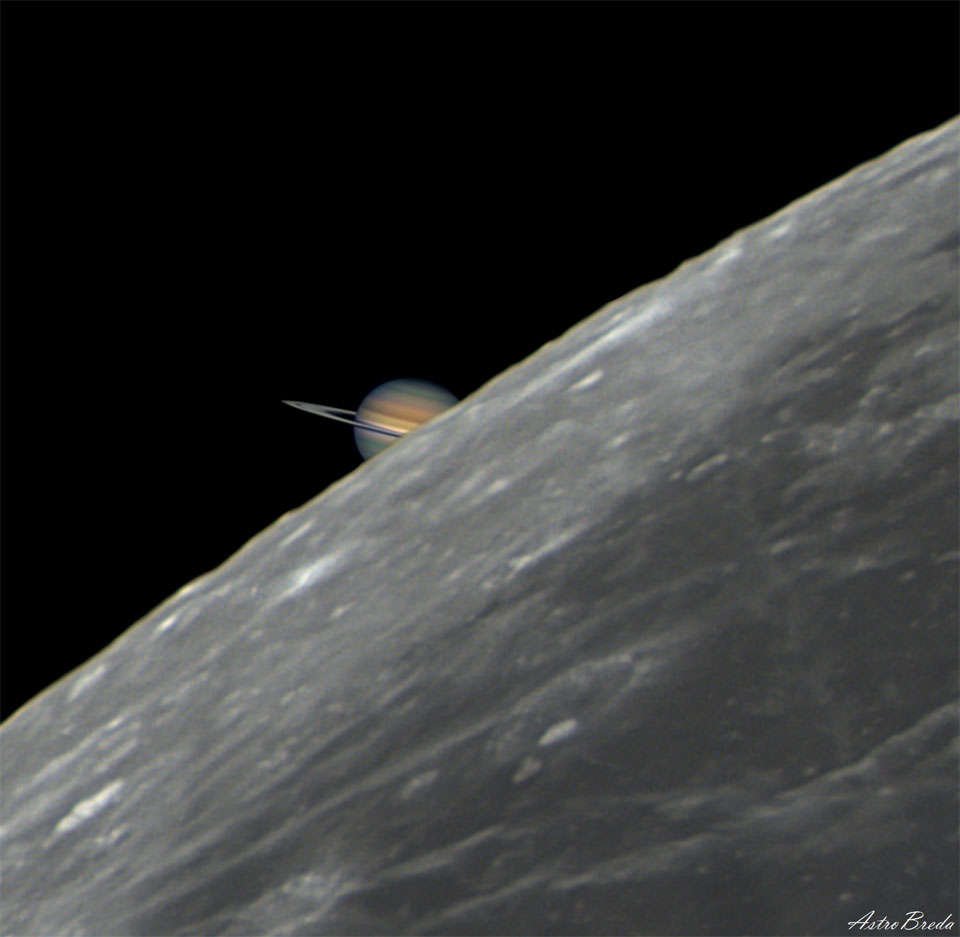
What if Saturn disappeared? Sometimes, it does. It doesn't really go away, though, it just disappears from view when our Moon moves in front. Such a Saturnian eclipse, more formally called an occultation, was visible along a long swath of Earth -- from Peru, across the Atlantic Ocean, to Italy -- only a few days ago. The featured color image is a digital fusion of the clearest images captured during the event and rebalanced for color and relative brightness between the relatively dim Saturn and the comparatively bright Moon. Saturn and the comparative bright Moon. The exposures were all taken from Breda, Catalonia, Spain, just before occultation. Eclipses of Saturn by our Moon will occur each month for the rest of this year. Each time, though, the fleeting event will be visible only to those with clear skies -- and the right location on Earth. Gallery: Moon Eclipses Saturn in August 2024
© Pau Montplet Sanz — used with the credit NASA publishes
2023
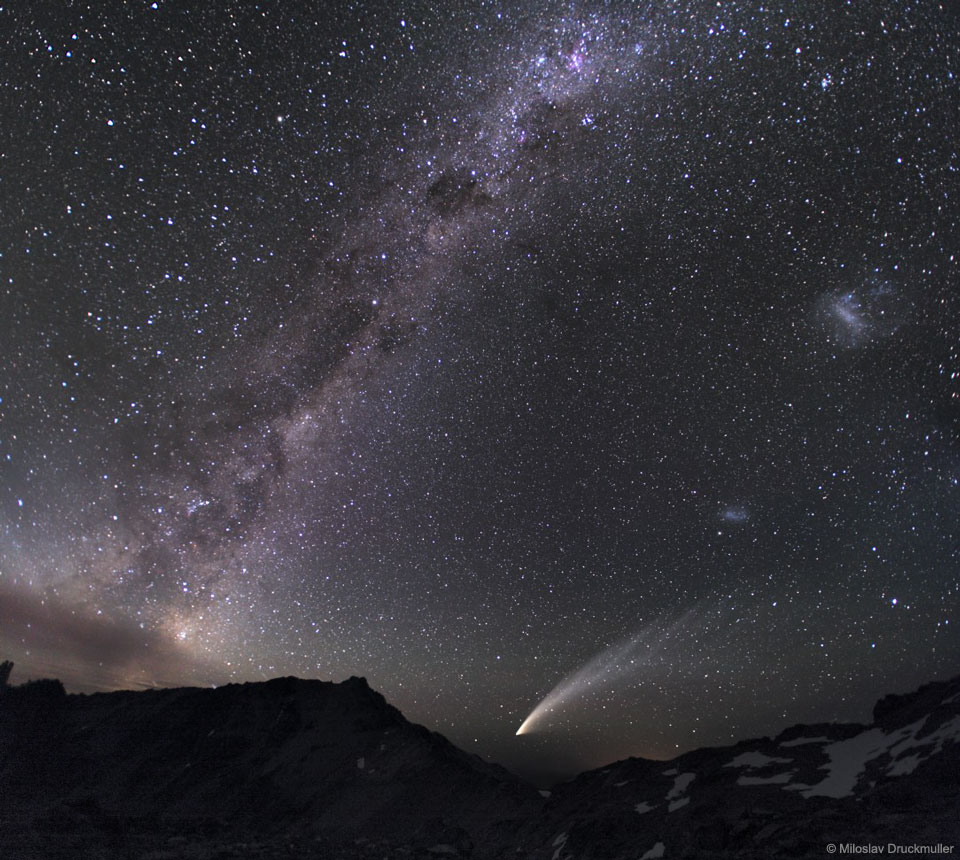
Diffuse starlight and dark nebulae along the southern Milky Way arc over the horizon and sprawl diagonally through this gorgeous nightscape. The breath-taking mosaic spans a wide 100 degrees, with the rugged terrain of the Patagonia, Argentina region in the foreground. Along with the insider's view of our own galaxy, the image features our outside perspective on two irregular satellite galaxies - the Large and Small Magellanic Clouds. The scene also captures the broad tail and bright coma of Comet McNaught, the Great Comet of 2007.
© Miloslav Druckmuller (Brno University of Technology) — used with the credit NASA publishes
2022
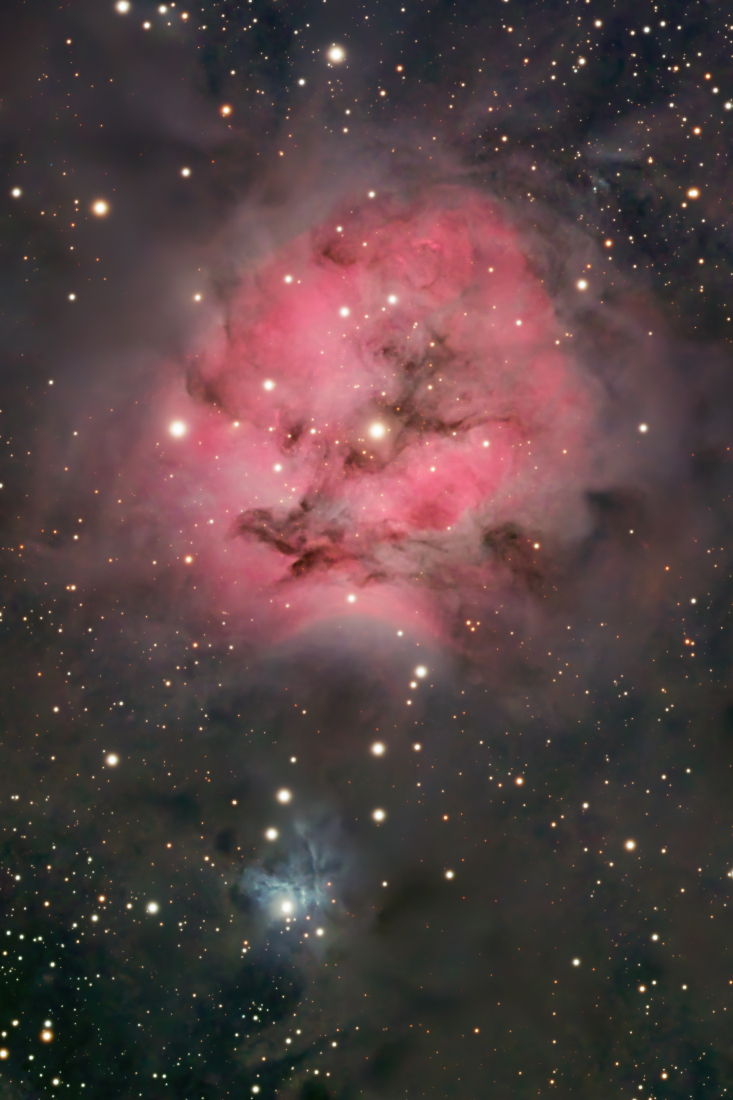
Inside the Cocoon Nebula is a newly developing cluster of stars. Cataloged as IC 5146, the beautiful nebula is nearly 15 light-years wide. Soaring high in northern summer night skies, it's located some 4,000 light years away toward the constellation Cygnus the Swan. Like other star forming regions, it stands out in red, glowing, hydrogen gas excited by young, hot stars, and dust-reflected starlight at the edge of an otherwise invisible molecular cloud. In fact, the bright star found near the center of this nebula is likely only a few hundred thousand years old, powering the nebular glow as it clears out a cavity in the molecular cloud's star forming dust and gas. A 29 hour long integration with a small telescope from Ayr, Ontario, Canada resulted in this exceptionally deep color view tracing tantalizing features within and surrounding the dusty stellar nursery.
© David Jenkins — used with the credit NASA publishes
2021
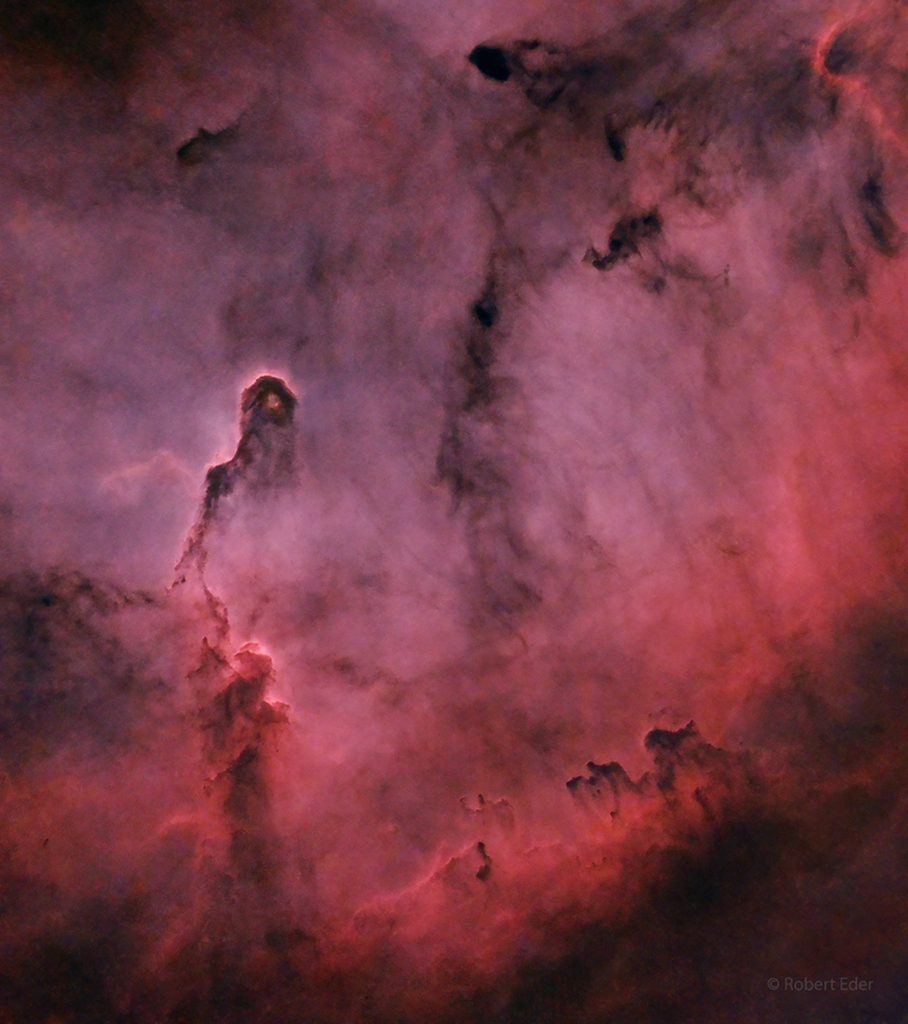
Like an illustration in a galactic Just So Story, the Elephant's Trunk Nebula winds through the emission nebula and young star cluster complex IC 1396, in the high and far off constellation of Cepheus. Also known as vdB 142, seen on the left the cosmic elephant's trunk is over 20 light-years long. Removed by digital processing, no visible stars are in this detailed telescopic close-up view highlighting the bright swept-back ridges that outline pockets of cool interstellar dust and gas. But the dark, tendril-shaped clouds contain the raw material for star formation and hide protostars within. Nearly 3,000 light-years distant, the relatively faint IC 1396 complex covers a large region on the sky, spanning over 5 degrees. This starless rendition spans a 1 degree wide field of view though, about the angular size of 2 full moons. Of course the dark shapes below and right, marching toward the winding Elephant's Trunk, are known to some as The Caravan.
© Robert Eder — used with the credit NASA publishes


1985
Space Shuttle Discovery is launched on STS-51-I to deploy three communication satellites and repair a fourth malfunctioning one.
Space Shuttle Discovery ↗
2003
Mars makes its closest approach to Earth in nearly 60,000 years, passing 34,646,418 miles (55,758,005 km) distant.
Mars ↗Event text and thumbnails come from Wikipedia and are used under CC BY-SA 4.0. Images are drawn only from Wikimedia Commons, which does not accept non-free content — each thumbnail links to its file page, where its licence and author are recorded.
Launch records are from The Space Devs’ Launch Library 2. This archive is still being mirrored, so some days are incomplete. Pictures are NASA’s Astronomy Picture of the Day; NASA imagery is generally not subject to copyright, but individual APOD entries are frequently the property of the photographer, and each caption says which applies.
General-audience astronomy and spaceflight — none of it a textbook.
As an Amazon Associate I earn from qualifying purchases. Links here cost you nothing extra.
LISTING
Still the best single argument for why any of this matters, and it leaves the arithmetic in. For a reader who wants the science, not just the awe.
LISTING
The case for leaving Earth, written by someone unsentimental about how hard that is. Suits readers who want the argument rather than the poster.
LISTING
Hard-SF problem solving in The Martian's key — for anyone who liked the engineering more than the peril. The only novel on this list.
BROWSE opens an Amazon search, not a specific recommendation.
LINKS AMAZON.COM