Launches
NO DATA0MISSIONS
The launch archive is still being mirrored, so this day has no launches listed yet.
ARCHIVE // DAY OF YEAR
Wikipedia records 5 spaceflight and astronomy events on August 24. Below are the pictures NASA published on August 24 in 5 different years — each one taken or released on this exact date.
0MISSIONS
The launch archive is still being mirrored, so this day has no launches listed yet.
5ENTRIES
Spaceflight and astronomy entries from Wikipedia's record of this date, oldest first — from 1932 onward.
5IMAGES
NASA's Astronomy Picture of the Day for August 24, one per year. Some are public domain and some belong to the photographer — each says which.
NASA’s Astronomy Picture of the Day, for this calendar date in each of the last several years.
2026
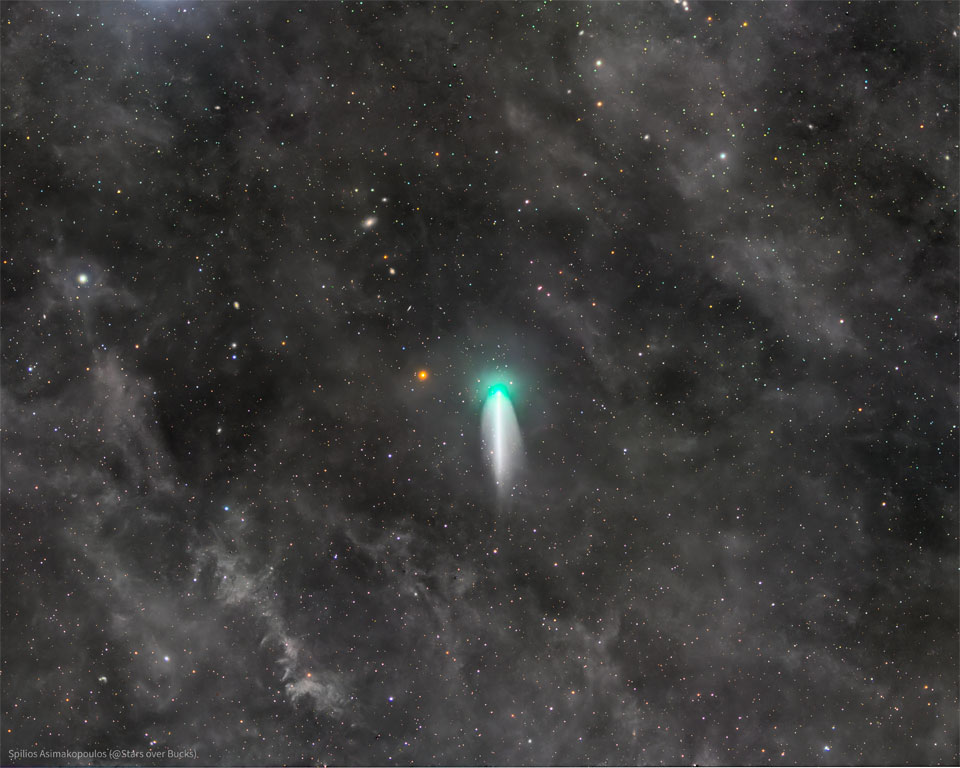
Comet 220P is unexpectedly bright. Normally, periodic Comet 220P/McNaught is so dim that to see it requires a telescope. Two surprising outbursts this year, however, have made it about 20,000 times brighter than usual, so that it is now visible with binoculars and long-duration camera exposures. As expected, Comet 220P continues to orbit the Sun between Mars and Jupiter with a period of over 5 years. The featured long duration exposure, taken 10 days ago from South Africa, shows the comet's bright green head and short dust tail. Reasons for Comet 220P's impressive outbursts are unknown but could be caused by the release of built-up subsurface gas or comet quakes. Comet 220P will pass about one Earth-Sun distance from the Earth in October, after which it is expected to fade quickly as it begins its return to the far part of its orbit. APOD's main NASA site is moving : From apod.nasa.gov to science.nasa.gov/apod
© Spilios Asimakopoulos — used with the credit NASA publishes

2025
At the core of the Crab Nebula lies a city-sized, magnetized neutron star spinning 30 times a second. Known as the Crab Pulsar, it is the bright spot in the center of the gaseous swirl at the nebula's core. About twelve light-years across, the spectacular picture frames the glowing gas, cavities and swirling filaments near the Crab Nebula's center. The featured picture combines visible light from the Hubble Space Telescope in purple, X-ray light from the Chandra X-ray Observatory in blue, and infrared light from the Spitzer Space Telescope in red. Like a cosmic dynamo, the Crab pulsar powers the emission from the nebula, driving a shock wave through surrounding material and accelerating the spiraling electrons. With more mass than the Sun and the density of an atomic nucleus,the spinning pulsar is the collapsed core of a massive star that exploded. The outer parts of the Crab Nebula are the expanding remnants of the star's component gases. The supernova explosion was witnessed on planet Earth in the year 1054. Sky Surprise: What picture did APOD feature on your birthday? (after 1995)
NASA · public domain
2023
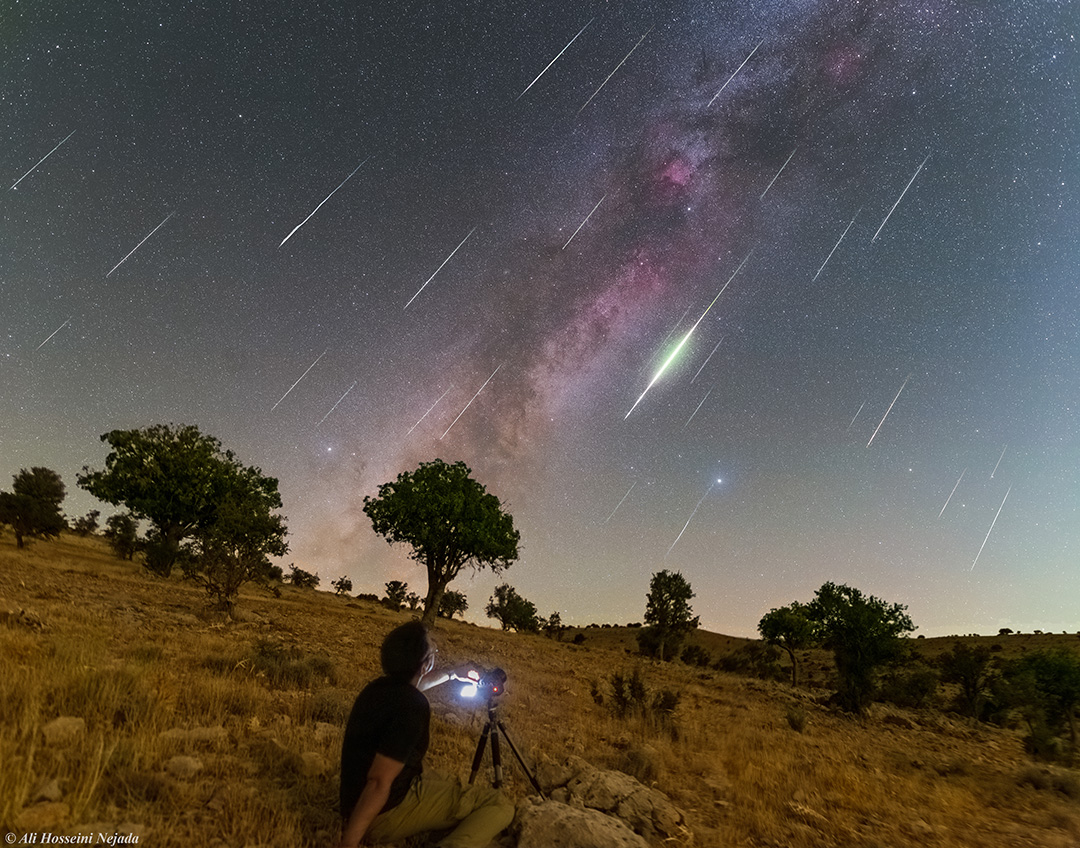
Under dark and mostly moonless night skies, many denizens of planet Earth were able to watch this year's Perseid meteor shower. Seen from a grassy hillside from Shiraz, Iran these Perseid meteors streak along the northern summer Milky Way before dawn on Sunday, August 13. Frames used to construct the composited image were captured near the active annual meteor shower's peak between 02:00 AM and 04:30 AM local time. Not in this night skyscape, the shower's radiant in the heroic constellation Perseus is far above the camera's field of view. But fans of northern summer nights can still spot a familiar asterism. Formed by bright stars Deneb, Vega, and Altair, the Summer Triangle spans the luminous band of the Milky Way.
© Under dark — used with the credit NASA publishes
2022
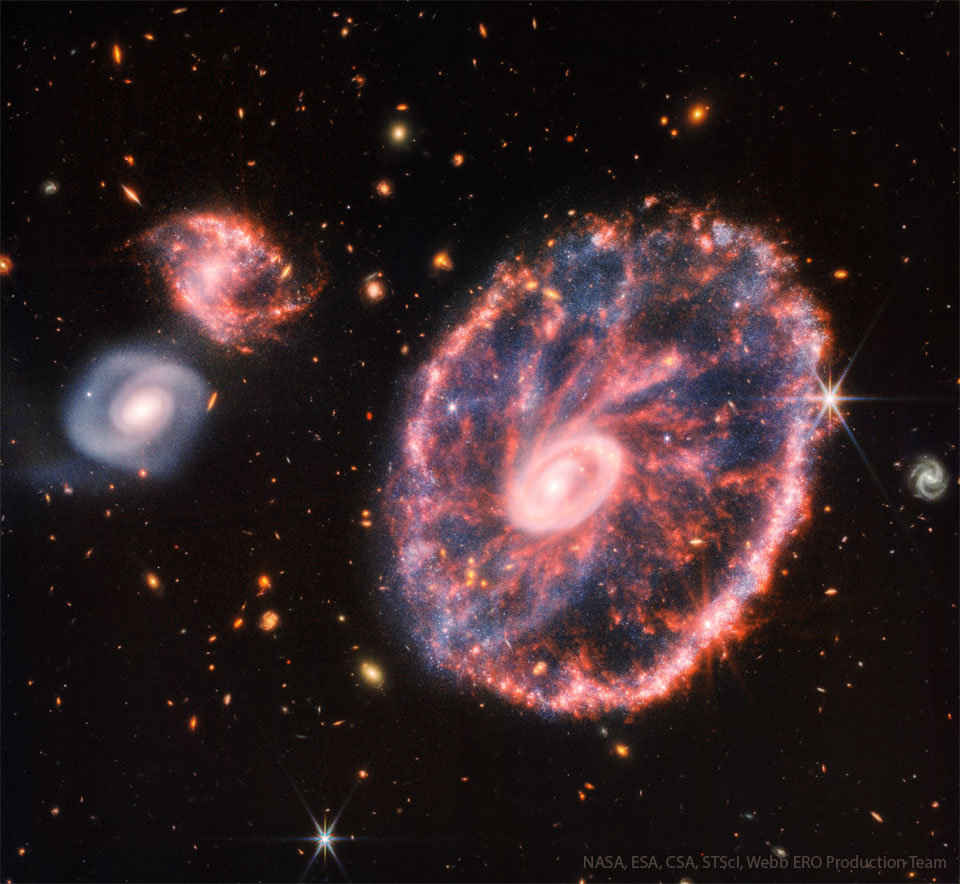
To some, it looks like a wheel of a cart. In fact, because of its outward appearance, the presence of a central galaxy, and its connection with what looks like the spokes of a wheel, the galaxy on the right is known as the Cartwheel Galaxy. To others, however, it looks like a complicated interaction between galaxies awaiting explanation. Along with the two galaxies on the left, the Cartwheel is part of a group of galaxies about 500 million light years away in the constellation Sculptor. The large galaxy's rim spans over 100,000 light years and is composed of star forming regions filled with extremely bright and massive stars. The Cartwheel's ring-like shape is the result of gravitational disruption caused by a smaller galaxy passing through a large one, compressing the interstellar gas and dust and causing a star formation wave to move out like a ripple across the surface of a pond. The featured recent image of the Cartwheel Galaxy by the Webb Space Telescope reveals new details not only about where stars are forming, but also about activity near the galaxy's central black hole. Teachers & Students: Ideas for utilizing APOD in the classroom
NASA · public domain
2021
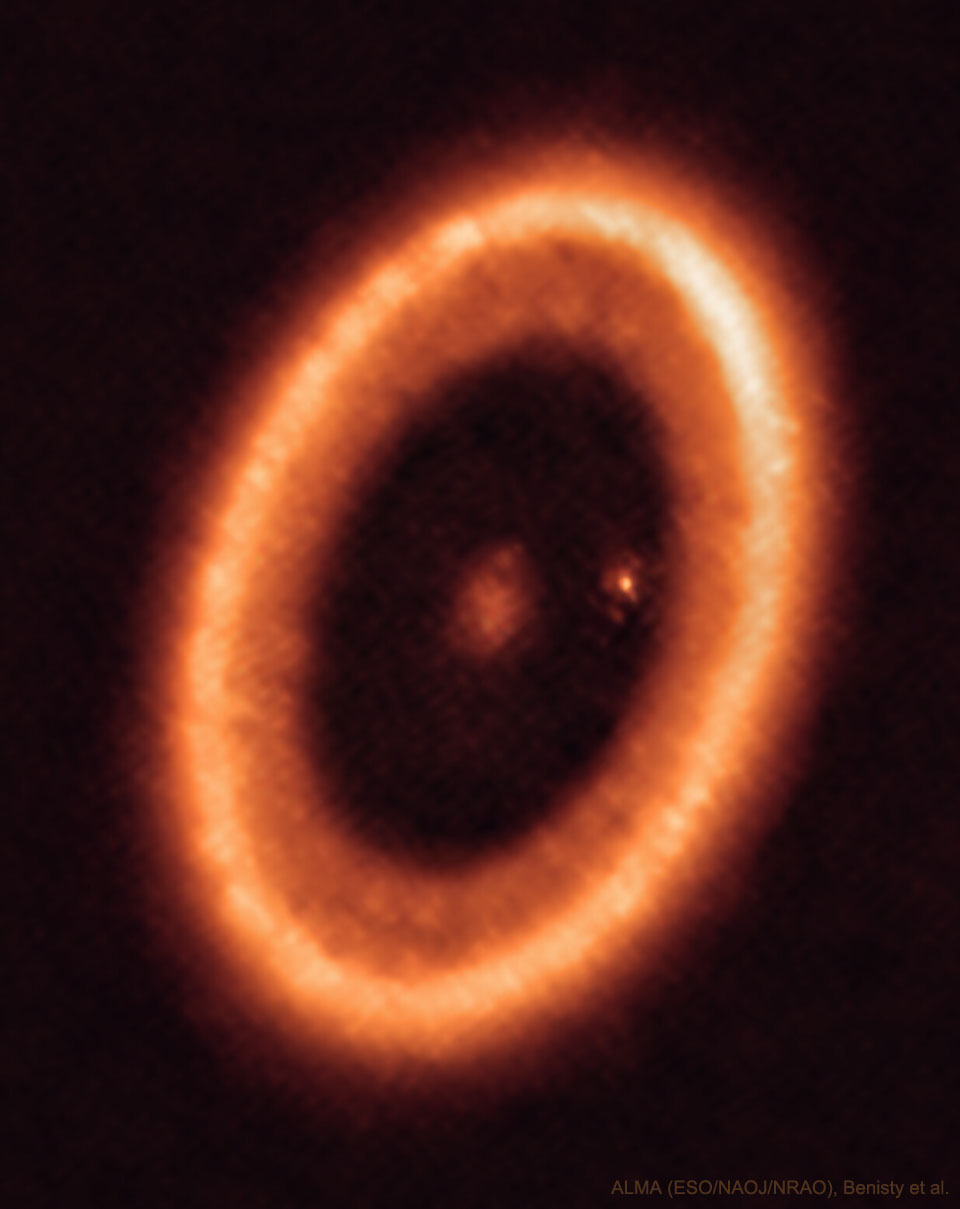
It's not the big disk that's attracting the most attention. Although the big planet-forming disk around the star PDS 70 is clearly imaged and itself quite interesting. It's also not the planet on the right, just inside the big disk, that’s being talked about the most. Although the planet PDS 70c is a newly formed and, interestingly, similar in size and mass to Jupiter. It's the fuzzy patch around the planet PDS 70c that's causing the commotion. That fuzzy patch is thought to be itself a dusty disk that is now forming into moons -- and that has never been seen before. The featured image was taken by the Atacama Large Millimeter Array (ALMA) of 66 radio telescopes in the high Atacama Desert of northern Chile. Based on ALMA data, astronomers infer that the moon-forming exoplanetary disk has a radius similar to our Earth's orbit, and may one day form three or so Luna-sized moons -- not very different from our Jupiter's four.
NASA · public domain

1932
Amelia Earhart becomes the first woman to fly across the United States non-stop (from Los Angeles to Newark, New Jersey).
Amelia Earhart ↗
2006
The International Astronomical Union passed a resolution redefining the term planet and classifying Pluto as a dwarf planet.
International Astronomical Union ↗2006
The International Astronomical Union (IAU) redefines the term "planet" such that Pluto is now considered a dwarf planet.
International Astronomical Union ↗
2016
Proxima Centauri b, the closest exoplanet to Earth, is discovered by the European Southern Observatory.
Proxima Centauri b ↗
2017
The National Space Agency of Taiwan successfully launches the observation satellite Formosat-5 into space.
List of government space agencies ↗Event text and thumbnails come from Wikipedia and are used under CC BY-SA 4.0. Images are drawn only from Wikimedia Commons, which does not accept non-free content — each thumbnail links to its file page, where its licence and author are recorded.
Launch records are from The Space Devs’ Launch Library 2. This archive is still being mirrored, so some days are incomplete. Pictures are NASA’s Astronomy Picture of the Day; NASA imagery is generally not subject to copyright, but individual APOD entries are frequently the property of the photographer, and each caption says which applies.
General-audience astronomy and spaceflight — none of it a textbook.
As an Amazon Associate I earn from qualifying purchases. Links here cost you nothing extra.
LISTING
Still the best single argument for why any of this matters, and it leaves the arithmetic in. For a reader who wants the science, not just the awe.
LISTING
The case for leaving Earth, written by someone unsentimental about how hard that is. Suits readers who want the argument rather than the poster.
LISTING
Hard-SF problem solving in The Martian's key — for anyone who liked the engineering more than the peril. The only novel on this list.
BROWSE opens an Amazon search, not a specific recommendation.
LINKS AMAZON.COM