Launches
ON RECORD21MISSIONS
19 of them reached orbit. The earliest was 1961, the most recent 2025.
ARCHIVE // DAY OF YEAR
21 orbital launches flew on August 23, the earliest of them in 1961, and 19 reached orbit. Wikipedia records 6 spaceflight and astronomy events on August 23. Below are the pictures NASA published on August 23 in 6 different years — each one taken or released on this exact date.
21MISSIONS
19 of them reached orbit. The earliest was 1961, the most recent 2025.
6ENTRIES
Spaceflight and astronomy entries from Wikipedia's record of this date, oldest first — from 1944 onward.
6IMAGES
NASA's Astronomy Picture of the Day for August 23, one per year. Some are public domain and some belong to the photographer — each says which.
NASA’s Astronomy Picture of the Day, for this calendar date in each of the last several years.
2026
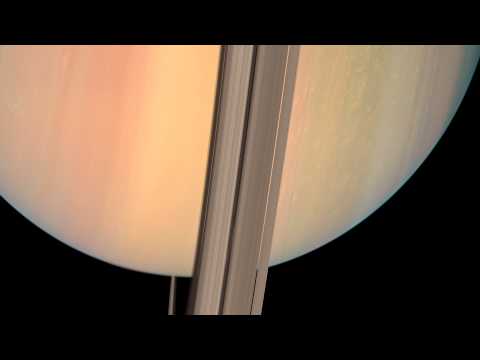
What would it look like to approach the grand planet Saturn? One doesn't have to just imagine -- the Cassini spacecraft did just this in 2004, recording thousands of images along the way, and hundreds of thousands more since entering orbit. Some of Cassini's early images have been digitally tweaked, cropped, and compiled into the featured inspiring video which is part of a larger IMAX movie project named In Saturn's Rings. In the concluding sequence, Saturn looms increasingly large on approach as cloudy Titan swoops below. With Saturn whirling around in the background, Cassini is next depicted flying over Mimas, with large Herschel Crater clearly visible. Saturn's majestic rings then take over the show as Cassini crosses Saturn's thin ring plane. Dark shadows of the ring appear on Saturn itself. Finally, the enigmatic ice-geyser moon Enceladus appears in the distance and then is approached just as the video clip ends. After more than a decade of exploration and discovery, the Cassini spacecraft ran low on fuel in 2017 was directed to enter Saturn's atmosphere, where it surely melted. APOD's main NASA site is moving : From apod.nasa.gov to science.nasa.gov/apod
© Cassini Imaging Team, ISS, JPL, NASA, ESA, S. Van Vuuren et al.; Music: Adagio for Strings (NY Philharmonic) — used with the credit NASA publishes

2025
How big is planet Earth's Moon? Compared to other moons of the Solar System, it's number 5 on the largest to smallest ranked list, following Jupiter's moon Ganymede, Saturn's moon Titan, and Jovian moons Callisto and Io. Continuing the list, the Moon comes before Jupiter's Europa and Neptune's Triton. It's also larger than dwarf planets Pluto and Eris. With a diameter of 3,475 kilometers the Moon is about 1/4 the size of Earth though, and that does make it the largest moon when compared to the size of its parent Solar System planet. Of course in this serene, twilight sea and skyscape, August's rising Full Moon still appears small enough to be caught in the nets of an ancient fishing rig. The telephoto snapshot was taken along the Italian Costa dei Trabocchi, on the Adriatic Sea.
© How big is planet Earth's Moon — used with the credit NASA publishes
2024
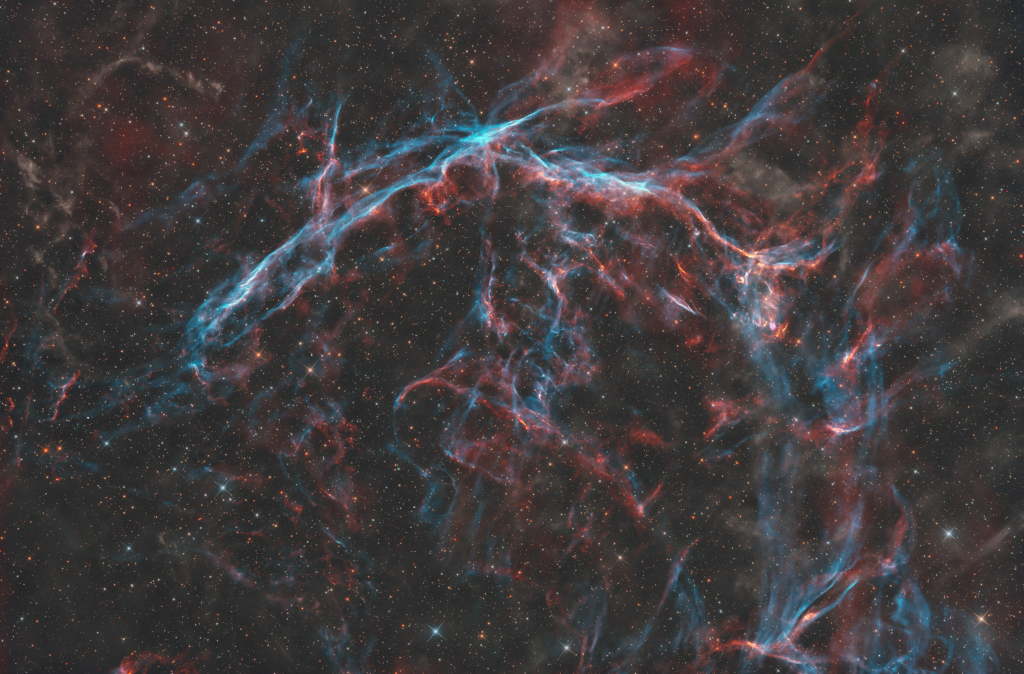
There is a quiet pulsar at the heart of CTA 1. The supernova remnant was discovered as a source of emission at radio wavelengths by astronomers in 1960 and since identified as the result of the death explosion of a massive star. But no radio pulses were detected from the expected pulsar, the rotating neutron star remnant of the massive star's collapsed core. Seen about 10,000 years after the initial supernova explosion, the interstellar debris cloud is faint at optical wavelengths. CTA 1's visible wavelength emission from still expanding shock fronts is revealed in this deep telescopic image, a frame that spans about 2 degrees across a starfield in the northern constellation of Cepheus. While no pulsar has since been found at radio wavelengths, in 2008 the Fermi Gamma-ray Space Telescope detected pulsed emission from CTA 1, identifying the supernova remnant's rotating neutron star. The source has been recognized as the first in a growing class of pulsars that are quiet at radio wavelengths but pulse in high-energy gamma-rays.
© Thomas Lelu — used with the credit NASA publishes
2023
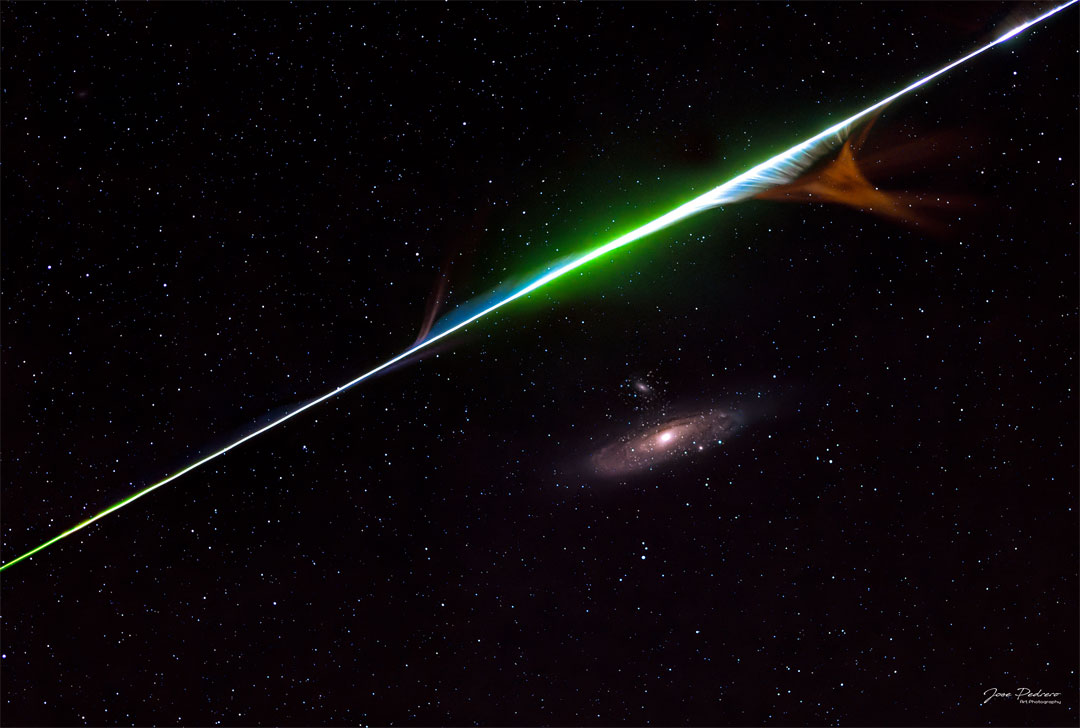
It came from outer space. It -- in this case a sand-sized bit of a comet nucleus -- was likely ejected many years ago from Sun-orbiting Comet Swift-Tuttle, but then continued to orbit the Sun alone. When the Earth crossed through this orbit, the piece of comet debris impacted the atmosphere of our fair planet and was seen as a meteor. This meteor deteriorated, causing gases to be emitted that glowed in colors emitted by its component elements. The featured image was taken last week from Castilla La Mancha, Spain, during the peak night of the Perseids meteor shower. The picturesque meteor streak happened to appear in the only one of 50 frames that also included the Andromeda galaxy. Stars dot the frame, each much further away than the meteor. Compared to the stars, the Andromeda galaxy (M31) is, again, much further away.
© Jose Pedrero — used with the credit NASA publishes
2022
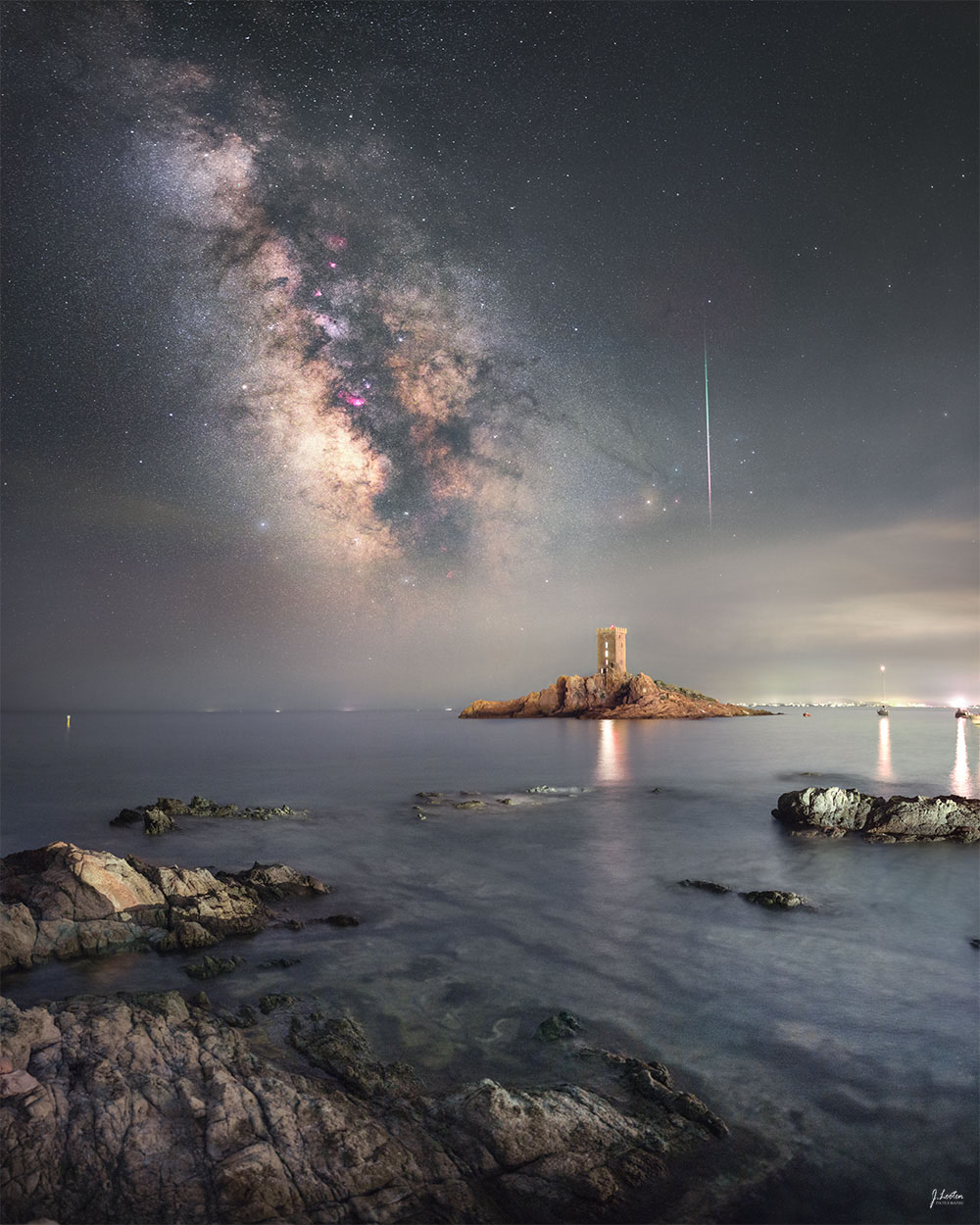
Careful planning made this a nightscape to remember. First, the night itself was chosen to occur during the beginning of this year's Perseid Meteor Shower. Next, the time of night was chosen to be before the bright Moon would rise and dominate the night sky's brightness. The picturesque foreground was selected to be a rocky beach of the Mediterranean Sea in Le Dramont, France, with, at the time, île d’Or island situated near the ominously descending central band of our Milky Way Galaxy. Once everything was set and with the weather cooperating, all of the frames for this seemingly surreal nightscape were acquired within 15 minutes. What you can't see is that, on this night, the astrophotographer brought along his father who, although unskilled in modern sky-capture techniques, once made it a point to teach his child about the sky. Perseid Meteor Shower 2022 Gallery: Notable Submissions to APOD
© Julien Looten — used with the credit NASA publishes
2021
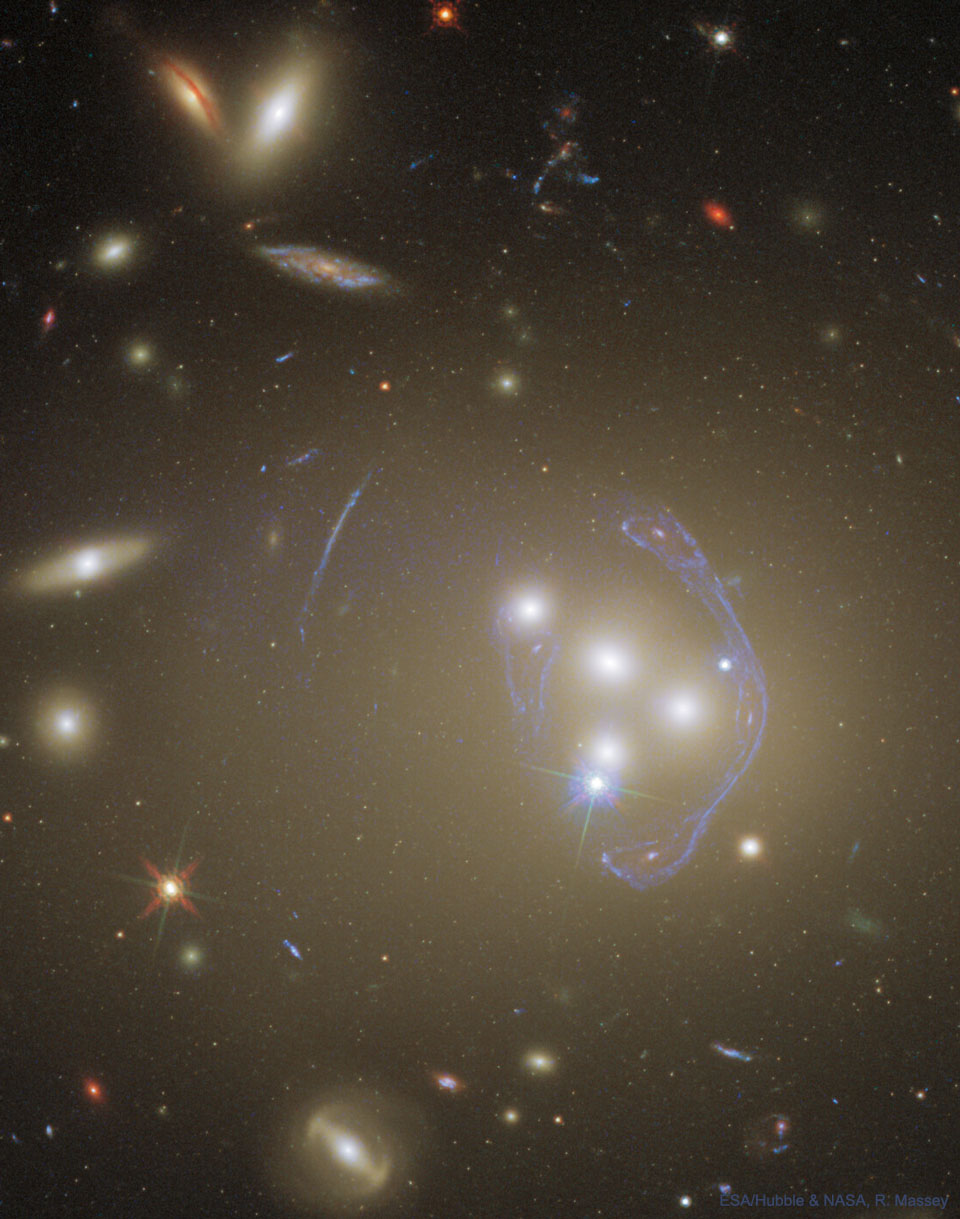
Is that one galaxy or three? Toward the right of the featured Hubble image of the massive galaxy cluster Abell 3827 is what appears to be a most unusual galaxy -- curved and with three centers. A detailed analysis, however, finds that these are three images of the same background galaxy -- and that there are at least four more images. Light we see from the single background blue galaxy takes multiple paths through the complex gravity of the cluster, just like a single distant light can take multiple paths through the stem of a wine glass. Studying how clusters like Abell 3827 and their component galaxies deflect distant light gives information about how mass and dark matter are distributed. Abell 3827 is so distant, having a redshift of 0.1, that the light we see from it left about 1.3 billion years ago -- before dinosaurs roamed the Earth. Therefore, the cluster's central galaxies have now surely all coalesced -- in a feast of galactic cannibalism -- into one huge galaxy near the cluster's center.
NASA · public domain


1944
World War II: King Michael of Romania dismisses the pro-Nazi government of Marshal Antonescu, who is later arrested. Romania switches sides from the Axis to the Allies.
Michael I of Romania ↗
1954
The Cruise of the Kings, a royal cruise organised by the Queen Consort of Greece, Frederica of Hanover, departed from Marseille, France.
Cruise of the Kings ↗
1966
Lunar Orbiter 1 takes the first photograph of Earth from orbit around the Moon.
Lunar Orbiter 1 ↗2012
A hot-air balloon crashes near the Slovenian capital of Ljubljana, killing six people and injuring 28 others.
2012 Ljubljana Marshes hot air balloon crash ↗
Event text and thumbnails come from Wikipedia and are used under CC BY-SA 4.0. Images are drawn only from Wikimedia Commons, which does not accept non-free content — each thumbnail links to its file page, where its licence and author are recorded.
Launch records are from The Space Devs’ Launch Library 2. This archive is still being mirrored, so some days are incomplete. Pictures are NASA’s Astronomy Picture of the Day; NASA imagery is generally not subject to copyright, but individual APOD entries are frequently the property of the photographer, and each caption says which applies.
General-audience astronomy and spaceflight — none of it a textbook.
As an Amazon Associate I earn from qualifying purchases. Links here cost you nothing extra.
LISTING
Still the best single argument for why any of this matters, and it leaves the arithmetic in. For a reader who wants the science, not just the awe.
LISTING
The case for leaving Earth, written by someone unsentimental about how hard that is. Suits readers who want the argument rather than the poster.
LISTING
Hard-SF problem solving in The Martian's key — for anyone who liked the engineering more than the peril. The only novel on this list.
BROWSE opens an Amazon search, not a specific recommendation.
LINKS AMAZON.COM