Launches
ON RECORD26MISSIONS
21 of them reached orbit. The earliest was 1960, the most recent 2025.
ARCHIVE // DAY OF YEAR
26 orbital launches flew on December 22, the earliest of them in 1960, and 21 reached orbit. Wikipedia records 3 spaceflight and astronomy events on December 22. Below are the pictures NASA published on December 22 in 4 different years — each one taken or released on this exact date.
26MISSIONS
21 of them reached orbit. The earliest was 1960, the most recent 2025.
3ENTRIES
Spaceflight and astronomy entries from Wikipedia's record of this date, oldest first — from 1891 onward.
4IMAGES
NASA's Astronomy Picture of the Day for December 22, one per year. Some are public domain and some belong to the photographer — each says which.
NASA’s Astronomy Picture of the Day, for this calendar date in each of the last several years.
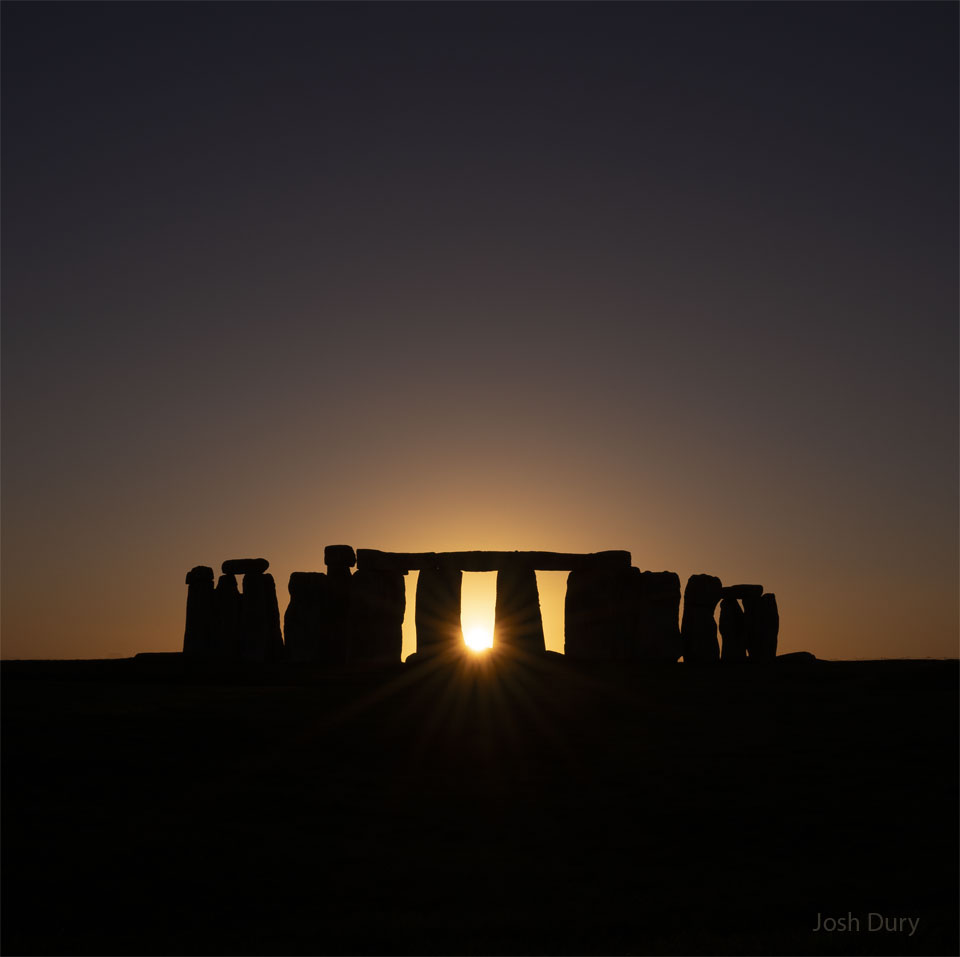
2025
Yesterday the Sun reached its southernmost point in planet Earth's sky. Called a solstice, many cultures mark yesterday's date as a change of seasons -- from autumn to winter in Earth's Northern Hemisphere and from spring to summer in Earth's Southern Hemisphere. The featured image was taken just before the longest night of the 2025 northern year at Stonehenge in United Kingdom. There, through stones precisely placed 4,500 years ago, a 4.5 billion year old large glowing orb is seen setting. Even given the precession of the Earth's rotational axis over the millennia, the Sun continues to set over Stonehenge in an astronomically significant way.
© English Heritage, Josh Dury — used with the credit NASA publishes

2024
The stars are not alone. In the disk of our Milky Way Galaxy, about 10 percent of visible matter is in the form of gas called the interstellar medium (ISM). The ISM is not uniform and shows patchiness even near our Sun. It can be quite difficult to detect the local ISM because it is so tenuous and emits so little light. This mostly hydrogen gas, however, absorbs some very specific colors that can be detected in the light of the nearest stars. A working map of the local ISM within 20 light-years, based on ongoing observations and particle detections from the Earth-orbiting Interstellar Boundary Explorer satellite (IBEX), is shown here. These observations indicate that our Sun is moving through a Local Interstellar Cloud as this cloud flows outwards from the Scorpius-Centaurus Association star forming region. Our Sun may exit the Local Cloud, also called the Local Fluff, during the next 10,000 years. Much remains unknown about the local ISM, including details of its distribution, its origin, and how it affects the Sun and the Earth. Unexpectedly, IBEX spacecraft measurements indicate that the direction from which neutral interstellar particles flow through our Solar System is changing. APOD Year in Review: Night Sky Network Presentation for 2024
NASA · public domain
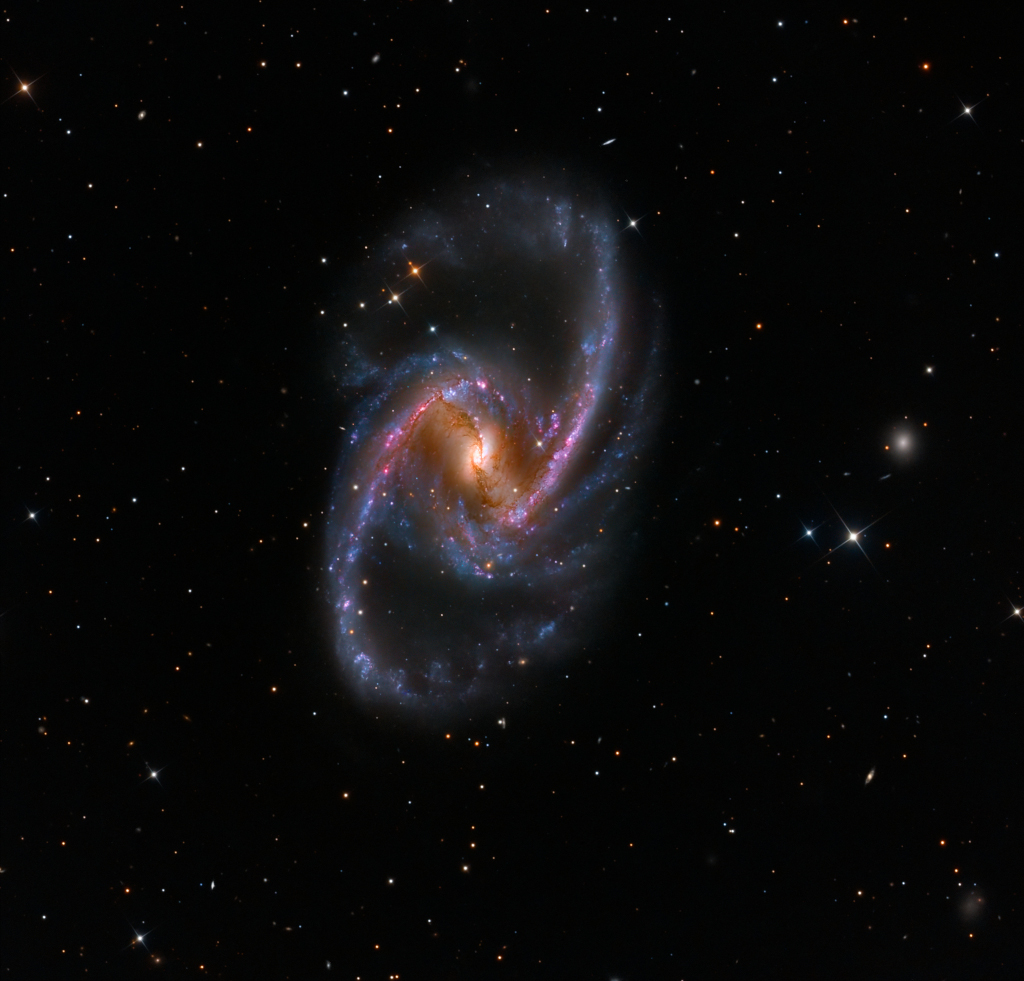
2022
Barred spiral galaxy NGC 1365 is truly a majestic island universe some 200,000 light-years across. Located a mere 60 million light-years away toward the faint but heated constellation Fornax, NGC 1365 is a dominant member of the well-studied Fornax Cluster of galaxies. This impressively sharp color image shows the intense, reddish star forming regions near the ends of the galaxy's central bar and along its spiral arms. Seen in fine detail, obscuring dust lanes cut across the galaxy's bright core. At the core lies a supermassive black hole. Astronomers think NGC 1365's prominent bar plays a crucial role in the galaxy's evolution, drawing gas and dust into a star-forming maelstrom and ultimately feeding material into the central black hole.
© Martin Pugh — used with the credit NASA publishes
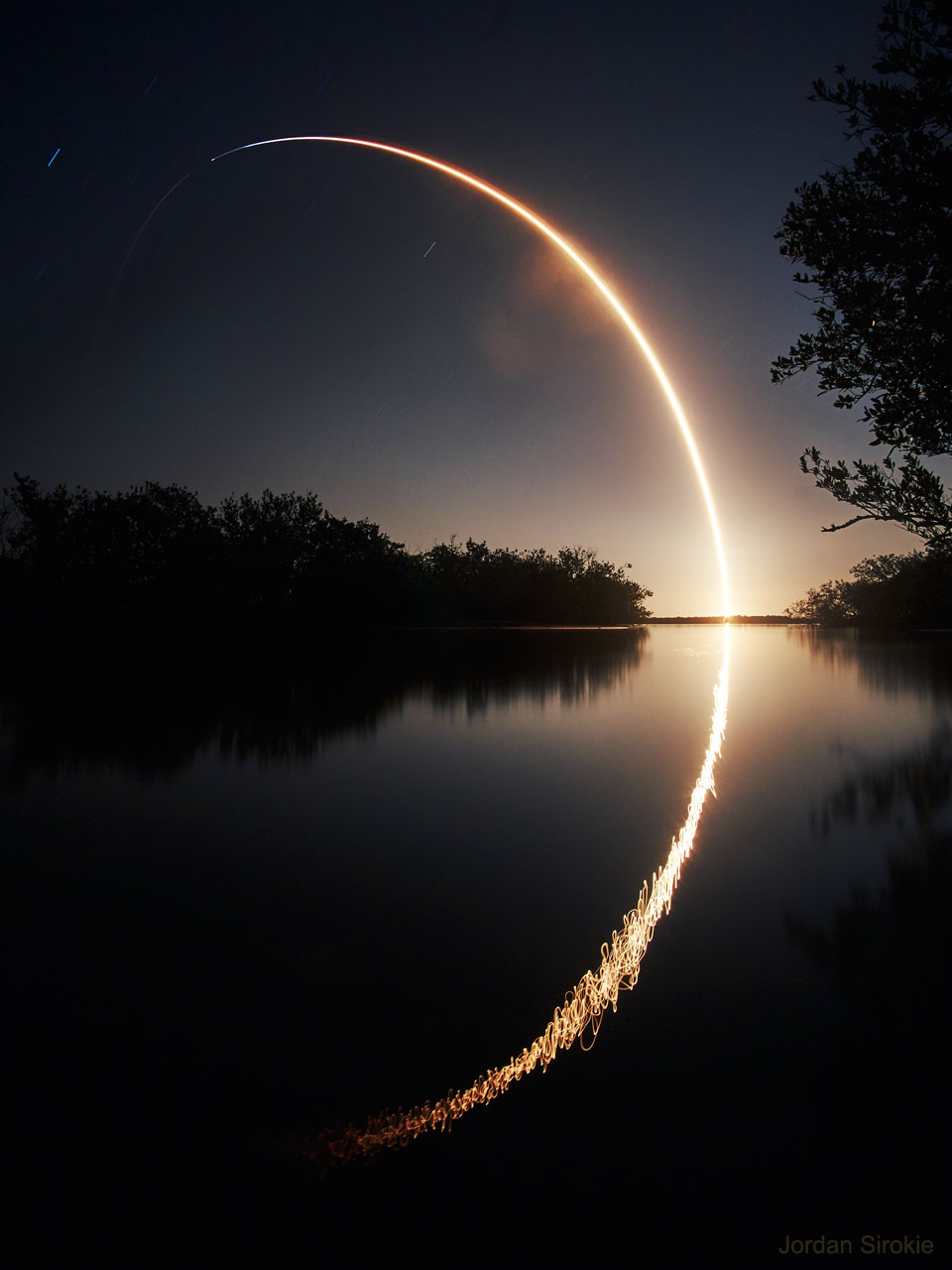
2021
Birds don't fly this high. Airplanes don't go this fast. The Statue of Liberty weighs less. No species other than human can even comprehend what is going on, nor could any human just a millennium ago. The launch of a rocket bound for space is an event that inspires awe and challenges description. Pictured here, a SpaceX Falcon 9 rocket lifted off from Kennedy Space Center, Florida earlier this month carrying the Imaging X-ray Polarimetry Explorer (IXPE). IXPE is scheduled to observe high-energy objects such as neutron stars, black holes, and the centers of distant galaxies to better determine the physics and geometries that create and control them. From a standing start, the 300,000+ kilogram rocket ship lifted IXPE up to circle the Earth, where the outside air is too thin to breathe. Rockets bound for space are now launched from somewhere on Earth every few days. Launch Update: James Webb Space Telescope
© Jordan Sirokie — used with the credit NASA publishes
1990
Final independence of Marshall Islands and Federated States of Micronesia after termination of trusteeship.
Marshall Islands ↗General-audience astronomy and spaceflight — none of it a textbook.
As an Amazon Associate I earn from qualifying purchases. Links here cost you nothing extra.
LISTING
Still the best single argument for why any of this matters, and it leaves the arithmetic in. For a reader who wants the science, not just the awe.
LISTING
The case for leaving Earth, written by someone unsentimental about how hard that is. Suits readers who want the argument rather than the poster.
LISTING
Hard-SF problem solving in The Martian's key — for anyone who liked the engineering more than the peril. The only novel on this list.
BROWSE opens an Amazon search, not a specific recommendation.
LINKS AMAZON.COM
Event text and thumbnails come from Wikipedia and are used under CC BY-SA 4.0. Images are drawn only from Wikimedia Commons, which does not accept non-free content — each thumbnail links to its file page, where its licence and author are recorded.
Launch records are from The Space Devs’ Launch Library 2. Pictures are NASA’s Astronomy Picture of the Day; NASA imagery is generally not subject to copyright, but individual APOD entries are frequently the property of the photographer, and each caption says which applies.