Launches
ON RECORD43MISSIONS
39 of them reached orbit. The earliest was 1961, the most recent 2025.
MARKED ON THIS DATE
1968 · 58 years ago today
Apollo 8 leaves for the Moon
Apollo 8 became the first crewed flight to leave Earth orbit, three months after the decision to send it was taken.
read more2015 · 11 years ago today
The first orbital booster landing
A Falcon 9 first stage returned to Cape Canaveral and landed upright after delivering eleven satellites to orbit.
read moreARCHIVE // DAY OF YEAR
43 orbital launches flew on December 21, the earliest of them in 1961, and 39 reached orbit. Wikipedia records 6 spaceflight and astronomy events on December 21. Below are the pictures NASA published on December 21 in 4 different years — each one taken or released on this exact date.
43MISSIONS
39 of them reached orbit. The earliest was 1961, the most recent 2025.
6ENTRIES
Spaceflight and astronomy entries from Wikipedia's record of this date, oldest first — from 1844 onward.
4IMAGES
NASA's Astronomy Picture of the Day for December 21, one per year. Some are public domain and some belong to the photographer — each says which.
NASA’s Astronomy Picture of the Day, for this calendar date in each of the last several years.
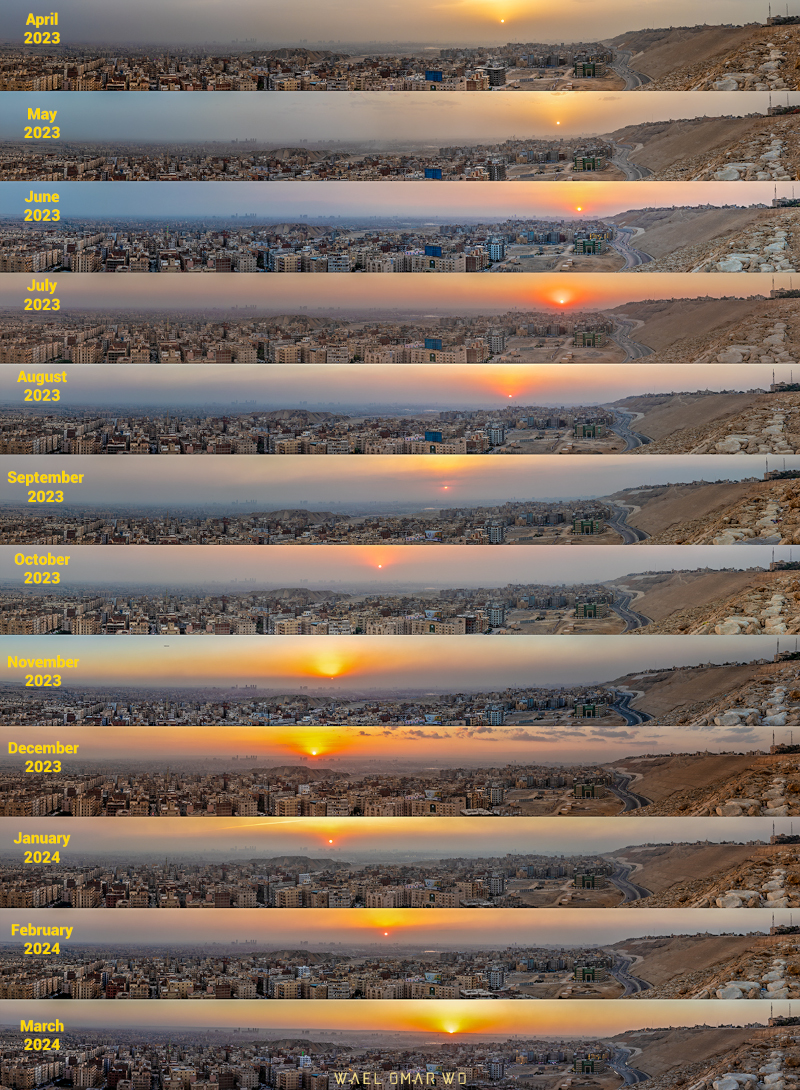
2024
A year in sunsets, from April 2023 to March 2024, track along the western horizon in these stacked panoramic views. The well-planned sequence is constructed of images recorded near the 21st day of the indicated month from the same location overlooking Cairo, Egypt. But for any location on planet Earth the yearly extreme northern (picture right) and southern limits of the setting Sun mark the solstice days. The word solstice is from Latin for "Sun" and "stand still". On the solstice date the seasonal drift of the Sun's daily path through the sky appears to pause and reverse direction in its annual celestial journey. Of course the Sun reaches a stand still on today's date. The 21 December 2024 solstice at 09:21 UTC is the moment of the Sun's southernmost declination, the start of astronomical winter in the north and summer in the south.
© Wael Omar — used with the credit NASA publishes
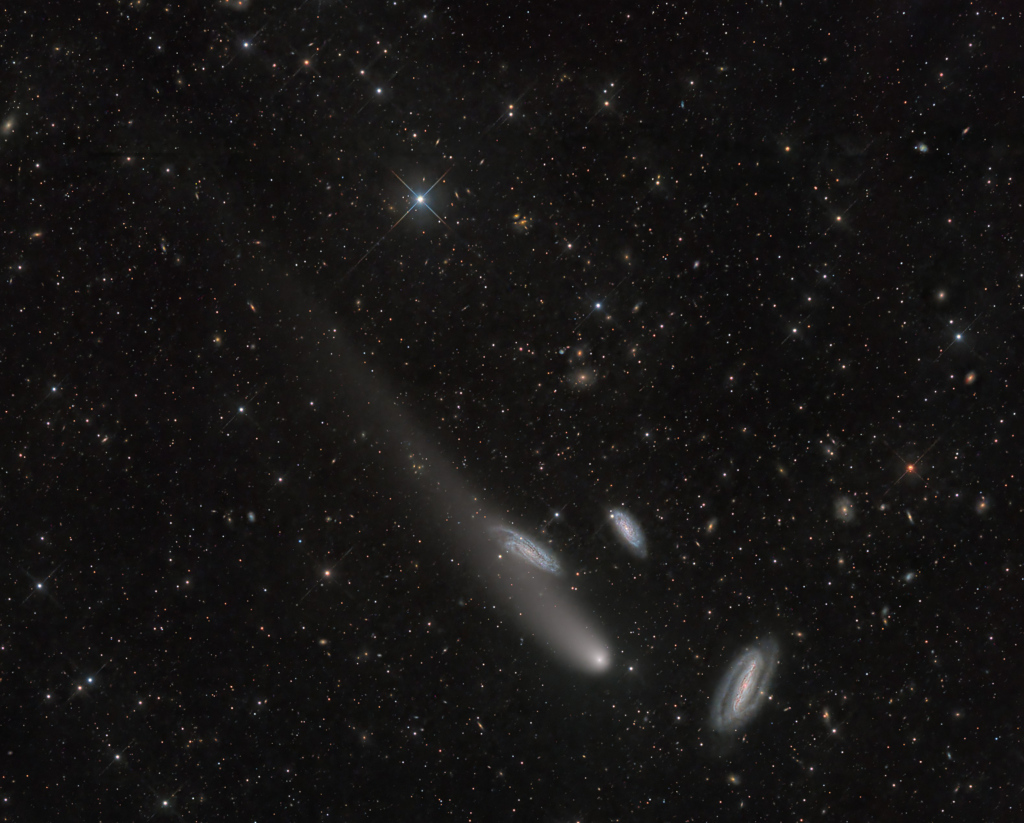
2023
Distant galaxies abound in this one degree wide field of view toward the southern constellation Grus (The Crane). But the three spiral galaxies at the lower right are quite striking. In fact, all three galaxies are grouped about 70 million light years away and sometimes known as the Grus Triplet. They share the pretty telescopic frame, recorded on December 13, with the comet designated C/2020 V2 ZTF. Now outbound from the inner Solar System and swinging below the ecliptic plane in a hyperbolic orbit, the comet was about 29 light-minutes from our fair planet in this image. And though this comet ZTF was brighter when it was closest to the Sun last May and closest to Earth in September of 2023, it still shines in telescopes pointed toward southern night skies, remaining almost as bright as the Grus Triplet galaxies.
© Dan Bartlett — used with the credit NASA publishes
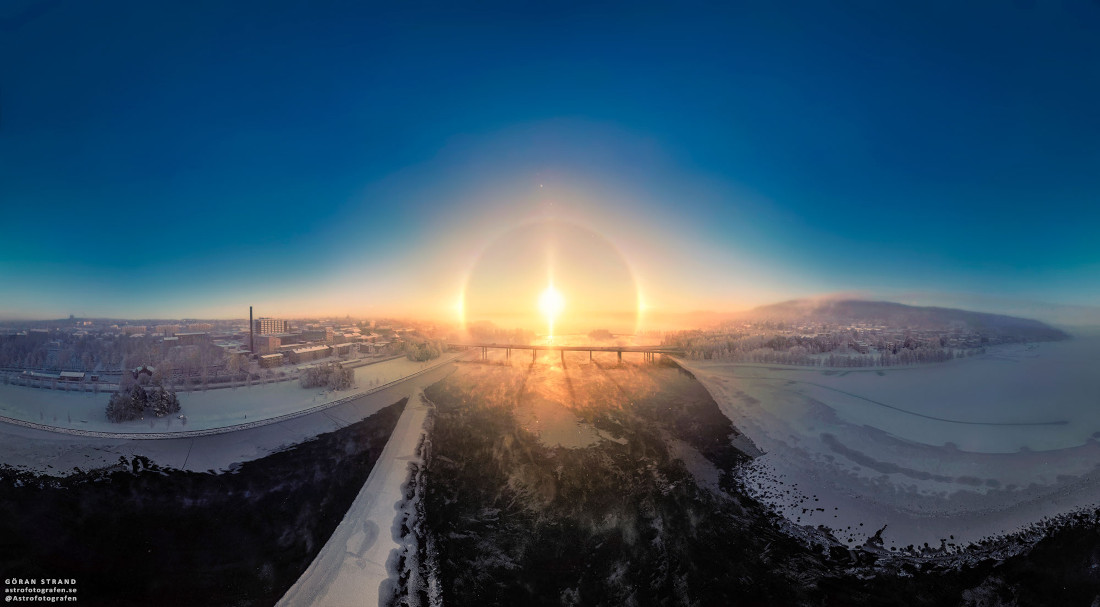
2022
Happy Solstice! Today is the December solstice, marking an astronomical beginning of summer in the southern hemisphere and winter in the north. On its yearly trek through planet Earth's skies, at this solstice the Sun reaches its southern most declination, 23.5 degrees south, at 21:48 UTC. About 4 days ago the Sun was near this seasonal southern limit and so only just above the horizon at local noon from Ostersund in central Sweden. This view looking over the far northern lakeside city finds the midday Sun with a beautiful solar ice halo. Naturally occurring atmospheric ice crystals can produce the tantalizing halo displays, refracting and reflecting the sunlight through their hexagonal geometry. Still, with the Sun low and near the horizon in the clear sky, likely sources of the ice crystals producing this intense halo are snow cannons. Operating at a local ski area, the snowmaking machines create a visible plume at the top of the nearby island Froson toward the right side of the panorama.
© Goran Strand — used with the credit NASA publishes
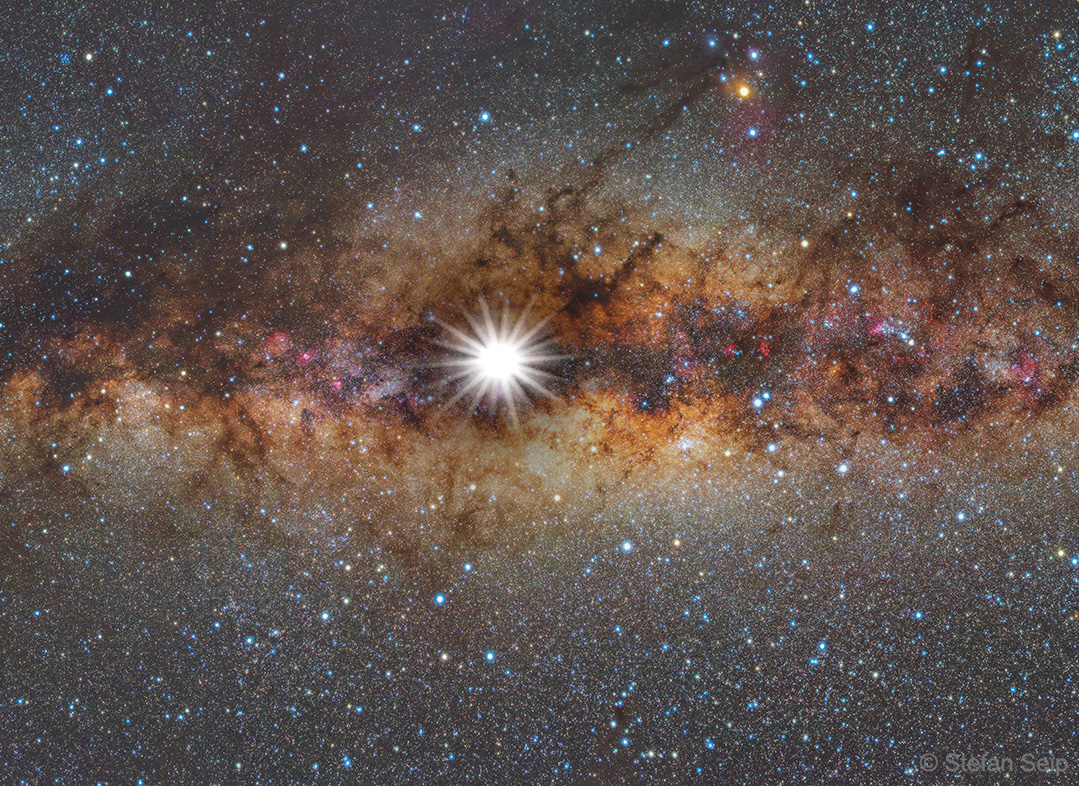
2021
Welcome to December's solstice, first day of winter in the north and summer for the southern hemisphere. Astronomical markers of the seasons, solstice and equinox dates are based on the Sun's place in its annual journey along the ecliptic, through planet Earth's sky. At this solstice, the Sun reaches its maximum southern declination of -23.5 degrees today at 15:59 UTC, while its right ascension coordinate on the celestial sphere is 18 hours. That puts the Sun in the constellation Sagittarius in a direction near the center of our Milky Way galaxy. In fact, if you could see today's Solstice Sun against faint background stars and nebulae (that's really hard to do, especially in the daytime ...) your view might look something like this composited panorama. To make it, images of our fair galaxy were taken under dark Namibian night skies, then stitched together in a panoramic view. From a snapshot made on 2015 December 21, the Sun was digitally overlayed as a brilliant star at today's northern winter solstice position, close to the center of the Milky Way. Discovery + Outreach: Graduate student research position open for APOD
© Stefan Seip — used with the credit NASA publishes
1844
The Rochdale Pioneers opened their store (pictured) in Rochdale, England, forming the basis for the modern co-operative movement.
Rochdale Society of Equitable Pioneers ↗1844
The Rochdale Society of Equitable Pioneers commences business at its cooperative in Rochdale, England, starting the Cooperative movement.
Rochdale Society of Equitable Pioneers ↗1968
Apollo 8 launched from Kennedy Space Center in Florida on a trajectory to the Moon; its crew (pictured) became the first humans to visit another celestial body.
Apollo 8 ↗1968
Apollo program: Apollo 8 is launched from the Kennedy Space Center, placing its crew on a lunar trajectory for the first visit to another celestial body by humans.
Apollo program ↗2020
A great conjunction of Jupiter and Saturn occurs, with the two planets separated in the sky by 0.1 degrees. This is the closest conjunction between the two planets since 1623.
Great conjunction ↗General-audience astronomy and spaceflight — none of it a textbook.
As an Amazon Associate I earn from qualifying purchases. Links here cost you nothing extra.
LISTING
Still the best single argument for why any of this matters, and it leaves the arithmetic in. For a reader who wants the science, not just the awe.
LISTING
The case for leaving Earth, written by someone unsentimental about how hard that is. Suits readers who want the argument rather than the poster.
LISTING
Hard-SF problem solving in The Martian's key — for anyone who liked the engineering more than the peril. The only novel on this list.
BROWSE opens an Amazon search, not a specific recommendation.
LINKS AMAZON.COM
Event text and thumbnails come from Wikipedia and are used under CC BY-SA 4.0. Images are drawn only from Wikimedia Commons, which does not accept non-free content — each thumbnail links to its file page, where its licence and author are recorded.
Launch records are from The Space Devs’ Launch Library 2. Pictures are NASA’s Astronomy Picture of the Day; NASA imagery is generally not subject to copyright, but individual APOD entries are frequently the property of the photographer, and each caption says which applies.