Launches
ON RECORD30MISSIONS
27 of them reached orbit. The earliest was 1960, the most recent 2025.
MARKED ON THIS DATE
1970 · 56 years ago today
Venera 7 transmits from Venus
Venera 7 survived its descent and sent twenty-three minutes of data from the surface of Venus, the first from another planet.
read moreARCHIVE // DAY OF YEAR
30 orbital launches flew on December 15, the earliest of them in 1960, and 27 reached orbit. Wikipedia records 3 spaceflight and astronomy events on December 15. Below are the pictures NASA published on December 15 in 5 different years — each one taken or released on this exact date.
30MISSIONS
27 of them reached orbit. The earliest was 1960, the most recent 2025.
3ENTRIES
Spaceflight and astronomy entries from Wikipedia's record of this date, oldest first — from 1965 onward.
5IMAGES
NASA's Astronomy Picture of the Day for December 15, one per year. Some are public domain and some belong to the photographer — each says which.
NASA’s Astronomy Picture of the Day, for this calendar date in each of the last several years.

2025
Where are all of these meteors coming from? In terms of direction on the sky, the pointed answer is the constellation of Gemini. That is why the major meteor shower in December is known as the Geminids -- because shower meteors all appear to come from a radiant toward Gemini. Three dimensionally, however, sand-sized debris expelled from the unusual asteroid 3200 Phaethon follows a well-defined orbit about our Sun, and the part of the orbit that approaches Earth is superposed in front of the constellation of Gemini. Therefore, when Earth crosses this orbit, the radiant point of falling debris appears in Gemini. Featured here is a composite of many images taken over the past few days through dark skies from Slovakia and capturing the snow-covered peaks of the Belianske Tatra mountains Numerous bright meteor streaks from the Geminids meteor shower are visible. Orion is visible above the horizon, while the bright star nearest the radiant is Castor. APOD Review: RJN's Night Sky Network Lecture
© Tomáš Slovinský — used with the credit NASA publishes
2024
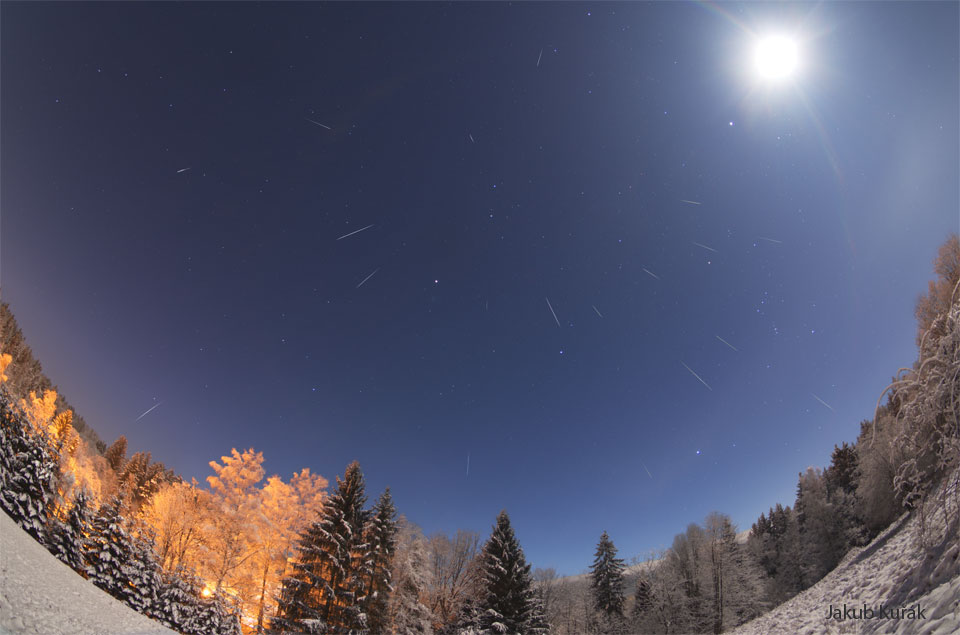
Meteors have been flowing out from the constellation Gemini. This was expected, as mid-December is the time of the Geminid Meteor Shower. Pictured here, over two dozen meteors were caught in successively added exposures taken over several hours early Saturday morning from a snowy forest in Poland. The fleeting streaks were bright enough to be seen over the din of the nearly full Moon on the upper right. These streaks can all be traced back to a point on the sky called the radiant toward the bright stars Pollux and Castor in the image center. The Geminid meteors started as sand sized bits expelled from asteroid 3200 Phaethon during its elliptical orbit through the inner Solar System. Jigsaw Challenge: Astronomy Puzzle of the Day
© Jakub Kuřák — used with the credit NASA publishes
2023
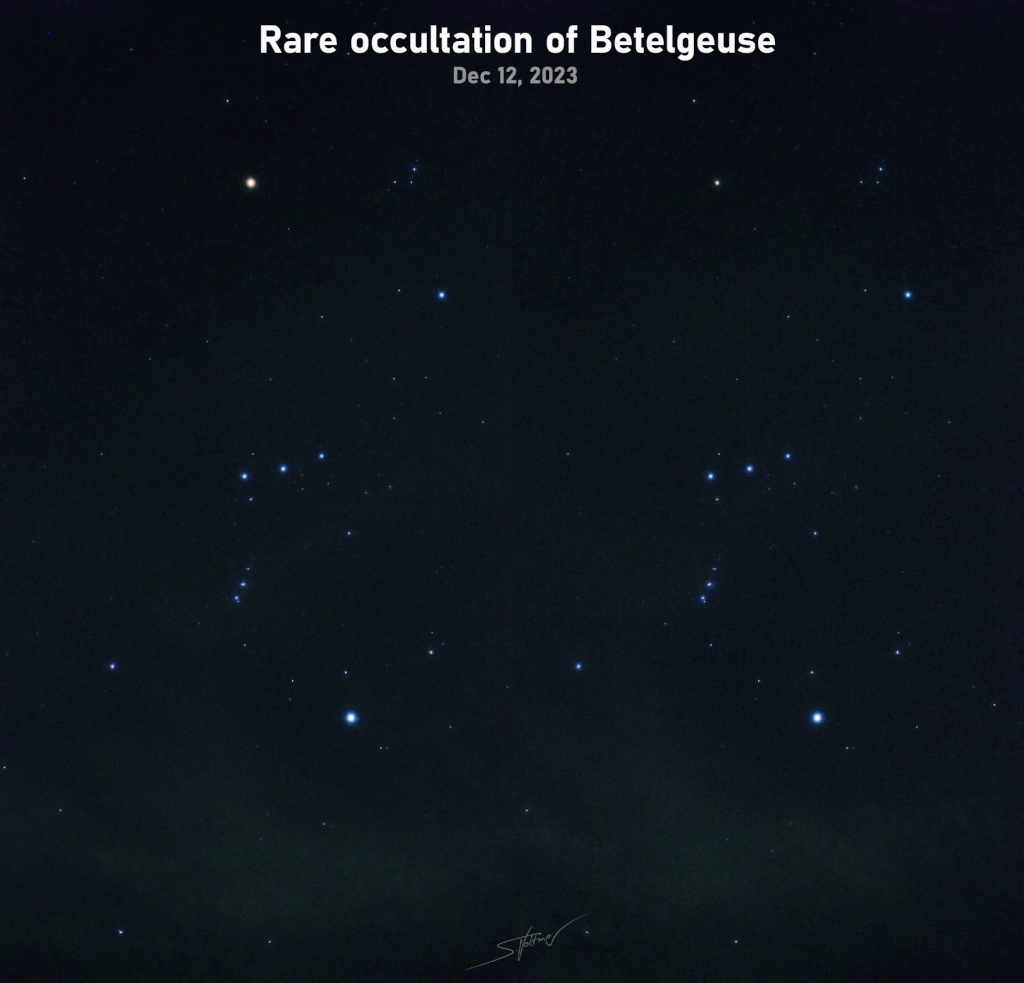
Asteroid 319 Leona cast a shadow across planet Earth on December 12, as it passed in front of bright star Betelgeuse. But to see everyone's favorite red giant star fade this time, you had to stand near the center line of the narrow shadow path starting in central Mexico and extending eastward across southern Florida, the Atlantic Ocean, southern Europe, and Eurasia. The geocentric celestial event was captured in these two panels taken at Almodovar del Rio, Spain from before (left) and during the asteroid-star occultation. In both panels Betelgeuse is seen above and left, at the shoulder of the familiar constellation Orion. Its brightness diminishes noticeably during the exceedingly rare occultation when, for several seconds, the giant star was briefly eclipsed by a roughly 60 kilometer diameter main-belt asteroid.
© Sebastian Voltmer — used with the credit NASA publishes
2022
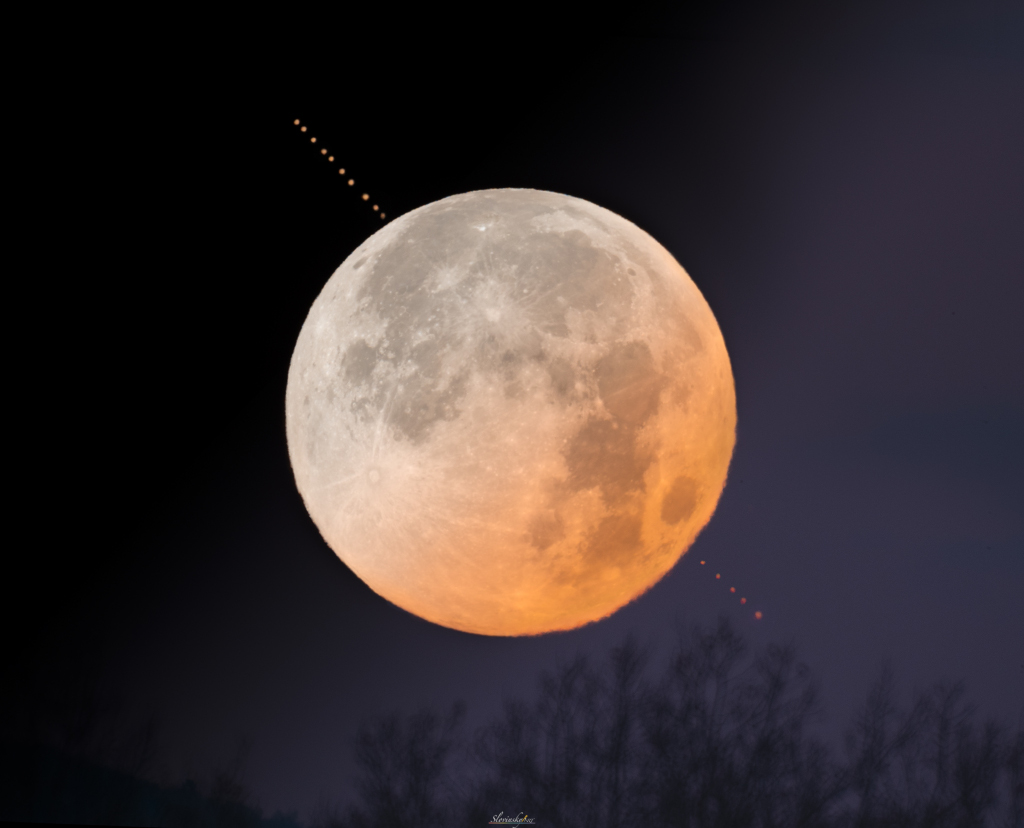
On December 8 a full Moon and a full Mars were close, both bright and opposite the Sun in planet Earth's sky. In fact Mars was occulted, passing behind the Moon when viewed from some locations across Europe and North America. Seen from the city of Kosice in eastern Slovakia, the lunar occultation of Mars happened just before sunrise. The tantalizing spectacle was recorded in this telescopic timelapse sequence of exposures. It took about an hour for the Red Planet to disappear behind the lunar disk and then reappear as a warm-hued full Moon, the last full Moon of 2022, sank toward the western horizon. The next lunar occultation of bright planet Mars will be in the new year on January 3, when the Moon is in a waxing gibbous phase. Lunar occultations are only ever visible from a fraction of the Earth's surface, though. The January 3 occultation of Mars will be visible from parts of the South Atlantic, southern Africa, and the Indian Ocean.
© Tomas Slovinsky — used with the credit NASA publishes
2021
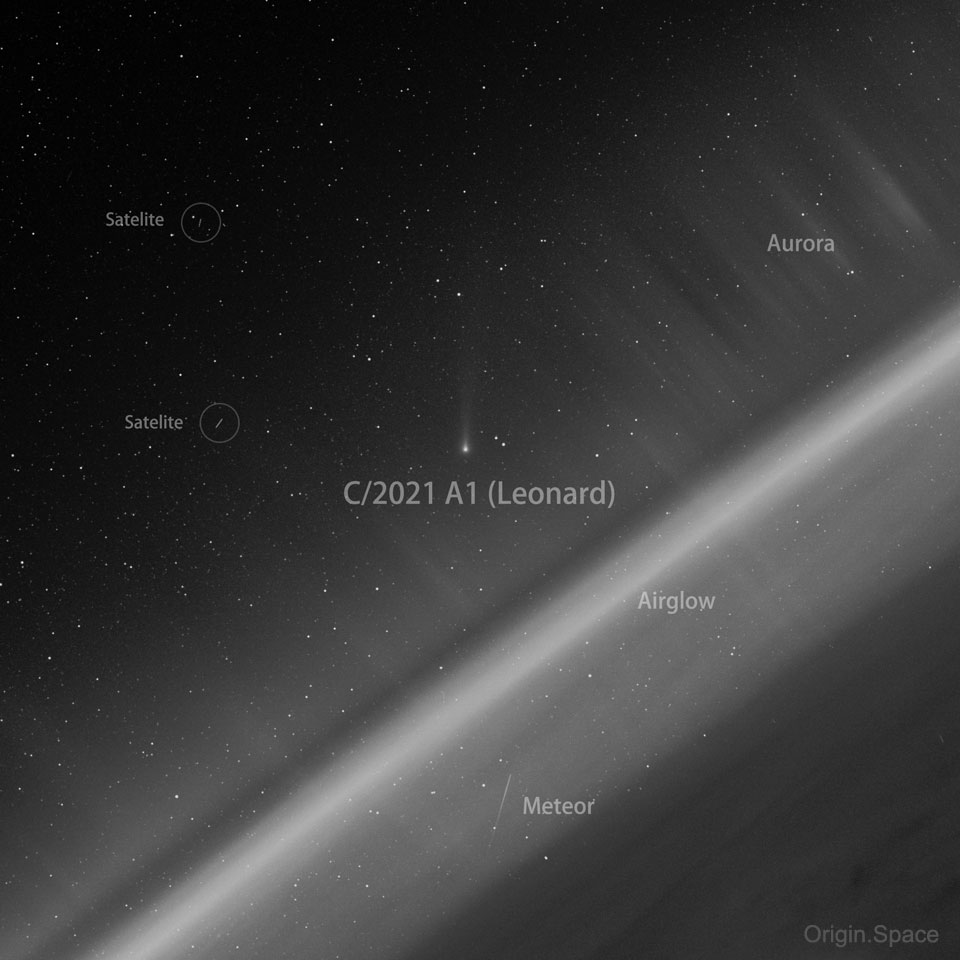
What does Comet Leonard look like from space? Today's featured image from Origin.Space's Yangwang-1 space telescope shows not only the currently bright comet -- but several other space delights as well. Taken in optical and ultraviolet light, C/2021 A1 (Leonard) is visible with an extended tail near the image center as it appeared five days ago. The Earth is visible on the lower right, while layers of the Earth's atmosphere glow diagonally from the lower left to the upper right. The trails of two satellites can be seen in front of a myriad of distant stars that dot the background on the upper left. The faint bands of light running diagonally from the lower right to the upper left are auroras. Finally, the image also caught a meteor streaking just below the airglow. To see Comet Leonard yourself from the Earth's surface during the next few days, look toward the western horizon just after sunset or just before sunrise.
© Zhuoxiao Wang, Yangwang-1 Space Telescope, Origin.Space — used with the credit NASA publishes
1965
Project Gemini: Gemini 6A, crewed by Wally Schirra and Thomas Stafford, is launched from Cape Kennedy, Florida. Four orbits later, it achieves the first space rendezvous, with Gemini 7.
Project Gemini ↗
1970
The Soviet spacecraft Venera 7 touched down on the surface of Venus, making the first successful landing of a spacecraft on another planet.
Venera 7 ↗1970
Soviet spacecraft Venera 7 successfully lands on Venus. It is the first successful soft landing on another planet.
Venera 7 ↗General-audience astronomy and spaceflight — none of it a textbook.
As an Amazon Associate I earn from qualifying purchases. Links here cost you nothing extra.
LISTING
Still the best single argument for why any of this matters, and it leaves the arithmetic in. For a reader who wants the science, not just the awe.
LISTING
The case for leaving Earth, written by someone unsentimental about how hard that is. Suits readers who want the argument rather than the poster.
LISTING
Hard-SF problem solving in The Martian's key — for anyone who liked the engineering more than the peril. The only novel on this list.
BROWSE opens an Amazon search, not a specific recommendation.
LINKS AMAZON.COM
Event text and thumbnails come from Wikipedia and are used under CC BY-SA 4.0. Images are drawn only from Wikimedia Commons, which does not accept non-free content — each thumbnail links to its file page, where its licence and author are recorded.
Launch records are from The Space Devs’ Launch Library 2. Pictures are NASA’s Astronomy Picture of the Day; NASA imagery is generally not subject to copyright, but individual APOD entries are frequently the property of the photographer, and each caption says which applies.