Launches
ON RECORD21MISSIONS
17 of them reached orbit. The earliest was 1961, the most recent 2024.
ARCHIVE // DAY OF YEAR
21 orbital launches flew on November 29, the earliest of them in 1961, and 17 reached orbit. Wikipedia records 2 spaceflight and astronomy events on November 29. Below are the pictures NASA published on November 29 in 4 different years — each one taken or released on this exact date.
21MISSIONS
17 of them reached orbit. The earliest was 1961, the most recent 2024.
2ENTRIES
Spaceflight and astronomy entries from Wikipedia's record of this date, oldest first — from 1899 onward.
4IMAGES
NASA's Astronomy Picture of the Day for November 29, one per year. Some are public domain and some belong to the photographer — each says which.
NASA’s Astronomy Picture of the Day, for this calendar date in each of the last several years.

2024
Messier 4 can be found west of bright red-giant star Antares, alpha star of the constellation Scorpius. M4 itself is only just visible from dark sky locations, even though the globular cluster of 100,000 stars or so is a mere 5,500 light-years away. Still, its proximity to prying telescopic eyes makes it a prime target for astronomical explorations. Recent studies have included Hubble observations of M4's pulsating cepheid variable stars, cooling white dwarf stars, and ancient, pulsar orbiting exoplanet PSR B1620-26 b. This sharp image was captured with a small telescope on planet Earth. At M4's estimated distance it spans about 50 light-years across the core of the globular star cluster.
© Steve Crouch — used with the credit NASA publishes
2023
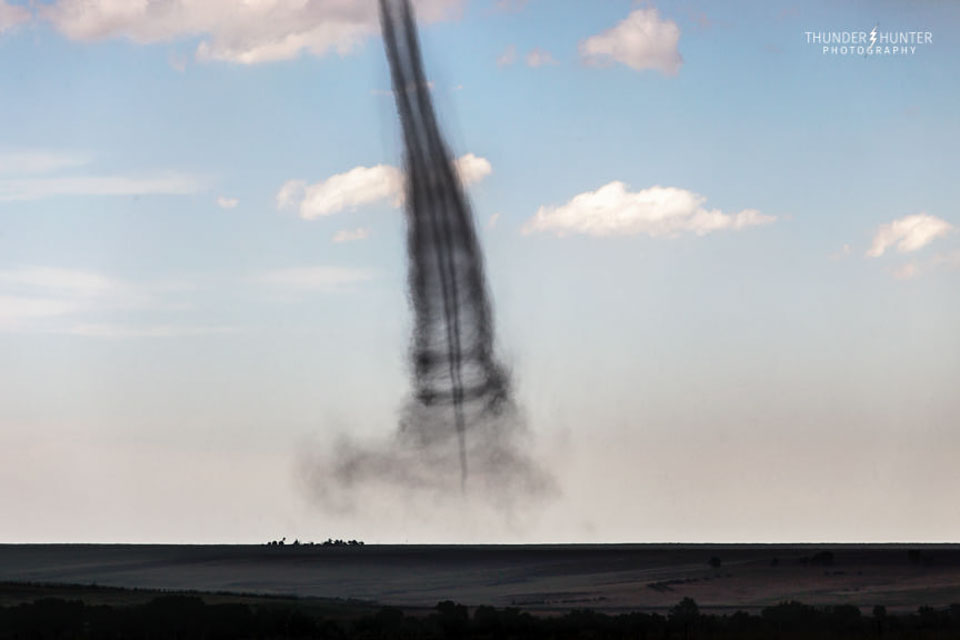
Could there be a tornado inside another tornado? In general, no. OK, but could there be a tornado inside a wider dust devil? No again, for one reason because tornados comes down from the sky, but dust devils rise up from the ground. What is pictured is a landspout, an unusual type of tornado known to occur on the edge of a violent thunderstorm. The featured landspout was imaged and identified in Kansas, USA, in June 2019 by an experienced storm chaser. The real tornado is in the center, and the outer sheath was possibly created by large dust particles thrown out from the central tornado. So far, the only planet known to create tornados is Earth, although tornado-like activity has been found on the Sun and dust devils are common on Mars. Almost Hyperspace: Random APOD Generator
© Brad Hannon — used with the credit NASA publishes
2022
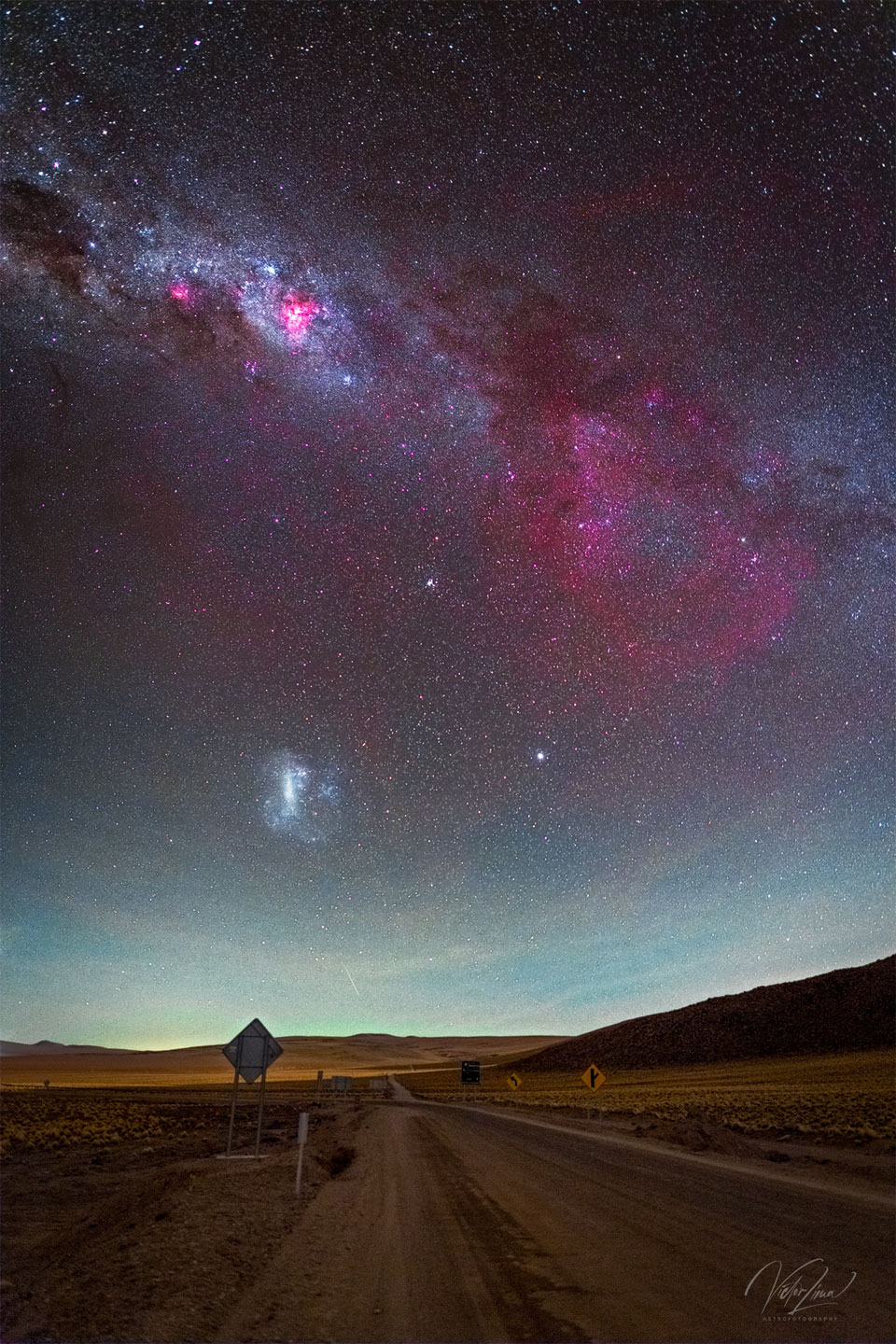
Because the Gum Nebula is the closest supernova remnant, it is actually hard to see. Spanning 40 degrees across the sky, the nebula appears so large and faint that it is easily lost in the din of a bright and complex background. The Gum Nebula is highlighted nicely in red emission toward the right of the featured wide-angle, single-image photograph taken in late May. Also visible in the frame are the Atacama Desert in Chile in the foreground, the Carina Nebula in the plane of our Milky Way galaxy running diagonally down from the upper left, and the neighboring Large Magellanic Cloud (LMC) galaxy. The Gum Nebula is so close that we are much nearer the front edge than the back edge, each measuring 450 and 1500 light years respectively. The complicated nebula lies in the direction of the constellations of Puppis and Vela. Oddly, much remains unknown about the Gum Nebula, including the timing and even number of supernova explosions that formed it.
© Victor Lima — used with the credit NASA publishes
2021
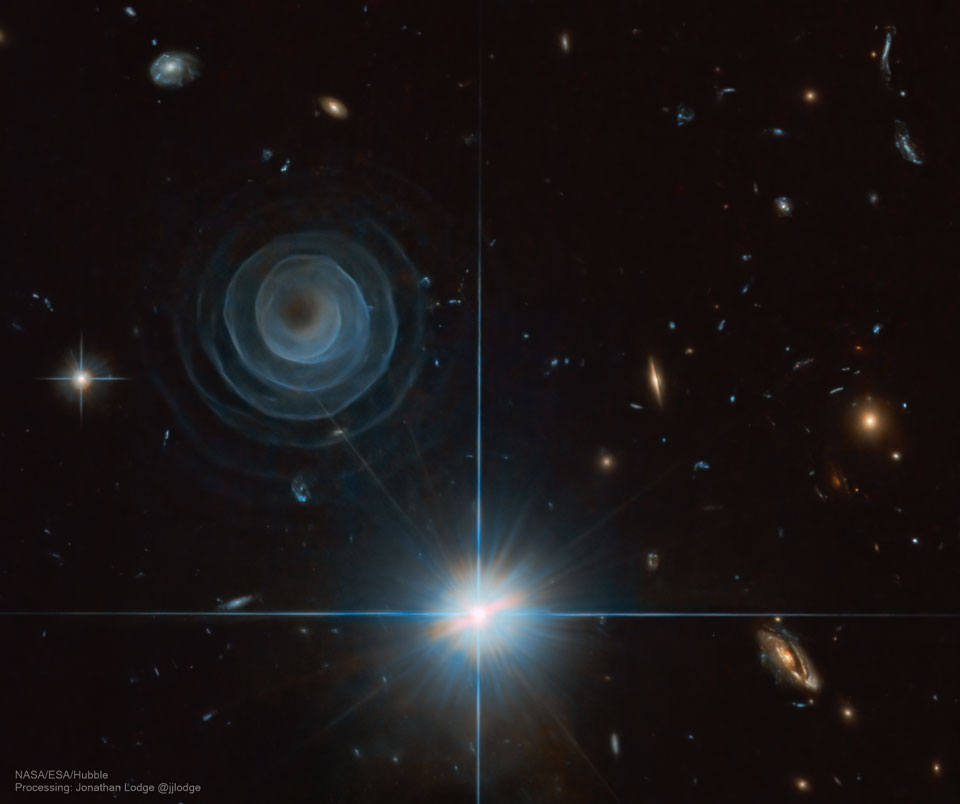
What created the strange spiral structure on the upper left? No one is sure, although it is likely related to a star in a binary star system entering the planetary nebula phase, when its outer atmosphere is ejected. The huge spiral spans about a third of a light year across and, winding four or five complete turns, has a regularity that is without precedent. Given the expansion rate of the spiral gas, a new layer must appear about every 800 years, a close match to the time it takes for the two stars to orbit each other. The star system that created it is most commonly known as LL Pegasi, but also AFGL 3068 and IRAS 23166+1655. The featured image was taken in near-infrared light by the Hubble Space Telescope. Why the spiral glows is itself a mystery, with a leading hypothesis being illumination by light reflected from nearby stars.
© Jonathan Lodge — used with the credit NASA publishes
1899
FC Barcelona, one of the most successful clubs in Spanish football, was founded by Swiss football pioneer Joan Gamper.
FC Barcelona ↗1961
Enos, a chimpanzee, is launched into space. The spacecraft orbits the Earth twice and splashes down off the coast of Puerto Rico.
Enos (chimpanzee) ↗General-audience astronomy and spaceflight — none of it a textbook.
As an Amazon Associate I earn from qualifying purchases. Links here cost you nothing extra.
LISTING
Still the best single argument for why any of this matters, and it leaves the arithmetic in. For a reader who wants the science, not just the awe.
LISTING
The case for leaving Earth, written by someone unsentimental about how hard that is. Suits readers who want the argument rather than the poster.
LISTING
Hard-SF problem solving in The Martian's key — for anyone who liked the engineering more than the peril. The only novel on this list.
BROWSE opens an Amazon search, not a specific recommendation.
LINKS AMAZON.COM
Event text and thumbnails come from Wikipedia and are used under CC BY-SA 4.0. Images are drawn only from Wikimedia Commons, which does not accept non-free content — each thumbnail links to its file page, where its licence and author are recorded.
Launch records are from The Space Devs’ Launch Library 2. Pictures are NASA’s Astronomy Picture of the Day; NASA imagery is generally not subject to copyright, but individual APOD entries are frequently the property of the photographer, and each caption says which applies.