Launches
ON RECORD27MISSIONS
25 of them reached orbit. The earliest was 1962, the most recent 2024.
ARCHIVE // DAY OF YEAR
27 orbital launches flew on November 24, the earliest of them in 1962, and 25 reached orbit. Wikipedia records 3 spaceflight and astronomy events on November 24. Below are the pictures NASA published on November 24 in 5 different years — each one taken or released on this exact date.
27MISSIONS
25 of them reached orbit. The earliest was 1962, the most recent 2024.
3ENTRIES
Spaceflight and astronomy entries from Wikipedia's record of this date, oldest first — from 1643 onward.
5IMAGES
NASA's Astronomy Picture of the Day for November 24, one per year. Some are public domain and some belong to the photographer — each says which.
NASA’s Astronomy Picture of the Day, for this calendar date in each of the last several years.

2025
What created this unusual space sculpture? Stars. This unusual system of swirls and shells, known as Apep, was observed in unprecedented detail by NASA’s James Webb Space Telescope in infrared light in 2024. Observations indicate that the unusual shape originates from two massive Wolf-Rayet stars orbiting each other every 190 years with each close passes causing a new shell of dust and gas to be expelled. Holes in these shells are thought to be caused by a third orbiting star. This stellar dust dance will likely continue for hundreds of thousands of years, possibly ending only when one of the massive stars runs out of internal nuclear fuel and explodes in a supernova punctuated by a burst of gamma-rays. Build your own star system: Astronomy Puzzle of the Day
NASA · public domain
2024
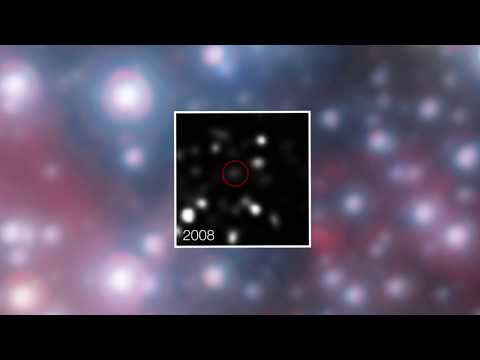
What lies at the center of our galaxy? In Jules Verne's science fiction classic, A Journey to the Center of the Earth, Professor Liedenbrock and his fellow explorers encounter many strange and exciting wonders. Astronomers already know of some of the bizarre objects that exist at our Galactic Center, including vast cosmic dust clouds, bright star clusters, swirling rings of gas, and even a supermassive black hole. Much of the Galactic Center is shielded from our view in visible light by the intervening dust and gas, but it can be explored using other forms of electromagnetic radiation. The featured video is actually a digital zoom into the Milky Way's center which starts by utilizing visible light images from the Digitized Sky Survey. As the movie proceeds, the light shown shifts to dust-penetrating infrared and highlights gas clouds that were recently discovered in 2013 to be falling toward the central black hole.
NASA · public domain
2023
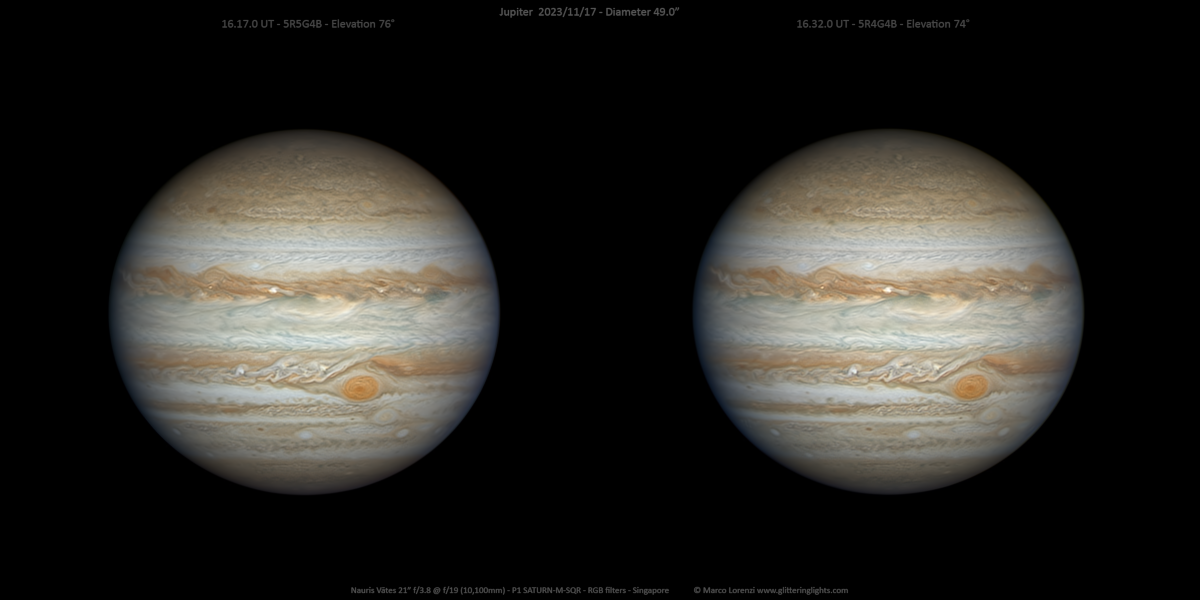
Jupiter looks sharp in these two rooftop telescope images. Both were captured on November 17 from Singapore, planet Earth, about two weeks after Jupiter's 2023 opposition. Climbing high in midnight skies the giant planet was a mere 33.4 light-minutes from Singapore. That's about 4 astronomical units away. Jupiter's planet girdling dark belts and light zones are visible in remarkable detail, along with the giant world's whitish oval vortices. Its signature Great Red Spot is still prominent in the south. Jupiter rotates rapidly on its axis once every 10 hours. So, based on video frames taken only 15 minutes apart, these images form a stereo pair. Look at the center of the pair and cross your eyes until the separate images come together to see the Solar System's ruling gas giant in 3D.
© Marco Lorenzi — used with the credit NASA publishes
2022
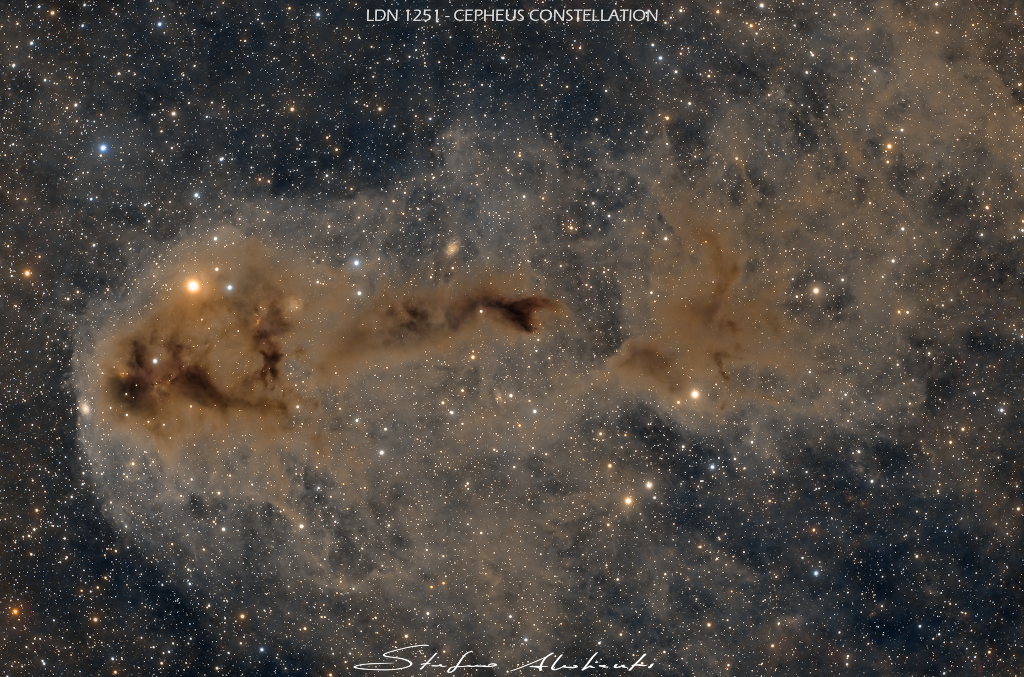
Stars are forming in Lynds Dark Nebula (LDN) 1251. About 1,000 light-years away and drifting above the plane of our Milky Way galaxy, the dusty molecular cloud is part of a complex of dark nebulae mapped toward the Cepheus flare region. Across the spectrum, astronomical explorations of the obscuring interstellar clouds reveal energetic shocks and outflows associated with newborn stars, including the telltale reddish glow from scattered Herbig-Haro objects hiding in the image. Distant background galaxies also lurk on the scene, almost buried behind the dusty expanse. This alluring view spans over four full moons on the sky, or 35 light-years at the estimated distance of LDN 1251.
© Stefano Attalienti — used with the credit NASA publishes
2021
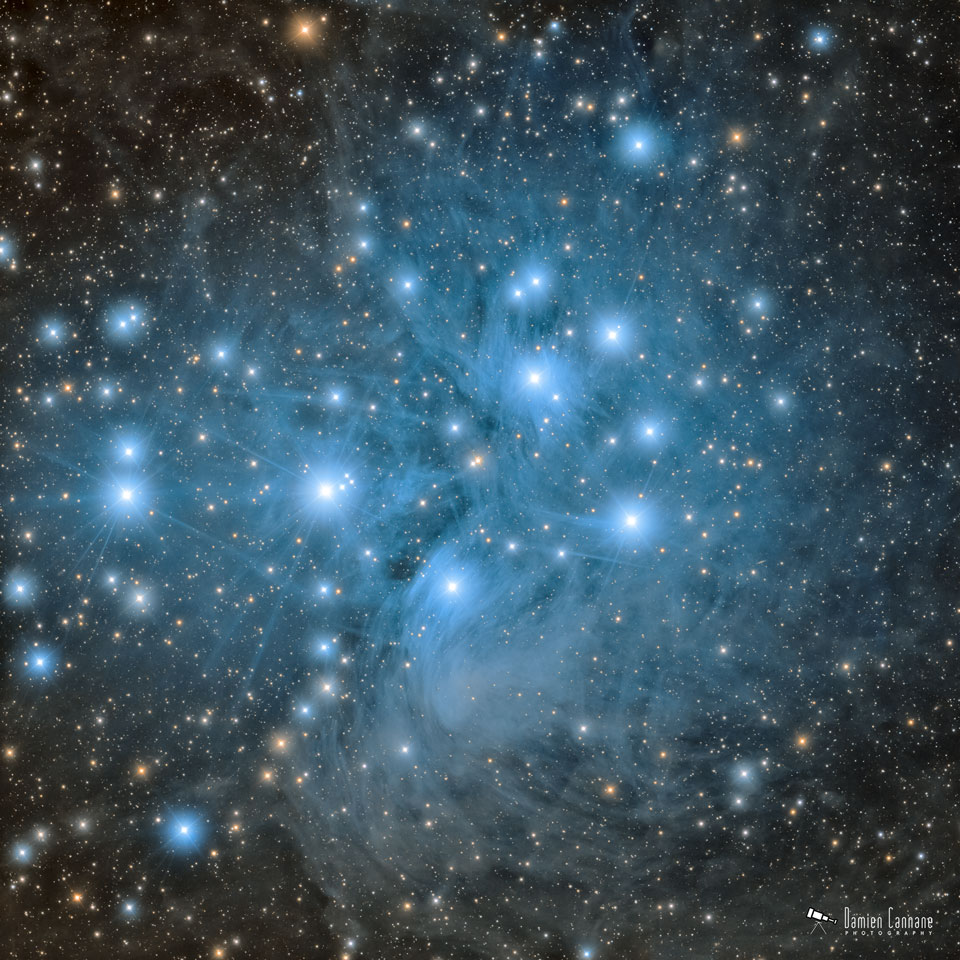
Have you ever seen the Pleiades star cluster? Even if you have, you probably have never seen it as large and clear as this. Perhaps the most famous star cluster on the sky, the bright stars of the Pleiades can be seen without binoculars from even the depths of a light-polluted city. With a long exposure from a dark location, though, the dust cloud surrounding the Pleiades star cluster becomes very evident. The featured exposure, taken from Florida, USA, covers a sky area several times the size of the full moon. Also known as the Seven Sisters and M45, the Pleiades lies about 400 light years away toward the constellation of the Bull (Taurus). A common legend with a modern twist is that one of the brighter stars faded since the cluster was named, leaving only six of the sister stars visible to the unaided eye. The actual number of Pleiades stars visible, however, may be more or less than seven, depending on the darkness of the surrounding sky and the clarity of the observer's eyesight. Volunteer Opportunity: Someone to Update APOD's RSS Feed
© Damien Cannane — used with the credit NASA publishes
1643
Thirty Years' War: Holy Roman Empire, Bavarian and Spanish forces led by Franz von Mercy defeated the French army in Germany led by Marshal Josias von Rantzau at the Battle of Tuttlingen.
Thirty Years' War ↗1969
Apollo program: The Apollo 12 command module splashes down safely in the Pacific Ocean, ending the second crewed mission to land on the Moon.
Apollo program ↗General-audience astronomy and spaceflight — none of it a textbook.
As an Amazon Associate I earn from qualifying purchases. Links here cost you nothing extra.
LISTING
Still the best single argument for why any of this matters, and it leaves the arithmetic in. For a reader who wants the science, not just the awe.
LISTING
The case for leaving Earth, written by someone unsentimental about how hard that is. Suits readers who want the argument rather than the poster.
LISTING
Hard-SF problem solving in The Martian's key — for anyone who liked the engineering more than the peril. The only novel on this list.
BROWSE opens an Amazon search, not a specific recommendation.
LINKS AMAZON.COM
Event text and thumbnails come from Wikipedia and are used under CC BY-SA 4.0. Images are drawn only from Wikimedia Commons, which does not accept non-free content — each thumbnail links to its file page, where its licence and author are recorded.
Launch records are from The Space Devs’ Launch Library 2. Pictures are NASA’s Astronomy Picture of the Day; NASA imagery is generally not subject to copyright, but individual APOD entries are frequently the property of the photographer, and each caption says which applies.