Launches
ON RECORD27MISSIONS
25 of them reached orbit. The earliest was 1960, the most recent 2025.
ARCHIVE // DAY OF YEAR
27 orbital launches flew on October 26, the earliest of them in 1960, and 25 reached orbit. Wikipedia records 1 spaceflight and astronomy event on October 26. Below are the pictures NASA published on October 26 in 5 different years — each one taken or released on this exact date.
27MISSIONS
25 of them reached orbit. The earliest was 1960, the most recent 2025.
1ENTRY
Spaceflight and astronomy entries from Wikipedia's record of this date, oldest first — from 1968 onward.
5IMAGES
NASA's Astronomy Picture of the Day for October 26, one per year. Some are public domain and some belong to the photographer — each says which.
NASA’s Astronomy Picture of the Day, for this calendar date in each of the last several years.

2025
Halloween's origin is ancient and astronomical. Since the fifth century BC, Halloween has been celebrated as a cross-quarter day, a day halfway between an equinox (equal day / equal night) and a solstice (minimum day / maximum night in the northern hemisphere). With a modern calendar however, even though Halloween is later this week, the real cross-quarter day will occur the next week. Another cross-quarter day is Groundhog Day. Halloween's modern celebration retains historic roots in dressing to scare away the spirits of the dead. Perhaps a fitting tribute to this ancient holiday is this view of the Ghost Head Nebula taken with the Hubble Space Telescope. Similar to the icon of a fictional ghost, NGC 2080 is actually a star forming region in the Large Magellanic Cloud, a satellite galaxy of our own Milky Way Galaxy. The Ghost Head Nebula (NGC 2080) spans about 50 light-years and is shown in representative colors.
NASA · public domain
2024
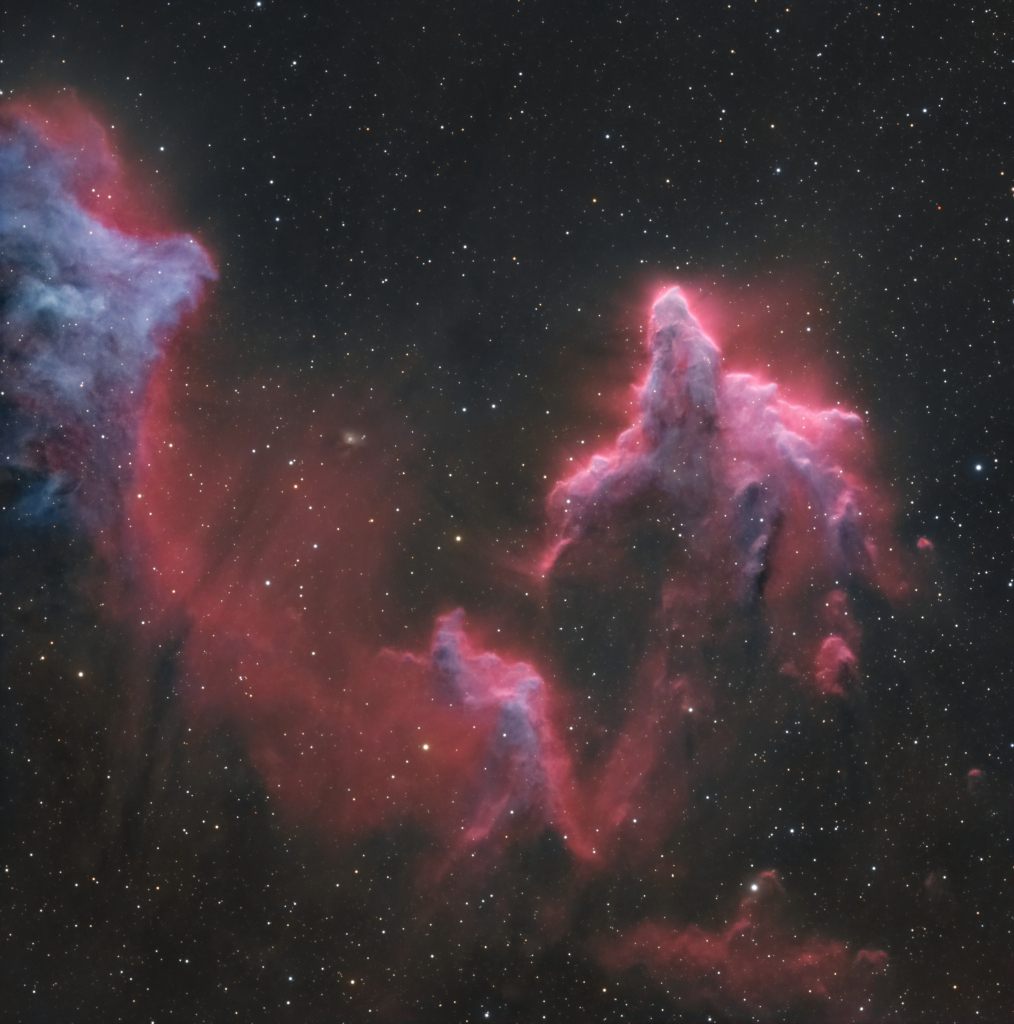
These brightly outlined flowing shapes look ghostly on a cosmic scale. A telescopic view toward the constellation Cassiopeia, the colorful skyscape features the swept-back, comet-shaped clouds IC 59 (left) and IC 63. About 600 light-years distant, the clouds aren't actually ghosts. They are slowly disappearing though, under the influence of energetic radiation from hot, luminous star gamma Cas. Gamma Cas is physically located only 3 to 4 light-years from the nebulae and lies just above the right edge of the frame. Slightly closer to gamma Cas, IC 63 is dominated by red H-alpha light emitted as hydrogen atoms ionized by the hot star's ultraviolet radiation recombine with electrons. Farther from the star, IC 59 shows less H-alpha emission but more of the characteristic blue tint of dust reflected star light. The field of view spans over 1 degree or 10 light-years at the estimated distance of the interstellar apparitions.
© Christophe Vergnes — used with the credit NASA publishes
2023
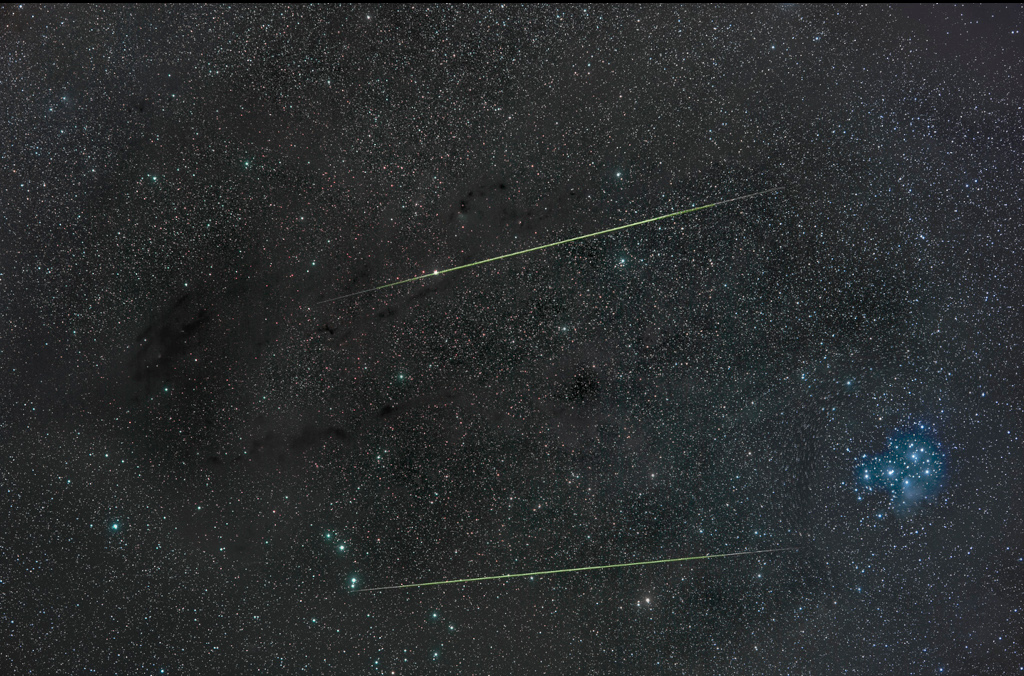
History's first known periodic comet, Comet Halley (1P/Halley), returns to the inner Solar System every 76 years or so. The famous comet made its last appearance to the naked-eye in 1986. But dusty debris from Comet Halley can be seen raining through planet Earth's skies twice a year during two annual meteor showers, the Eta Aquarids in May and the Orionids in October. In fact, an unhurried series of exposures captured these two bright meteors, vaporizing bits of Halley dust, during the early morning hours of October 23 against a starry background along the Taurus molecular cloud. Impacting the atmosphere at about 66 kilometers per second their greenish streaks point back to the shower's radiant just north of Orion's bright star Betelgeuse off the lower left side of the frame. The familiar Pleiades star cluster anchors the dusty celestial scene at the right.
© David Cortner — used with the credit NASA publishes
2022
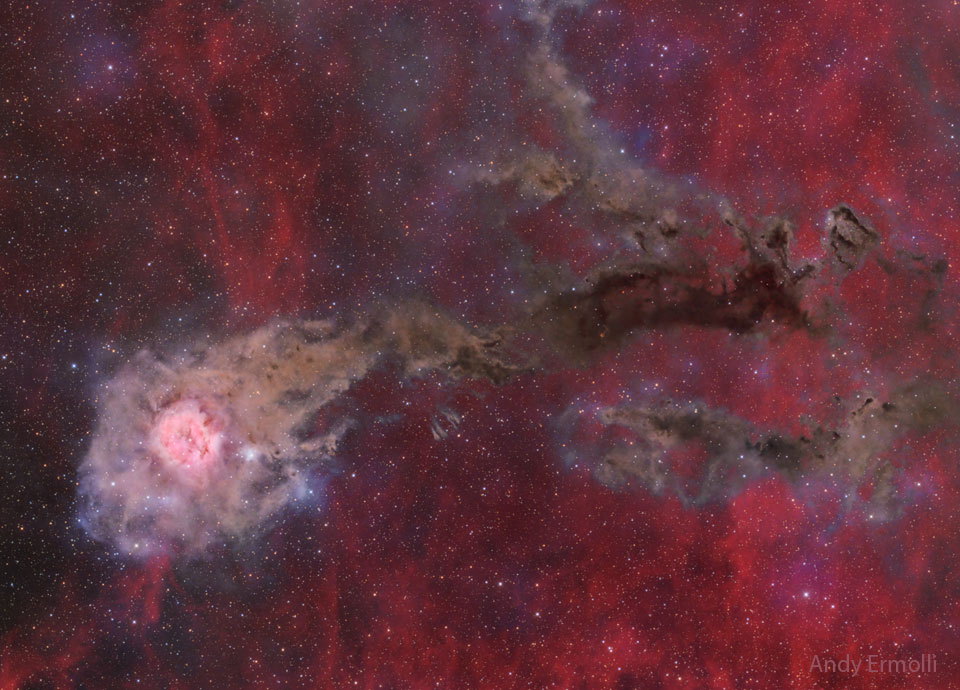
When does a nebula look like a comet? In this crowded starfield, covering over two degrees within the high flying constellation of the Swan (Cygnus), the eye is drawn to the Cocoon Nebula. A compact star forming region, the cosmic Cocoon punctuates a nebula bright in emission and reflection on the left, with a long trail of interstellar dust clouds to the right, making the entire complex appear a bit like a comet. Cataloged as IC 5146, the central bright head of the nebula spans about 10 light years, while the dark dusty tail spans nearly 100 light years. Both are located about 2,500 light years away. The bright star near the bright nebula's center, likely only a few hundred thousand years old, supplies power to the nebular glow as it helps clear out a cavity in the molecular cloud's star forming dust and gas. The long dusty filaments of the tail, although dark in this visible light image, are themselves hiding stars in the process of formation, stars that can be seen at infrared wavelengths.
© Andy Ermolli — used with the credit NASA publishes
2021
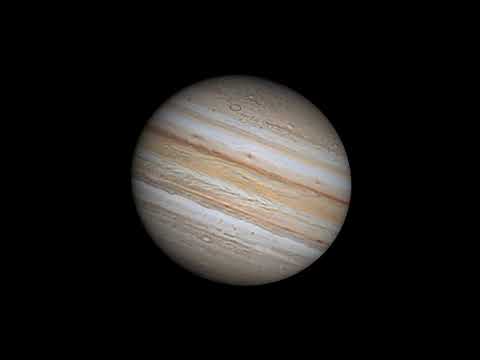
Observe the graceful twirl of our Solar System's largest planet. Many interesting features of Jupiter's enigmatic atmosphere, including dark belts and light zones, can be followed in detail. A careful inspection will reveal that different cloud layers rotate at slightly different speeds. The famous Great Red Spot is not visible at first -- but soon rotates into view. Other smaller storm systems occasionally appear. As large as Jupiter is, it rotates in only 10 hours. Our small Earth, by comparison, takes 24 hours to complete a spin cycle. The featured high-resolution time-lapse video was captured over five nights earlier this month by a mid-sized telescope on an apartment balcony in Paris, France. Since hydrogen and helium gas are colorless, and those elements compose most of Jupiter's expansive atmosphere, what trace elements create the observed colors of Jupiter's clouds remains a topic of research. Discovery + Outreach: Graduate student research position open for APOD
© JL Dauvergne; Music: Oro Aqua (Benoit Reeves) — used with the credit NASA publishes
General-audience astronomy and spaceflight — none of it a textbook.
As an Amazon Associate I earn from qualifying purchases. Links here cost you nothing extra.
LISTING
Still the best single argument for why any of this matters, and it leaves the arithmetic in. For a reader who wants the science, not just the awe.
LISTING
The case for leaving Earth, written by someone unsentimental about how hard that is. Suits readers who want the argument rather than the poster.
LISTING
Hard-SF problem solving in The Martian's key — for anyone who liked the engineering more than the peril. The only novel on this list.
BROWSE opens an Amazon search, not a specific recommendation.
LINKS AMAZON.COM
Event text and thumbnails come from Wikipedia and are used under CC BY-SA 4.0. Images are drawn only from Wikimedia Commons, which does not accept non-free content — each thumbnail links to its file page, where its licence and author are recorded.
Launch records are from The Space Devs’ Launch Library 2. Pictures are NASA’s Astronomy Picture of the Day; NASA imagery is generally not subject to copyright, but individual APOD entries are frequently the property of the photographer, and each caption says which applies.