Launches
ON RECORD23MISSIONS
22 of them reached orbit. The earliest was 1966, the most recent 2025.
ARCHIVE // DAY OF YEAR
23 orbital launches flew on October 22, the earliest of them in 1966, and 22 reached orbit. Wikipedia records 5 spaceflight and astronomy events on October 22. Below are the pictures NASA published on October 22 in 5 different years — each one taken or released on this exact date.
23MISSIONS
22 of them reached orbit. The earliest was 1966, the most recent 2025.
5ENTRIES
Spaceflight and astronomy entries from Wikipedia's record of this date, oldest first — from -2137 onward.
5IMAGES
NASA's Astronomy Picture of the Day for October 22, one per year. Some are public domain and some belong to the photographer — each says which.
NASA’s Astronomy Picture of the Day, for this calendar date in each of the last several years.
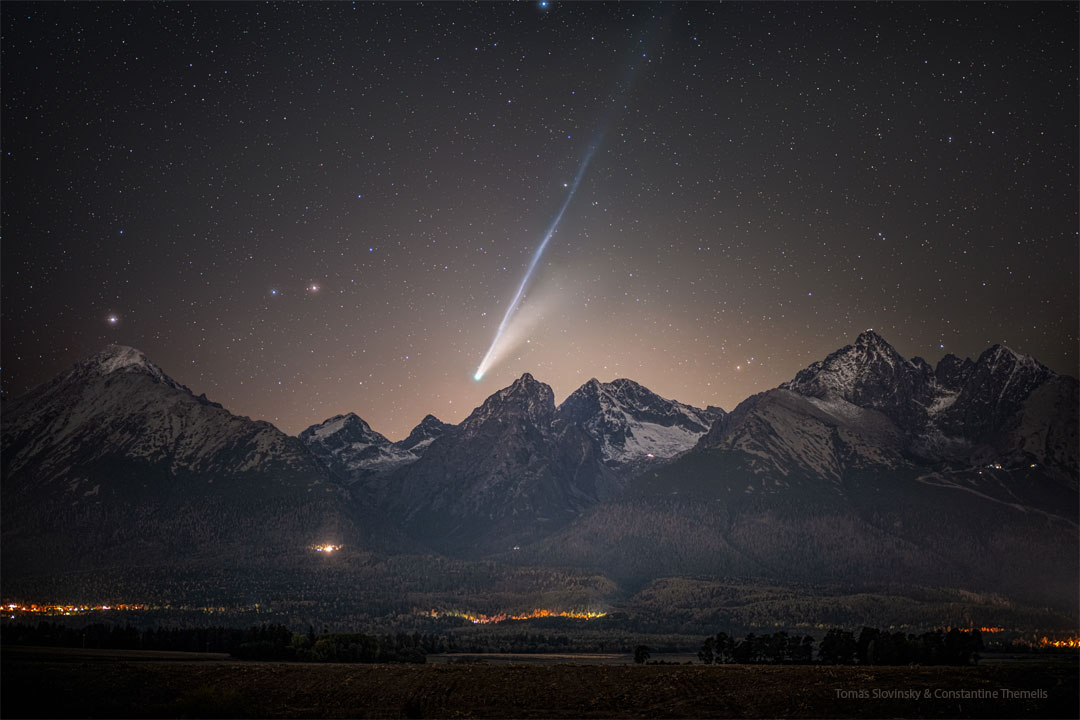
2025
Comet Lemmon putting on a show for cameras around the globe. Passing nearest to the Earth this week, the photogenic comet C/2025 A6 (Lemmon) is now extending two long tails : a blue ion tail and a white dust tail. The ion tail is pushed away from the Sun by the ever-present by ever-changing solar wind, and shows structure also created by how much gas is ejected at any one moment. It glows because it is ionized by high energy sunlight. The dust tail is pushed away from the comet by sunlight and shines by reflecting sunlight. The featured image is an enhanced composite of 50 exposures all taken two days ago from Mlynica, Slovakia. The mountains in the foreground are the High Tatras that partly separate Slovakia from Poland. Although Comet Lemmon is best visible in long camera exposures, the shedding ice ball has become faintly visible in northern skies even to unaided eyes through dark skies toward the west after sunset.
© Tomáš Slovinský & Constantine Themelis — used with the credit NASA publishes

2024
These dark pillars may look destructive, but they are creating stars. This pillar-capturing picture of the Eagle Nebula combines visible light exposures taken with the Hubble Space Telescope with infrared images taken with the James Webb Space Telescope to highlight evaporating gaseous globules (EGGs) emerging from pillars of molecular hydrogen gas and dust. The giant pillars are light years in length and are so dense that interior gas contracts gravitationally to form stars. At each pillar's end, the intense radiation of bright young stars causes low density material to boil away, leaving stellar nurseries of dense EGGs exposed. The Eagle Nebula, associated with the open star cluster M16, lies about 7000 light years away. Jigsaw Challenge: Astronomy Puzzle of the Day
NASA · public domain
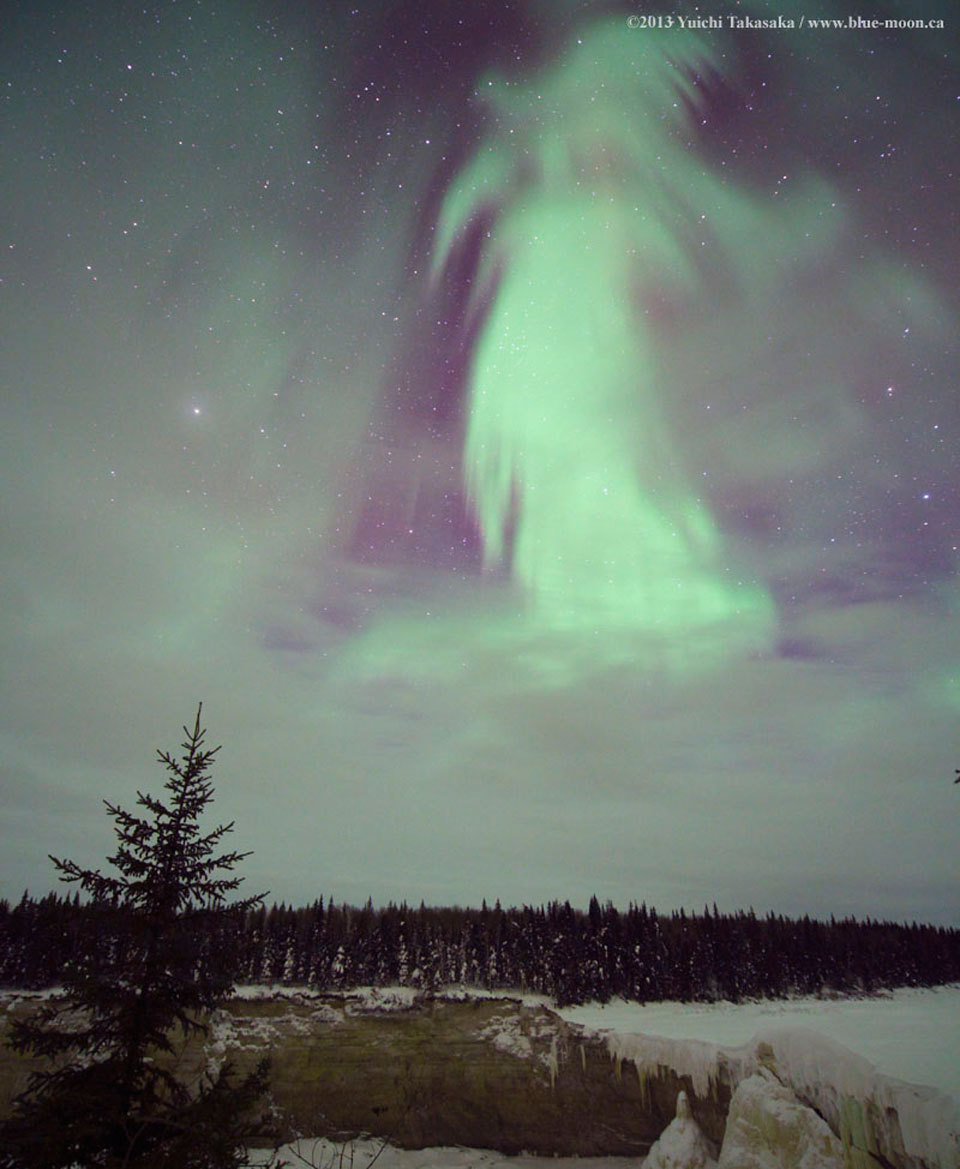
2023
What does this aurora look like to you? While braving the cold to watch the skies above northern Canada early one morning in 2013, a most unusual aurora appeared. The aurora definitely appeared to be shaped like something, but what? Two ghostly possibilities recorded by the astrophotographer were "witch" and "goddess of dawn", but please feel free to suggest your own Halloween-enhanced impressions. Regardless of fantastical pareidolic interpretations, the pictured aurora had a typical green color and was surely caused by the scientifically commonplace action of high-energy particles from space interacting with oxygen in Earth's upper atmosphere. In the image foreground, at the bottom, is a frozen Alexandra Falls, while evergreen trees cross the middle. Help Wanted: Professional-astronomer level guest writers and assistant editors for APOD
© Yuichi Takasaka, TWAN — used with the credit NASA publishes
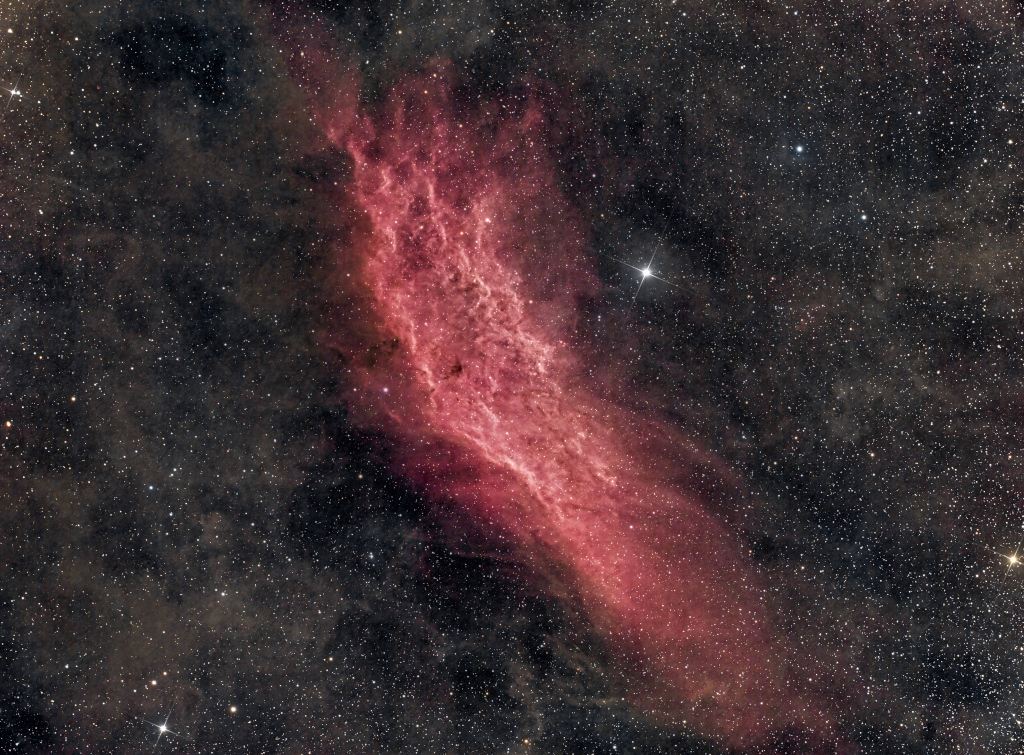
2022
Drifting through the Orion Arm of the spiral Milky Way Galaxy, this cosmic cloud by chance echoes the outline of California on the west coast of the United States. Our own Sun also lies within the Milky Way's Orion Arm, only about 1,500 light-years from the California Nebula. Also known as NGC 1499, the classic emission nebula is around 100 light-years long. The California Nebula shines with the telltale reddish glow characteristic of hydrogen atoms recombining with long lost electrons. The electrons have been stripped away, ionized by energetic starlight. Most likely providing the energetic starlight that ionizes much of the nebular gas is the bright, hot star Xi Persei just to the right of the nebula. A popular target for astrophotographers, this deep image reveals the glowing nebula, obscuring dust, and stars across a 3 degree wide field of view. The California nebula lies toward the constellation Perseus, not far from the Pleiades.
© this cosmic cloud — used with the credit NASA publishes
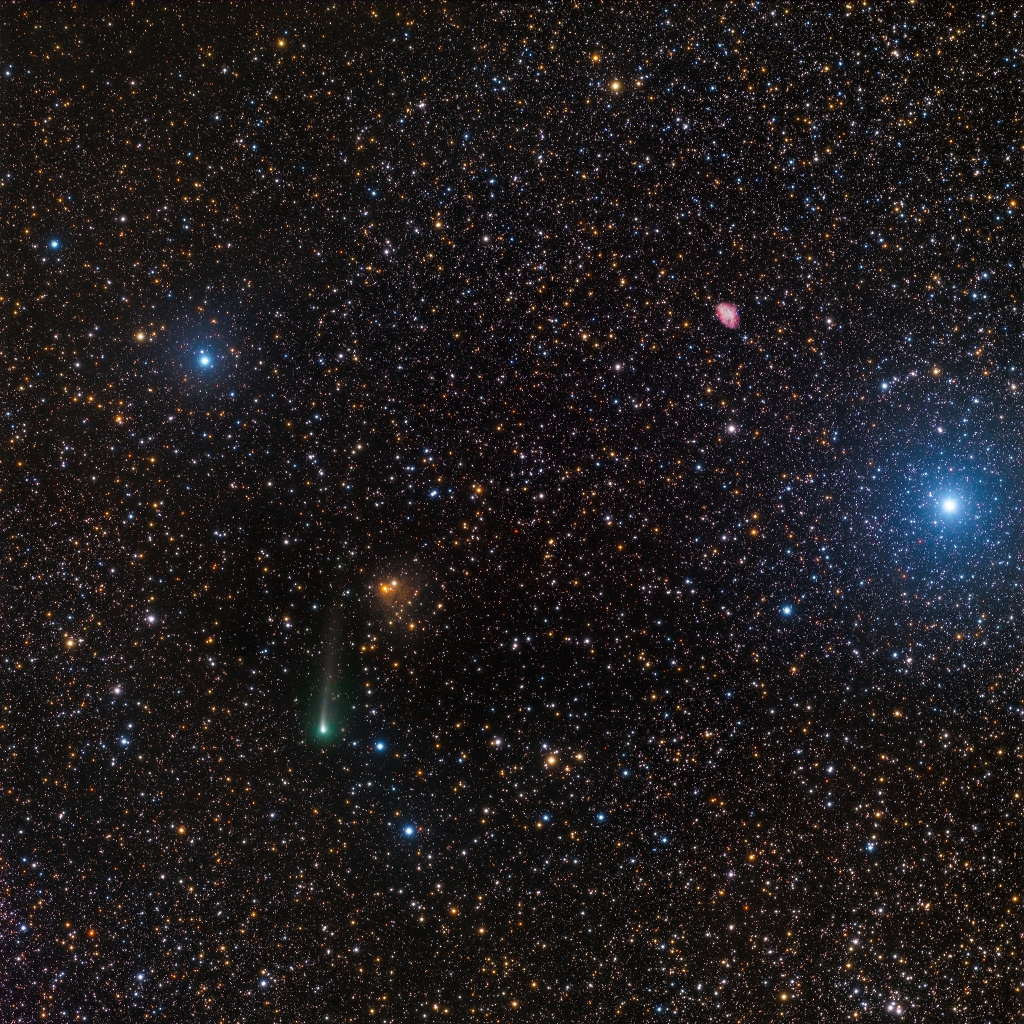
2021
This pretty field of view spans over 2 degrees or 4 full moons on the sky, filled with stars toward the constellation Taurus, the Bull. Above and right of center in the frame you can spot the faint fuzzy reddish appearance of Messier 1 (M1), also known as the Crab Nebula. M1 is the first object in 18th century comet hunter Charles Messier's famous catalog of things which are definitely not comets. Made from image data captured this October 11, there is a comet in the picture though. Below center and left lies the faint greenish coma and dusty tail of periodic comet 67P Churyumov-Gerasimenko, also known as Rosetta's comet. In the 21st century, it became the final resting place of robots from planet Earth. Rosetta's comet is now returning to the inner solar system, sweeping toward its next perihelion or closest approach to the Sun, on November 2. Too faint to be seen by eye alone, the comet's next perigee or closest approach to Earth will be November 12.
© Jose Mtanous — used with the credit NASA publishes

-2137
A solar eclipse occurs over China, one of the earliest recorded eclipses in history.
Solar eclipse of October 22, 2137 BC ↗
1884
The International Meridian Conference designates the Royal Observatory, Greenwich as the world's prime meridian.
International Meridian Conference ↗
1992
Space Shuttle Columbia launches on STS-52 to deploy the LAGEOS-2 satellite and microgravity experiments.
Space Shuttle Columbia ↗
General-audience astronomy and spaceflight — none of it a textbook.
As an Amazon Associate I earn from qualifying purchases. Links here cost you nothing extra.
LISTING
Still the best single argument for why any of this matters, and it leaves the arithmetic in. For a reader who wants the science, not just the awe.
LISTING
The case for leaving Earth, written by someone unsentimental about how hard that is. Suits readers who want the argument rather than the poster.
LISTING
Hard-SF problem solving in The Martian's key — for anyone who liked the engineering more than the peril. The only novel on this list.
BROWSE opens an Amazon search, not a specific recommendation.
LINKS AMAZON.COM
Event text and thumbnails come from Wikipedia and are used under CC BY-SA 4.0. Images are drawn only from Wikimedia Commons, which does not accept non-free content — each thumbnail links to its file page, where its licence and author are recorded.
Launch records are from The Space Devs’ Launch Library 2. Pictures are NASA’s Astronomy Picture of the Day; NASA imagery is generally not subject to copyright, but individual APOD entries are frequently the property of the photographer, and each caption says which applies.