Launches
ON RECORD20MISSIONS
20 of them reached orbit. The earliest was 1959, the most recent 2025.
ARCHIVE // DAY OF YEAR
20 orbital launches flew on October 13, the earliest of them in 1959, and 20 reached orbit. Wikipedia records 3 spaceflight and astronomy events on October 13. Below are the pictures NASA published on October 13 in 4 different years — each one taken or released on this exact date.
20MISSIONS
20 of them reached orbit. The earliest was 1959, the most recent 2025.
3ENTRIES
Spaceflight and astronomy entries from Wikipedia's record of this date, oldest first — from 1773 onward.
4IMAGES
NASA's Astronomy Picture of the Day for October 13, one per year. Some are public domain and some belong to the photographer — each says which.
NASA’s Astronomy Picture of the Day, for this calendar date in each of the last several years.
2025
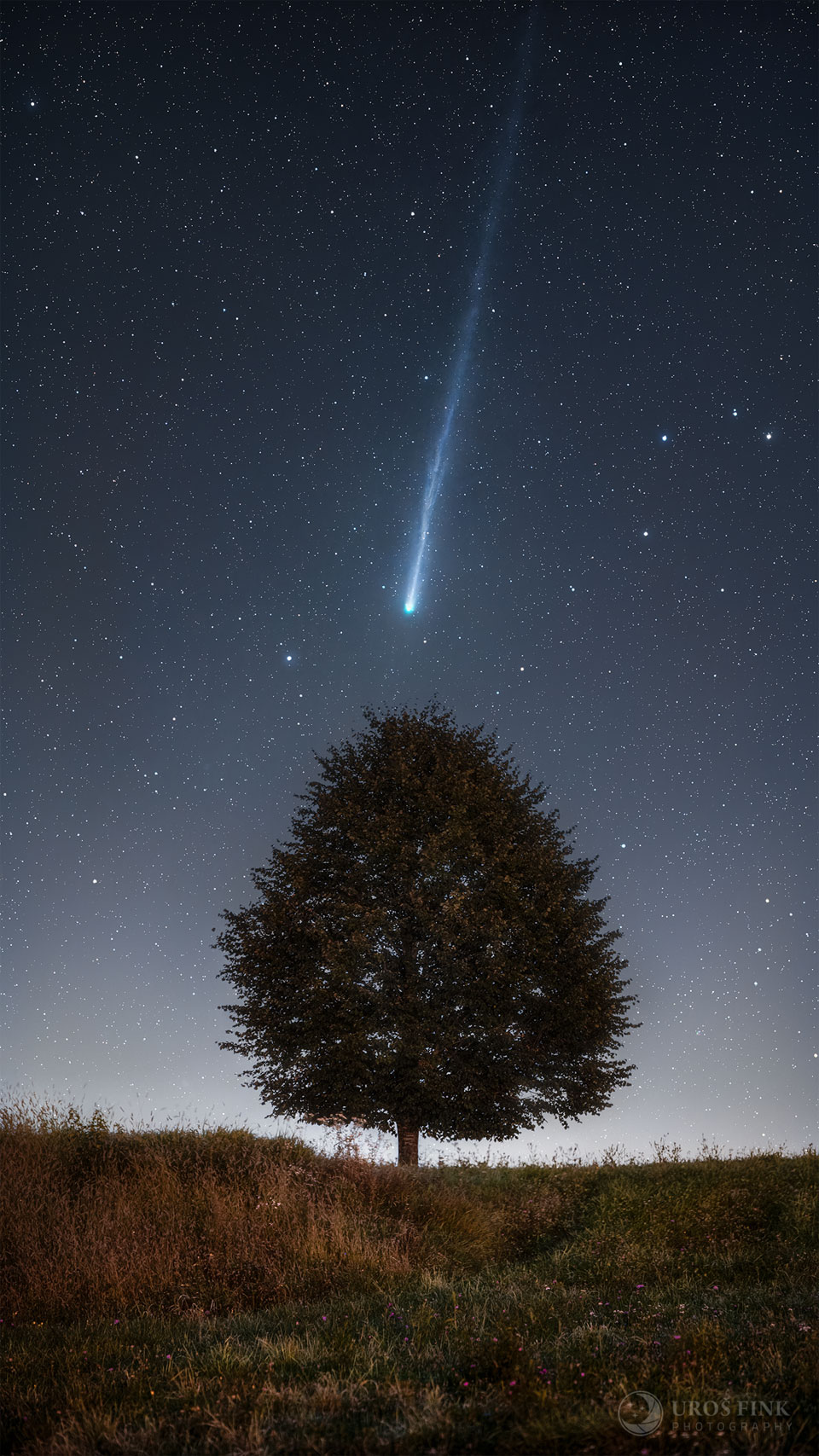
The tree is not in danger. That's because the comet pictured just above it, Comet C/2025 A6 (Lemmon), is far in the distance, well away from the Earth. Comet Lemmon now continues to brighten as it arcs through the inner Solar System, even though it has passed its nearest to the Sun -- because it is now approaching the Earth. The comet will likely appear brightest when it is at its closest to the Earth next week, then closing to about half the Earth-Sun distance. Comet Lemmon may then be visible to the unaided eye, but it is more likely to be imaged by a camera phone -- if you know where to look. Comet Lemmon, previously best visible in the morning, is now also visible in the evening sky for northern observers: look above the western horizon just after sunset. The featured image, centered on an unsuspecting European beech tree, was taken in Slovenia about ten days ago.
© Uroš Fink — used with the credit NASA publishes

2024
Did you see last night's aurora? This question was relevant around much of the world a few days ago because a powerful auroral storm became visible unusually far from the Earth's poles. The cause was a giant X-class solar flare on Tuesday that launched energetic electrons and protons into the Solar System, connecting to the Earth via our planet's magnetic field. A red glow of these particles striking oxygen atoms high in Earth's atmosphere pervades the frame, while vertical streaks dance. The featured video shows a one-hour timelapse as seen from Cortina d'Ampezzo over Alps Mountain peaks in northern Italy. Stars from our Milky Way Galaxy dot the background while streaks from airplanes and satellites punctuate the foreground. The high recent activity of our Sun is likely to continue to produce picturesque auroras over Earth during the next year or so. Gallery: Global aurora during October 10/11, 2024
© Cristian Bigontina — used with the credit NASA publishes
2023
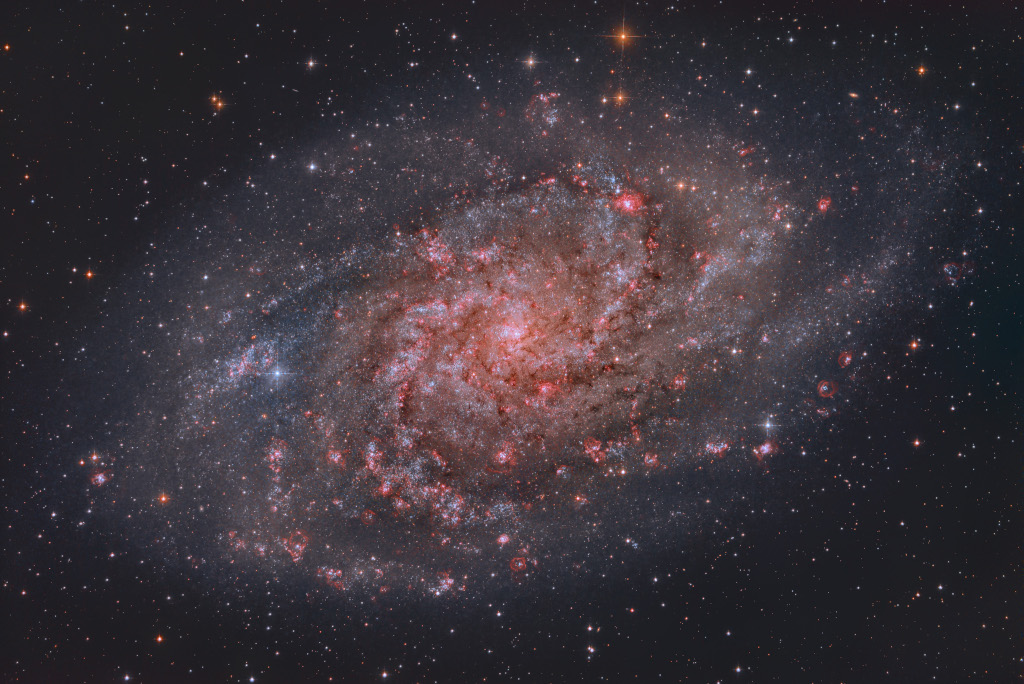
Gorgeous spiral galaxy Messier 33 seems to have more than its fair share of glowing hydrogen gas. A prominent member of the local group of galaxies, M33 is also known as the Triangulum Galaxy and lies a mere 3 million light-years away. The galaxy's central 30,000 light-years or so are shown in this sharp galaxy portrait. The portrait features M33's reddish ionized hydrogen clouds or HII regions. Sprawling along loose spiral arms that wind toward the core, M33's giant HII regions are some of the largest known stellar nurseries, sites of the formation of short-lived but very massive stars. Intense ultraviolet radiation from the luminous, massive stars ionizes the surrounding hydrogen gas and ultimately produces the characteristic red glow. In this image, broadband data were combined with narrowband data recorded through a hydrogen-alpha filter. That filter transmits the light of the strongest visible hydrogen emission line.
© Reinhold Wittich — used with the credit NASA publishes
2021
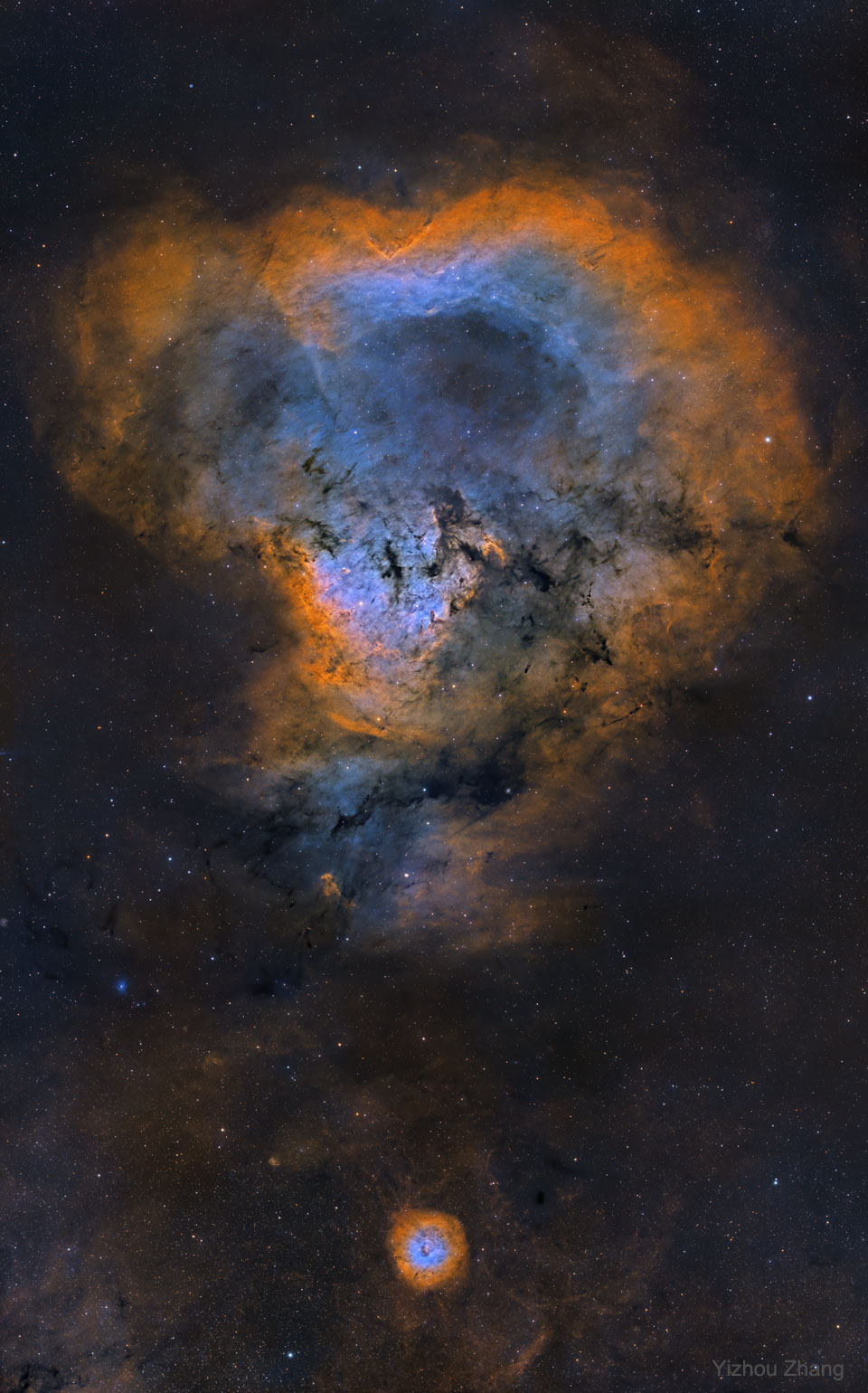
It may look like a huge cosmic question mark, but the big question really is how does the bright gas and dark dust tell this nebula's history of star formation. At the edge of a giant molecular cloud toward the northern constellation Cepheus, the glowing star forming region NGC 7822 lies about 3,000 light-years away. Within the nebula, bright edges and dark shapes stand out in this colorful and detailed skyscape. The 9-panel mosaic, taken over 28 nights with a small telescope in Texas, includes data from narrowband filters, mapping emission from atomic oxygen, hydrogen, and sulfur into blue, green, and red hues. The emission line and color combination has become well-known as the Hubble palette. The atomic emission is powered by energetic radiation from the central hot stars. Their powerful winds and radiation sculpt and erode the denser pillar shapes and clear out a characteristic cavity light-years across the center of the natal cloud. Stars could still be forming inside the pillars by gravitational collapse but as the pillars are eroded away, any forming stars will ultimately be cut off from their reservoir of star stuff. This field of view spans over 40 light-years across at the estimated distance of NGC 7822.
© Yizhou Zhang — used with the credit NASA publishes

1773
French astronomer Charles Messier discovered the Whirlpool Galaxy (pictured), an interacting, grand design spiral galaxy located an estimated 31 million light-years away.
Charles Messier ↗
1892
Edward Emerson Barnard is first to discover a comet by photographic means.
206P/Barnard–Boattini ↗
1943
World War II: Marshal Pietro Badoglio announces that Italy has officially declared war on Germany.
Pietro Badoglio ↗Event text and thumbnails come from Wikipedia and are used under CC BY-SA 4.0. Images are drawn only from Wikimedia Commons, which does not accept non-free content — each thumbnail links to its file page, where its licence and author are recorded.
Launch records are from The Space Devs’ Launch Library 2. Pictures are NASA’s Astronomy Picture of the Day; NASA imagery is generally not subject to copyright, but individual APOD entries are frequently the property of the photographer, and each caption says which applies.
General-audience astronomy and spaceflight — none of it a textbook.
As an Amazon Associate I earn from qualifying purchases. Links here cost you nothing extra.
LISTING
Still the best single argument for why any of this matters, and it leaves the arithmetic in. For a reader who wants the science, not just the awe.
LISTING
The case for leaving Earth, written by someone unsentimental about how hard that is. Suits readers who want the argument rather than the poster.
LISTING
Hard-SF problem solving in The Martian's key — for anyone who liked the engineering more than the peril. The only novel on this list.
BROWSE opens an Amazon search, not a specific recommendation.
LINKS AMAZON.COM