Launches
ON RECORD29MISSIONS
27 of them reached orbit. The earliest was 1960, the most recent 2025.
ARCHIVE // DAY OF YEAR
29 orbital launches flew on September 25, the earliest of them in 1960, and 27 reached orbit. Wikipedia records 3 spaceflight and astronomy events on September 25. Below are the pictures NASA published on September 25 in 5 different years — each one taken or released on this exact date.
29MISSIONS
27 of them reached orbit. The earliest was 1960, the most recent 2025.
3ENTRIES
Spaceflight and astronomy entries from Wikipedia's record of this date, oldest first — from 1918 onward.
5IMAGES
NASA's Astronomy Picture of the Day for September 25, one per year. Some are public domain and some belong to the photographer — each says which.
NASA’s Astronomy Picture of the Day, for this calendar date in each of the last several years.

2025
This year Saturn was at opposition on September 21, opposite the Sun in planet Earth's sky. At its closest to Earth, Saturn was also at its brightest of the year, rising as the Sun set and shining above the horizon all night long among the fainter stars of the constellation Pisces. In this snapshot from the Qinghai Lenghu Observatory, Tibetan Plateau, southwestern China, the outer planet is immersed in a faint, diffuse oval of light known as the gegenschein or counter glow. The diffuse gegenschein is produced by sunlight backscattered by interplanetary dust along the Solar System's ecliptic plane, opposite the Sun in planet Earth's sky. Like a giant eye, on this dark night Saturn and gegenschein seem to stare down on the observatory's telescope domes from their antisolar perspective. Strong atmospheric airglow forms a colorful background along the horizon.
© Jin Wang — used with the credit NASA publishes
2024
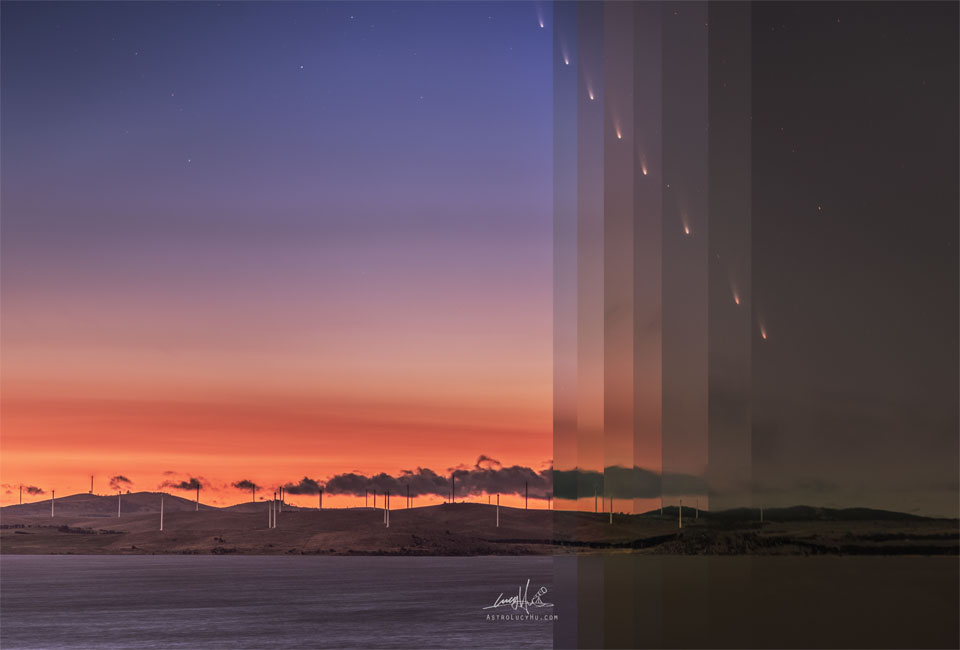
Comet Tsuchinshan-ATLAS is now visible in the early morning sky. Diving into the inner Solar System at an odd angle, this large dirty iceberg will pass its closest to the Sun -- between the orbits of Mercury and Venus -- in just two days. Long camera exposures are now capturing C/2023 A3 (Tsuchinshan–ATLAS), sometimes abbreviated as just A3, and its dust tail before and during sunrise. The featured image composite was taken four days ago and captured the comet as it rose above Lake George, NSW, Australia. Vertical bands further left are images of the comet as the rising Sun made the predawn sky increasingly bright and colorful. Just how bright the comet will become over the next month is currently unknown as it involves how much gas and dust the comet's nucleus will expel. Optimistic skywatchers are hoping for a great show where Tsuchinshan–ATLAS creates dust and ion tails visible across Earth's sky and becomes known as the Great Comet of 2024. Survey: Color Blindness and Astronomical Images Growing Gallery: Comet Tsuchinsan-ATLAS in 2024
© Lucy Yunxi Hu — used with the credit NASA publishes
2023
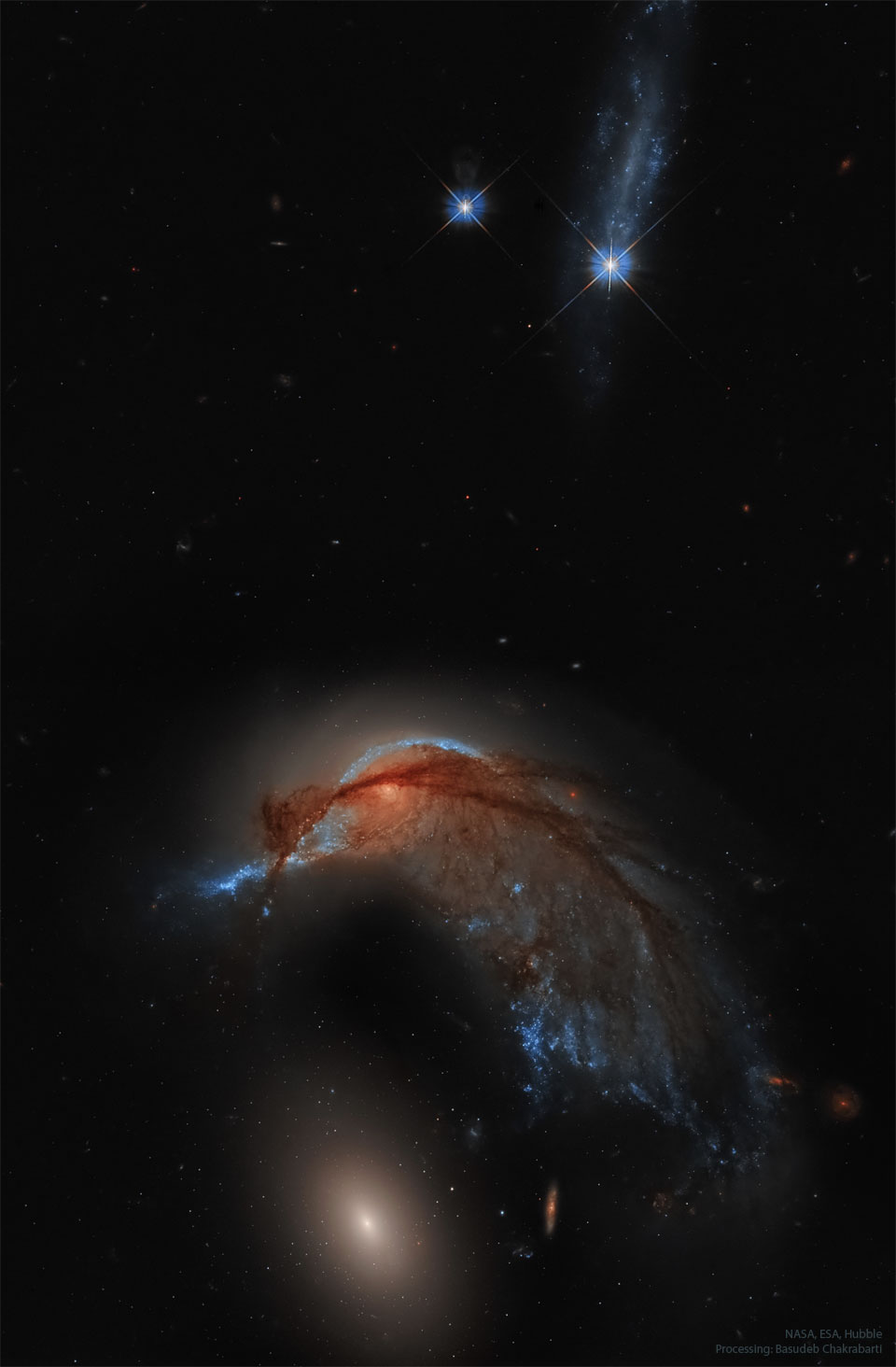
What's happening to this spiral galaxy? Just a few hundred million years ago, NGC 2936, the upper of the two large galaxies shown at the bottom, was likely a normal spiral galaxy -- spinning, creating stars -- and minding its own business. But then it got too close to the massive elliptical galaxy NGC 2937, just below, and took a turn. Sometimes dubbed the Hummingbird Galaxy for its iconic shape, NGC 2936 is not only being deflected but also being distorted by the close gravitational interaction. Behind filaments of dark interstellar dust, bright blue stars form the nose of the hummingbird, while the center of the spiral appears as an eye. Alternatively, the galaxy pair, together known as Arp 142, look to some like Porpoise or a penguin protecting an egg. The featured re-processed image showing Arp 142 in great detail was taken recently by the Hubble Space Telescope. Arp 142 lies about 300 million light years away toward the constellation of the Water Snake (Hydra). In a billion years or so the two galaxies will likely merge into one larger galaxy.
NASA · public domain
2022
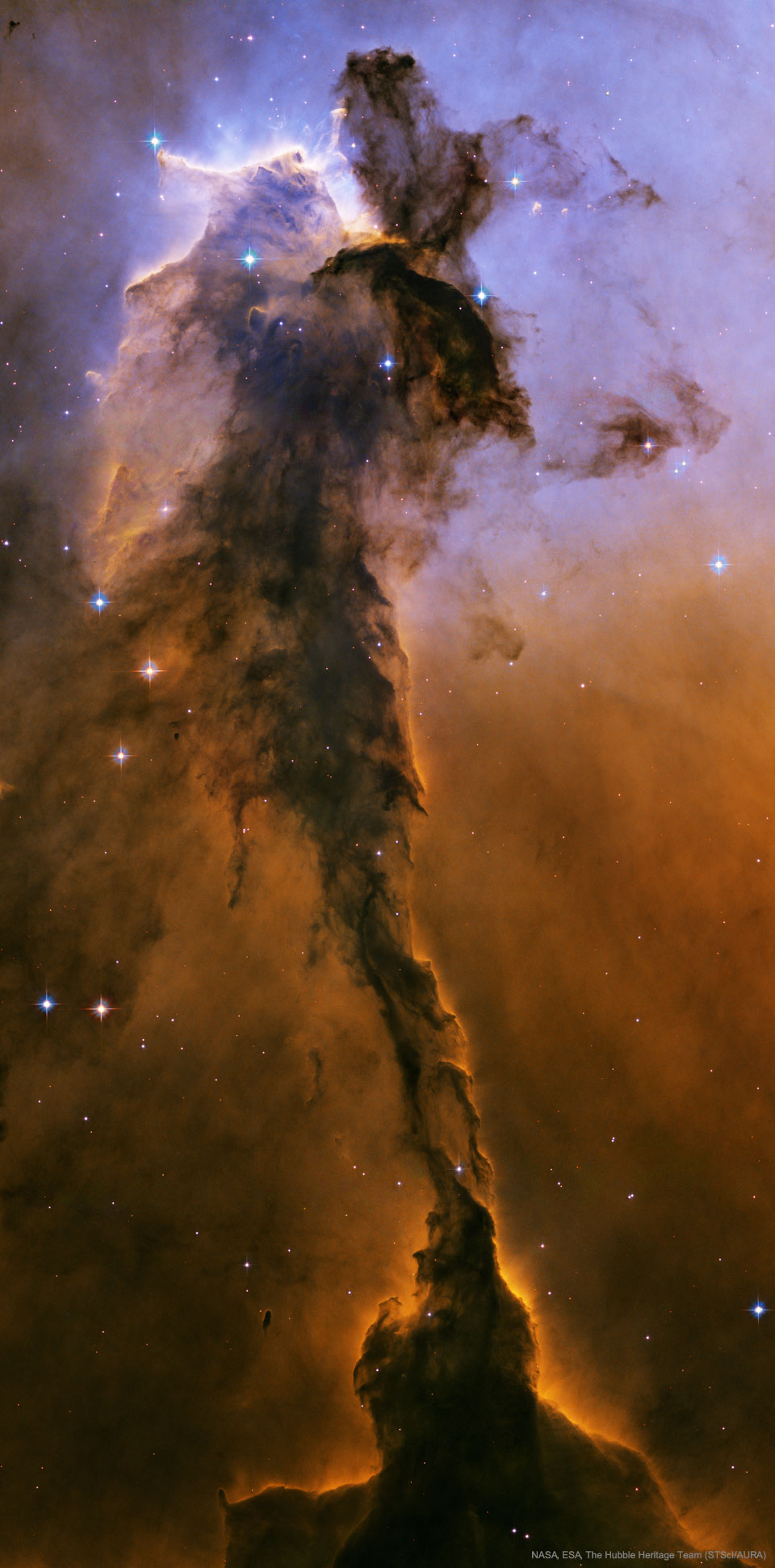
The dust sculptures of the Eagle Nebula are evaporating. As powerful starlight whittles away these cool cosmic mountains, the statuesque pillars that remain might be imagined as mythical beasts. Featured here is one of several striking dust pillars of the Eagle Nebula that might be described as a gigantic alien fairy. This fairy, however, is ten light years tall and spews radiation much hotter than common fire. The greater Eagle Nebula, M16, is actually a giant evaporating shell of gas and dust inside of which is a growing cavity filled with a spectacular stellar nursery currently forming an open cluster of stars. This great pillar, which is about 7,000 light years away, will likely evaporate away in about 100,000 years. The featured image is in scientifically re-assigned colors and was taken by the Earth-orbiting Hubble Space Telescope.
NASA · public domain
2021
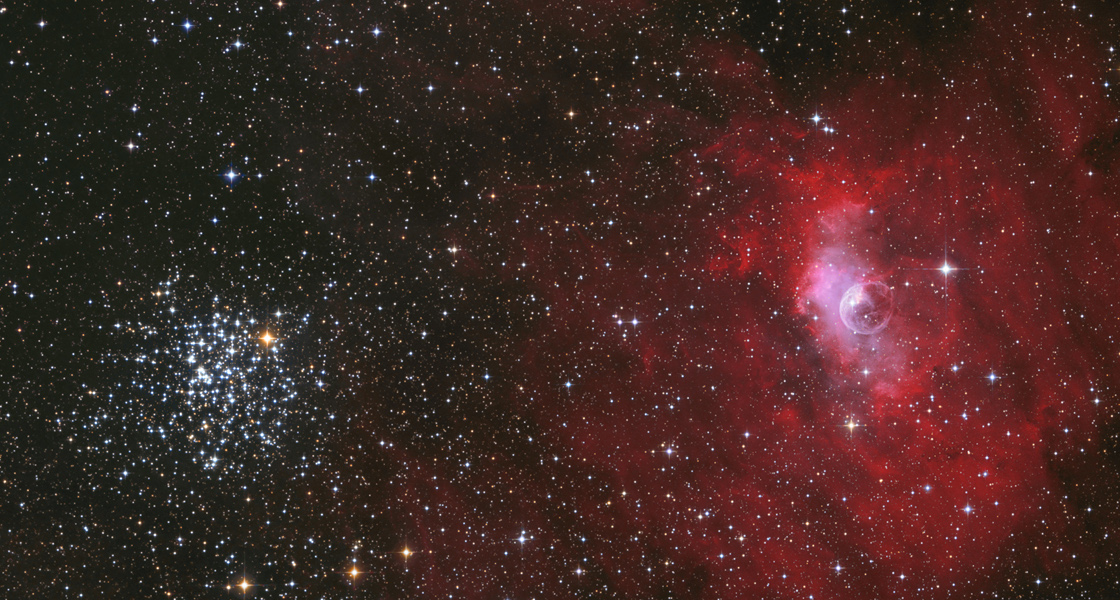
To the eye, this cosmic composition nicely balances the Bubble Nebula at the right with open star cluster M52. The pair would be lopsided on other scales, though. Embedded in a complex of interstellar dust and gas and blown by the winds from a single, massive O-type star, the Bubble Nebula, also known as NGC 7635, is a mere 10 light-years wide. On the other hand, M52 is a rich open cluster of around a thousand stars. The cluster is about 25 light-years across. Seen toward the northern boundary of Cassiopeia, distance estimates for the Bubble Nebula and associated cloud complex are around 11,000 light-years, while star cluster M52 lies nearly 5,000 light-years away. The wide telescopic field of view spans about 1.5 degrees on the sky or three times the apparent size of a full Moon.
© Lorand Fenyes — used with the credit NASA publishes

1918
World War I: The end of the Battle of Megiddo, the climax of the British Army's Sinai and Palestine campaign under General Edmund Allenby.
Battle of Megiddo (1918) ↗
1992
NASA launches the Mars Observer. Eleven months later, the probe would fail while preparing for orbital insertion.
NASA ↗
1997
NASA launches Space Shuttle Atlantis on STS-86 to the Mir space station.
Space Shuttle Atlantis ↗Event text and thumbnails come from Wikipedia and are used under CC BY-SA 4.0. Images are drawn only from Wikimedia Commons, which does not accept non-free content — each thumbnail links to its file page, where its licence and author are recorded.
Launch records are from The Space Devs’ Launch Library 2. Pictures are NASA’s Astronomy Picture of the Day; NASA imagery is generally not subject to copyright, but individual APOD entries are frequently the property of the photographer, and each caption says which applies.
General-audience astronomy and spaceflight — none of it a textbook.
As an Amazon Associate I earn from qualifying purchases. Links here cost you nothing extra.
LISTING
Still the best single argument for why any of this matters, and it leaves the arithmetic in. For a reader who wants the science, not just the awe.
LISTING
The case for leaving Earth, written by someone unsentimental about how hard that is. Suits readers who want the argument rather than the poster.
LISTING
Hard-SF problem solving in The Martian's key — for anyone who liked the engineering more than the peril. The only novel on this list.
BROWSE opens an Amazon search, not a specific recommendation.
LINKS AMAZON.COM