Launches
ON RECORD17MISSIONS
15 of them reached orbit. The earliest was 1960, the most recent 2025.
ARCHIVE // DAY OF YEAR
17 orbital launches flew on September 21, the earliest of them in 1960, and 15 reached orbit. Wikipedia records 3 spaceflight and astronomy events on September 21. Below are the pictures NASA published on September 21 in 4 different years — each one taken or released on this exact date.
17MISSIONS
15 of them reached orbit. The earliest was 1960, the most recent 2025.
3ENTRIES
Spaceflight and astronomy entries from Wikipedia's record of this date, oldest first — from 1934 onward.
4IMAGES
NASA's Astronomy Picture of the Day for September 21, one per year. Some are public domain and some belong to the photographer — each says which.
NASA’s Astronomy Picture of the Day, for this calendar date in each of the last several years.

2025
Does the Sun set in the same direction every day? No, the direction of sunset depends on the time of the year. Although the Sun always sets approximately toward the west, on an equinox like tomorrow the Sun sets directly toward the west. After tomorrow's September equinox, the Sun will set increasingly toward the southwest, reaching its maximum displacement at the December solstice. Before tomorrow's September equinox, the Sun had set toward the northwest, reaching its maximum displacement at the June solstice. The featured time-lapse image shows seven bands of the Sun setting one day each month from 2019 December through 2020 June. These image sequences were taken from Alberta, Canada -- well north of the Earth's equator -- and feature the city of Edmonton in the foreground. The middle band shows the Sun setting during an equinox -- in March. From this location, the Sun will set along this same equinox band again tomorrow.
NASA · public domain
2024
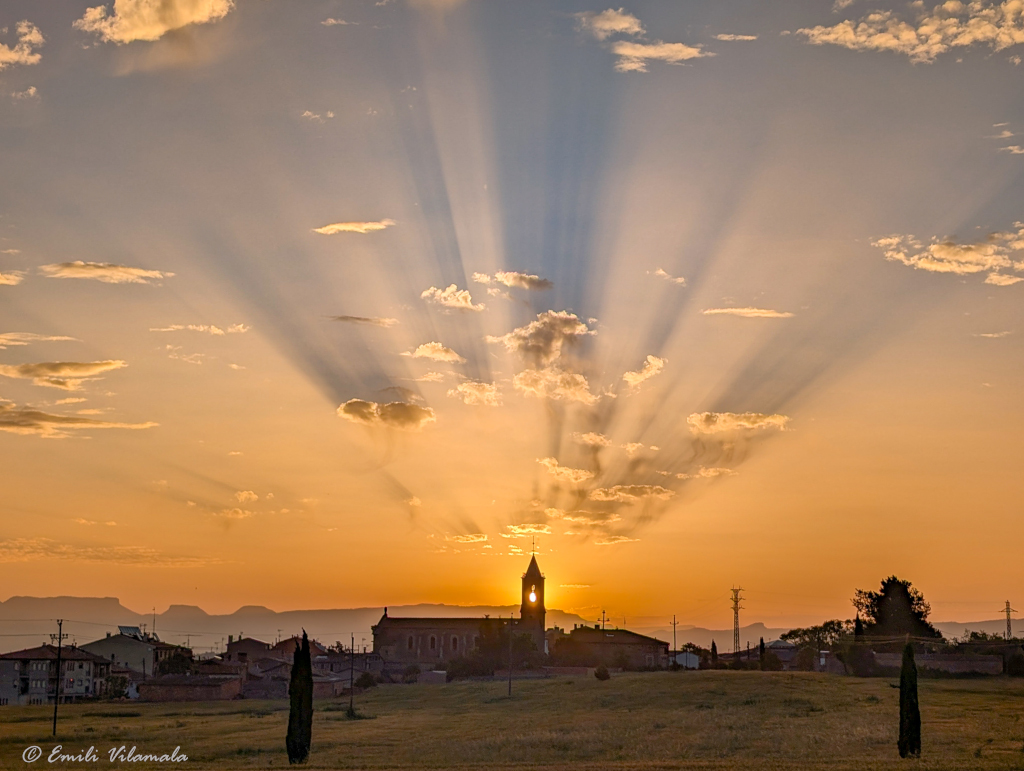
The defining astronomical moment of this September's equinox is at 12:44 UTC on September 22, when the Sun crosses the celestial equator moving south in its yearly journey through planet Earth's sky. That marks the beginning of fall for our fair planet in the northern hemisphere and spring in the southern hemisphere, when day and night are nearly equal around the globe. Of course, if you celebrate the astronomical change of seasons by watching a sunrise you can also look for crepuscular rays. Outlined by shadows cast by clouds, crepuscular rays can have a dramatic appearance in the twilight sky during any sunrise (or sunset). Due to perspective, the parallel cloud shadows will seem to point back to the rising Sun and a place due east on your horizon on the equinox date. But in this spectacular sunrise skyscape captured in early June, the parallel shadows and crepuscular rays appear to converge toward an eastern horizon's more northerly sunrise. The well-composed photo places the rising Sun just behind the bell tower of a church in the town of Vic, province of Barcelona, Catalonia, Spain.
© Emili Vilamala — used with the credit NASA publishes
2023
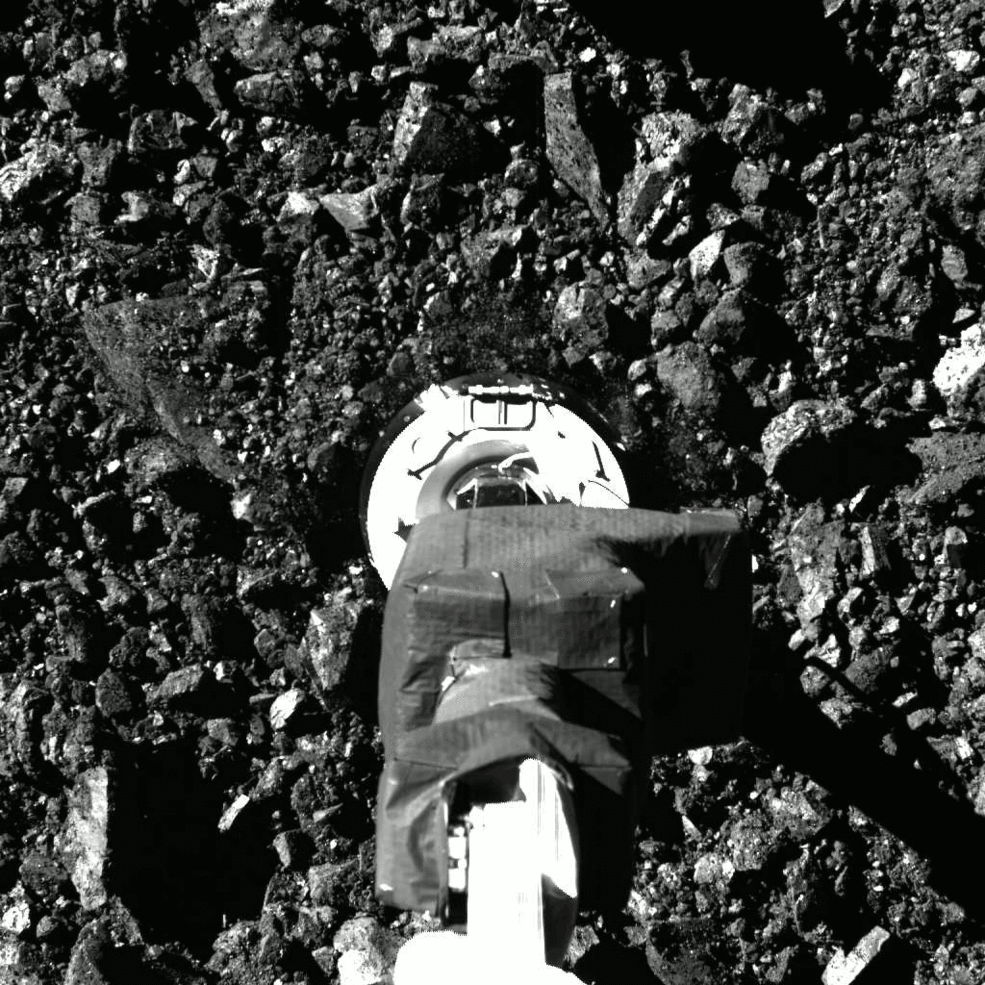
The OSIRIS-REx spacecraft's arm reached out and touched asteroid 101955 Bennu on October 20, 2020, after a careful approach to the small, near-Earth asteroid's boulder-strewn surface. Dubbed a Touch-And-Go (TAG) sampling event, the 30 centimeter wide sampling head (TAGSAM) appears to crush some of the rocks in this close-up recorded by the spacecraft's SamCam. The image was snapped just after surface contact some 321 million kilometers from planet Earth. One second later, the spacecraft fired nitrogen gas from a bottle to blow a substantial amount of Bennu's regolith into the sampling head, collecting the loose surface material. And now, nearly three years later, on Sunday, September 24, that sample of asteroid Bennu is scheduled to arrive on planet Earth. The sample return capsule will be dropped off by the OSIRIS-Rex spacecraft as it makes a close flyby of Earth. Twenty minutes after the drop-off, the spacecraft will fire its thrusters to divert past Earth and continue on to orbit near-Earth asteroid 99942 Apophis.
NASA · public domain
2021
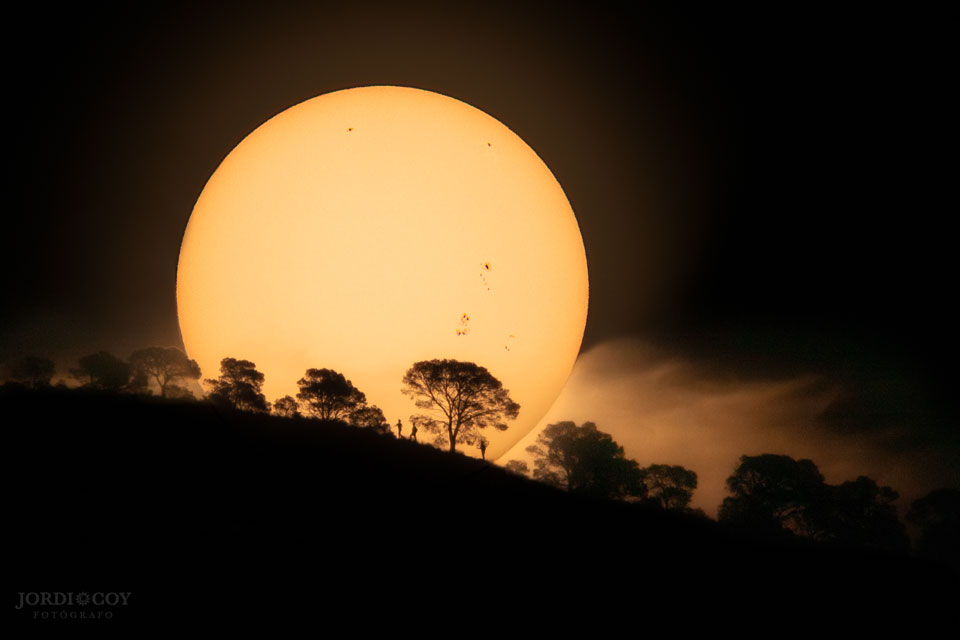
Is this giant orange ball about to roll down that tree-lined hill? No, because the giant orange ball is actually the Sun. Our Solar System's central star was captured rising beyond a hill on Earth twelve days ago complete with a delightfully detailed foreground. The Sun's disk showed five sunspots, quite a lot considering that during the solar minimum in solar activity of the past few years, most days showed no spots. A close look at the hill -- Sierra del Cid in Perter, Spain -- reveals not only silhouetted pine trees, but silhouetted people -- by coincidence three brothers of the photographer. The trees and brothers were about 3.5-kilometers away during the morning of the well-planned image. A dark filter muted the usually brilliant Sun and brought up great detail on the lower sunspots. Within a few minutes, the Sun rose far above the hill, while within a week, the sunspots rotated around the Sun, out of view. The captured scene, however, is now frozen in time for all to enjoy.
© Jordi Coy — used with the credit NASA publishes

1934
Chandrashekhar Agashe established the Brihan Maharashtra Sugar Syndicate Ltd., one of the oldest companies in India.
Chandrashekhar Agashe ↗
1968
The Soviet Union's Zond 5 landed in the Indian Ocean, becoming the first spacecraft to safely return to Earth after travelling around the Moon.
Zond 5 ↗
2003
The Galileo spacecraft is terminated by sending it into Jupiter's atmosphere.
Galileo (spacecraft) ↗Event text and thumbnails come from Wikipedia and are used under CC BY-SA 4.0. Images are drawn only from Wikimedia Commons, which does not accept non-free content — each thumbnail links to its file page, where its licence and author are recorded.
Launch records are from The Space Devs’ Launch Library 2. Pictures are NASA’s Astronomy Picture of the Day; NASA imagery is generally not subject to copyright, but individual APOD entries are frequently the property of the photographer, and each caption says which applies.
General-audience astronomy and spaceflight — none of it a textbook.
As an Amazon Associate I earn from qualifying purchases. Links here cost you nothing extra.
LISTING
Still the best single argument for why any of this matters, and it leaves the arithmetic in. For a reader who wants the science, not just the awe.
LISTING
The case for leaving Earth, written by someone unsentimental about how hard that is. Suits readers who want the argument rather than the poster.
LISTING
Hard-SF problem solving in The Martian's key — for anyone who liked the engineering more than the peril. The only novel on this list.
BROWSE opens an Amazon search, not a specific recommendation.
LINKS AMAZON.COM