Launches
ON RECORD20MISSIONS
16 of them reached orbit. The earliest was 1962, the most recent 2025.
ARCHIVE // DAY OF YEAR
20 orbital launches flew on August 31, the earliest of them in 1962, and 16 reached orbit. Wikipedia records 1 spaceflight and astronomy event on August 31. Below are the pictures NASA published on August 31 in 4 different years — each one taken or released on this exact date.
20MISSIONS
16 of them reached orbit. The earliest was 1962, the most recent 2025.
1ENTRY
Spaceflight and astronomy entries from Wikipedia's record of this date, oldest first — from 1895 onward.
4IMAGES
NASA's Astronomy Picture of the Day for August 31, one per year. Some are public domain and some belong to the photographer — each says which.
NASA’s Astronomy Picture of the Day, for this calendar date in each of the last several years.

2025
What created this unusual planetary nebula? Dubbed the Pillow Nebula and the Flying Carpet Nebula, NGC 7027 is one of the smallest, brightest, and most unusually shaped planetary nebulas known. Given its expansion rate, NGC 7027 first started expanding, as visible from Earth, about 600 years ago. For much of its history, the planetary nebula has been expelling shells, as seen in blue in the featured image by the Hubble Space Telescope. In modern times, though, for reasons unknown, it began ejecting gas and dust (seen in brown) in specific directions that created a new pattern that seems to have four corners. What lies at the nebula's center is unknown, with one hypothesis holding it to be a close binary star system where one star sheds gas onto an erratic disk orbiting the other star. NGC 7027, about 3,000 light years away, was first discovered in 1878 and can be seen with a standard backyard telescope toward the constellation of the Swan (Cygnus).
NASA · public domain
2024
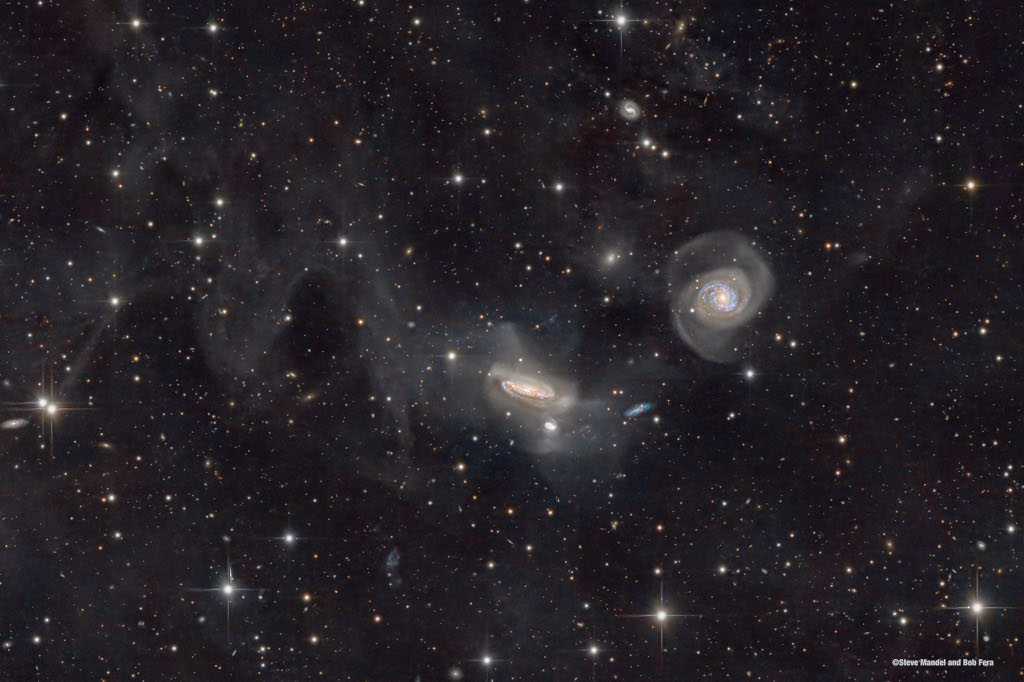
Galaxies of the NGC 7771 Group are featured in this intriguing skyscape. Some 200 million light-years distant toward the constellation Pegasus, NGC 7771 is the large, edge-on spiral near center, about 75,000 light-years across, with two smaller galaxies below it. Large spiral NGC 7769 is seen face-on to the right. Galaxies of the NGC 7771 group are interacting, making repeated close passages that will ultimately result in galaxy-galaxy mergers on a cosmic timescale. The interactions can be traced by distortions in the shape of the galaxies themselves and faint streams of stars created by their mutual gravitational tides. But a clear view of this galaxy group is difficult to come by as the deep image also reveals extensive clouds of foreground dust sweeping across the field of view. The dim, dusty galactic cirrus clouds are known as Integrated Flux Nebulae. The faint IFN reflect starlight from our own Milky Way Galaxy and lie only a few hundred light-years above the galactic plane.
© Steve Mandel — used with the credit NASA publishes
2023
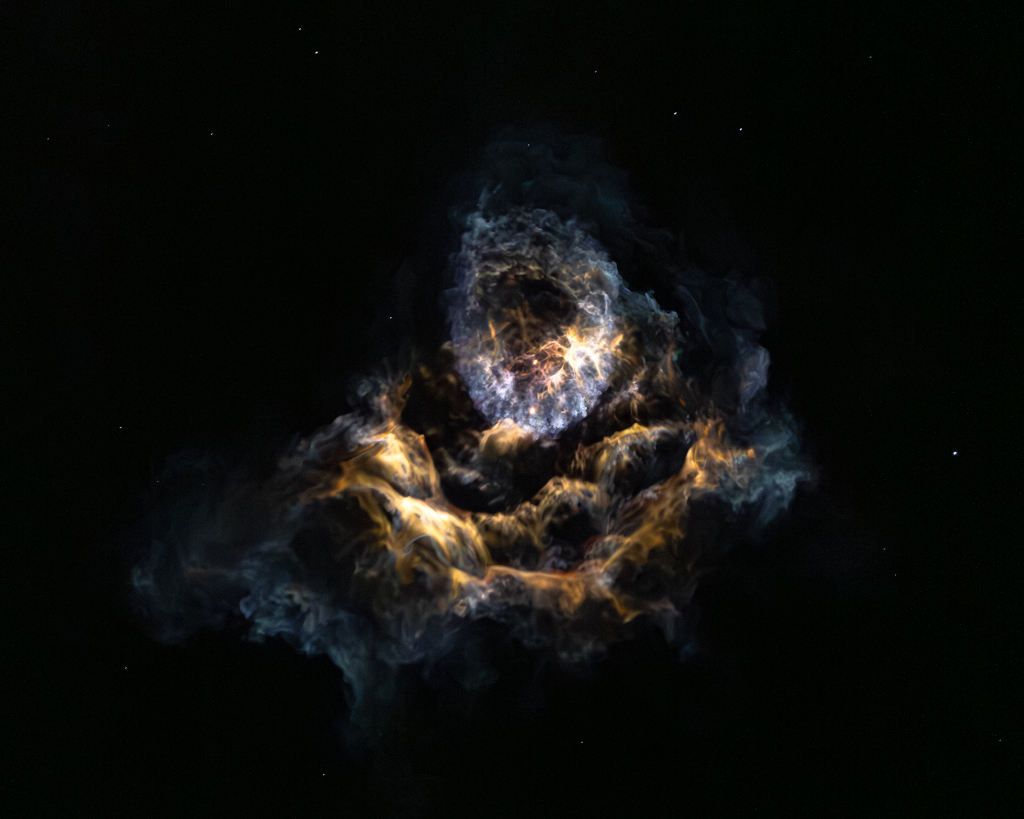
Not the James Webb Space Telescope's latest view of a distant galactic nebula, this illuminated cloud of gas and dust dazzled early morning spacecoast skygazers on August 26. The snapshot was taken about 2 minutes after the launch of a Falcon 9 rocket on the SpaceX Crew-7 mission, the seventh commercial crew rotation mission for the International Space Station. It captures drifting plumes and exhaust from the separated first and second stage illuminated against the still dark skies. Near the center of the image, within the ragged blueish ring, are two bright points of light. The lower one is the second stage of the rocket carrying 4 humans to space in a Crew Dragon spacecraft. The bright point above is the Falcon 9 first stage booster orienting itself for the trip back to Landing Zone-1 at Cape Canaveral, planet Earth.
© Michael Seeley — used with the credit NASA publishes
2021
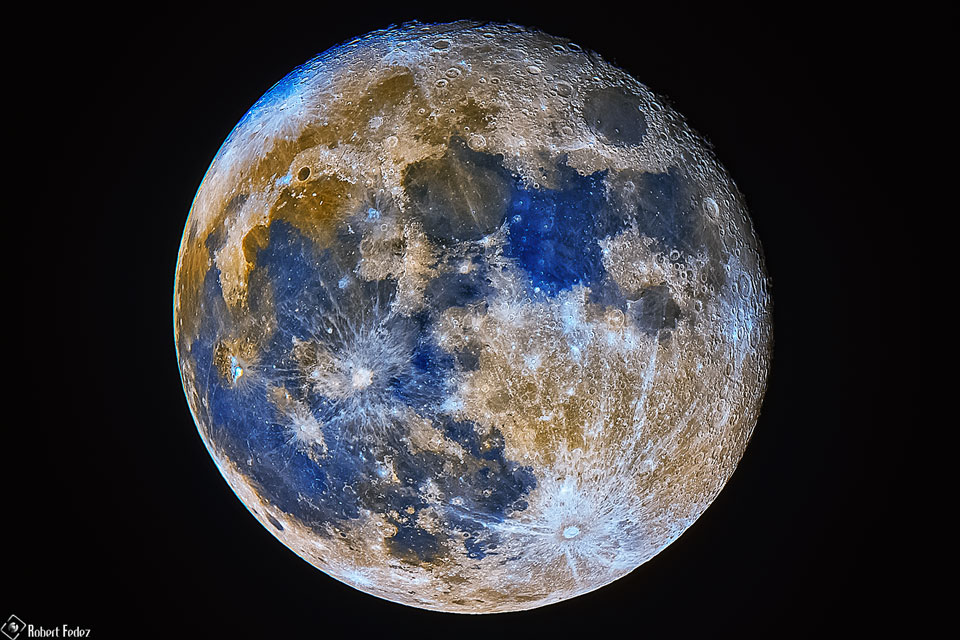
The Moon is normally seen in subtle shades of grey or gold. But small, measurable color differences have been greatly exaggerated to make this telescopic, multicolored, moonscape captured during the Moon's full phase. The different colors are recognized to correspond to real differences in the chemical makeup of the lunar surface. Blue hues reveal titanium rich areas while orange and purple colors show regions relatively poor in titanium and iron. The familiar Sea of Tranquility, or Mare Tranquillitatis, is the blue area toward the upper right. White lines radiate across the orange-hued southern lunar highlands from 85-kilometer wide ray-crater Tycho at bottom right. The full moon that occurred earlier this month could be counted as a seasonal blue moon because it was, unusually, the third of four full moons to occur during northern summer (and hence southern winter). The featured 272-image composite demonstrates that the full Moon is always blue, but usually not blue enough in hue to ooh. Almost Hyperspace: Random APOD Generator
© Robert Fedez — used with the credit NASA publishes

Event text and thumbnails come from Wikipedia and are used under CC BY-SA 4.0. Images are drawn only from Wikimedia Commons, which does not accept non-free content — each thumbnail links to its file page, where its licence and author are recorded.
Launch records are from The Space Devs’ Launch Library 2. Pictures are NASA’s Astronomy Picture of the Day; NASA imagery is generally not subject to copyright, but individual APOD entries are frequently the property of the photographer, and each caption says which applies.
General-audience astronomy and spaceflight — none of it a textbook.
As an Amazon Associate I earn from qualifying purchases. Links here cost you nothing extra.
LISTING
Still the best single argument for why any of this matters, and it leaves the arithmetic in. For a reader who wants the science, not just the awe.
LISTING
The case for leaving Earth, written by someone unsentimental about how hard that is. Suits readers who want the argument rather than the poster.
LISTING
Hard-SF problem solving in The Martian's key — for anyone who liked the engineering more than the peril. The only novel on this list.
BROWSE opens an Amazon search, not a specific recommendation.
LINKS AMAZON.COM