Launches
ON RECORD27MISSIONS
24 of them reached orbit. The earliest was 1958, the most recent 2026.
ARCHIVE // DAY OF YEAR
27 orbital launches flew on August 12, the earliest of them in 1958, and 24 reached orbit. Wikipedia records 3 spaceflight and astronomy events on August 12. Below are the pictures NASA published on August 12 in 5 different years — each one taken or released on this exact date.
27MISSIONS
24 of them reached orbit. The earliest was 1958, the most recent 2026.
3ENTRIES
Spaceflight and astronomy entries from Wikipedia's record of this date, oldest first — from 1865 onward.
5IMAGES
NASA's Astronomy Picture of the Day for August 12, one per year. Some are public domain and some belong to the photographer — each says which.
NASA’s Astronomy Picture of the Day, for this calendar date in each of the last several years.

2025
Where are all of these meteors coming from? In terms of direction on the sky, the pointed answer is the constellation of Perseus. That is why the meteor shower that peaks tonight is known as the Perseids -- the meteors all appear to come from a radiant toward Perseus. In terms of parent body, though, the sand-sized debris that makes up the Perseids meteors come from Comet Swift-Tuttle. The comet follows a well-defined orbit around our Sun, and the part of the orbit that approaches Earth is superposed in front of Perseus. Therefore, when Earth crosses this orbit, the radiant point of falling debris appears in Perseus. Featured here, a composite image taken over six nights and containing over 100 meteors from 2024 August Perseids meteor shower shows many bright meteors that streaked over the Bieszczady Mountains in Poland. This year's Perseids, usually one of the best meteor showers of the year, will compete with a bright moon that will rise, for many locations, soon after sunset.
© Marcin Rosadziński — used with the credit NASA publishes
2024
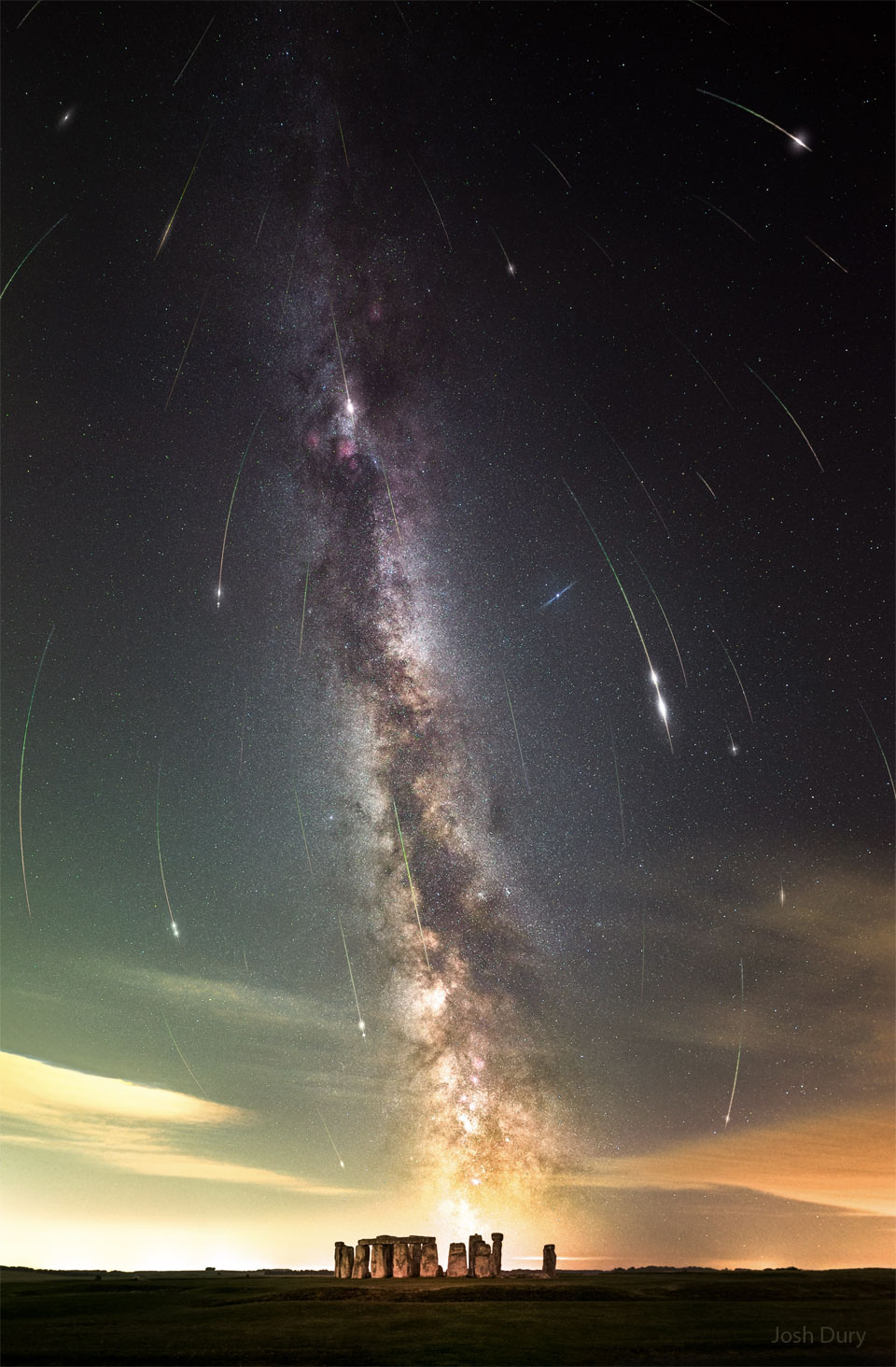
What's happening in the sky above Stonehenge? A meteor shower: specifically, the Perseid meteor shower. A few nights ago, after the sky darkened, many images of meteors from this year's Perseids were captured separately and merged into a single frame. Although the meteors all traveled on straight paths, these paths appear slightly curved by the wide-angle lens of the capturing camera. The meteor streaks can all be traced back to a single point on the sky called the radiant, here just off the top of the frame in the constellation of Perseus. The same camera took a deep image of the background sky that brought up the central band of our Milky Way galaxy running nearly vertical through the image center. The featured image was taken from Wiltshire, England, being careful to include, at the bottom, the famous astronomical monument of Stonehenge. Although the Perseids peaked last night, some Perseid meteors should still be visible for a few more nights.
© Josh Dury — used with the credit NASA publishes
2023
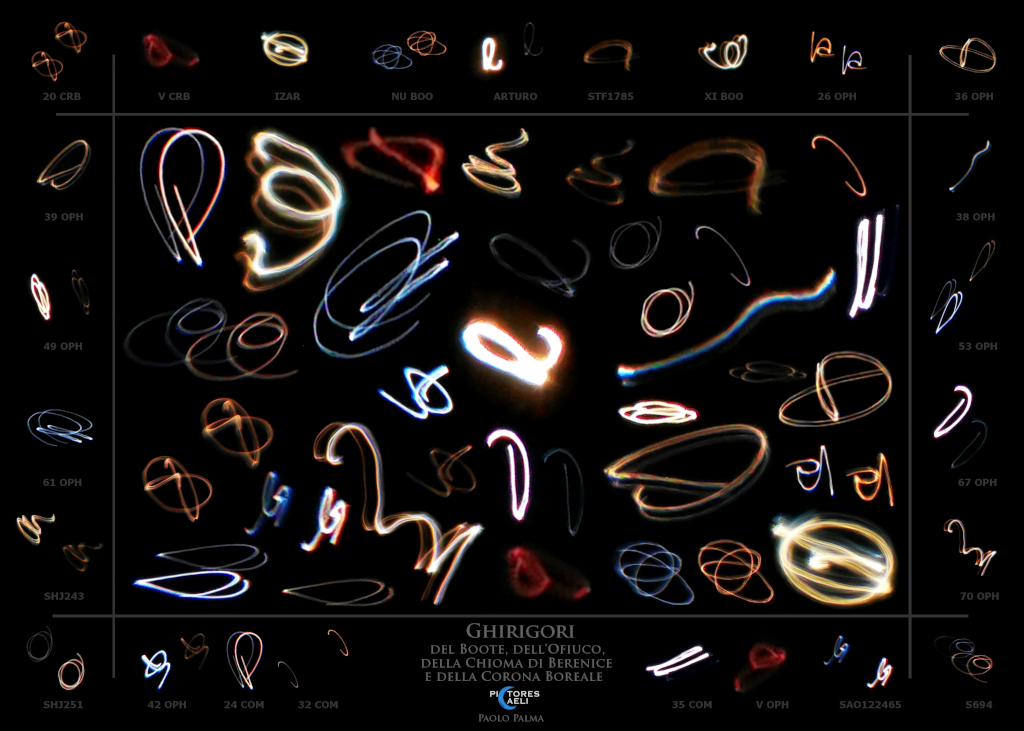
It's fun to scribble on the canvas of the sky. You can use a creative photographic technique to cause the light of point-like stars to dance across a digital image by tapping lightly on the telescope while making an exposure. The result will be a squiggly line traced by the star (or two squiggles traced by binary stars) that can reveal the star's color. Colorful lines, dubbed Ghirigori, made from stars found in the northern sky constellations Bootes, Corona Borealis, Ophiucus, and Coma Berenices, are captured in this artistic mosaic. The 25 stars creating the varied and colorful squiggles are identified around the border. Of course, temperature determines the color of a star. While whitish stars tend to be close to the Sun's temperature, stars with bluer hues are hotter, and yellow and red colors are cooler than the Sun. Weekend Watch: Perseid Meteor Shower
© Paolo Palma — used with the credit NASA publishes
2022
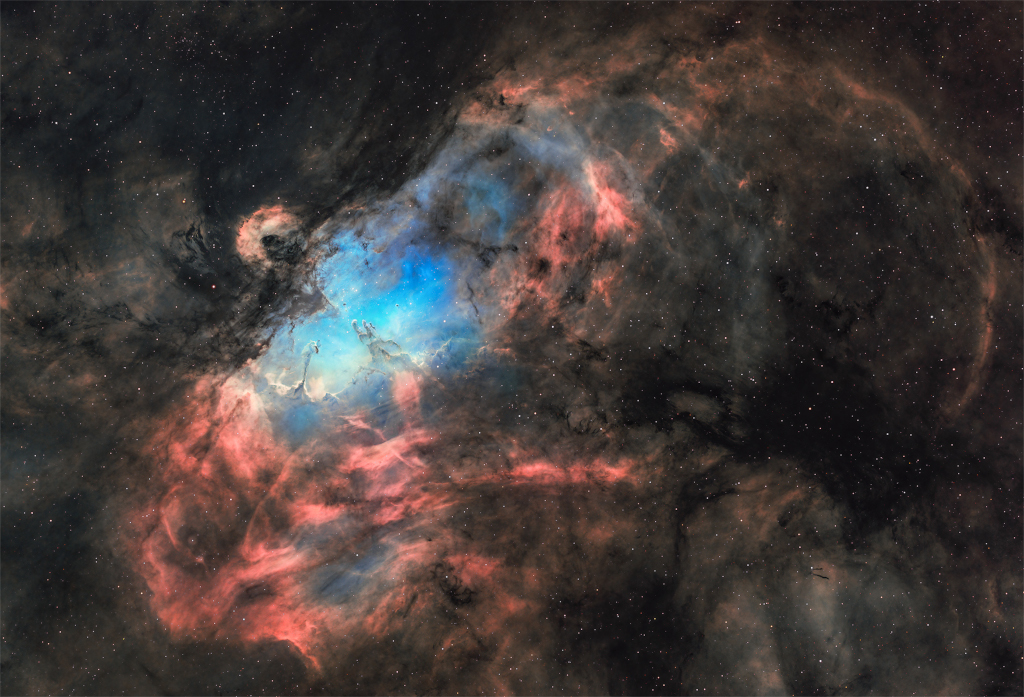
A star cluster around 2 million years young surrounded by natal clouds of dust and glowing gas, Messier 16 (M16) is also known as The Eagle Nebula. This beautifully detailed image of the region adopts the colorful Hubble palette and includes cosmic sculptures made famous in Hubble Space Telescope close-ups of the starforming complex. Described as elephant trunks or Pillars of Creation, dense, dusty columns rising near the center are light-years in length but are gravitationally contracting to form stars. Energetic radiation from the cluster stars erodes material near the tips, eventually exposing the embedded new stars. Extending from the ridge of bright emission left of center is another dusty starforming column known as the Fairy of Eagle Nebula. M16 lies about 7,000 light-years away, an easy target for binoculars or small telescopes in a nebula rich part of the sky toward the split constellation Serpens Cauda (the tail of the snake). As framed, this telescopic portrait of the Eagle Nebula is about 70 light-years across.
© Charles Bonafilia — used with the credit NASA publishes
2021
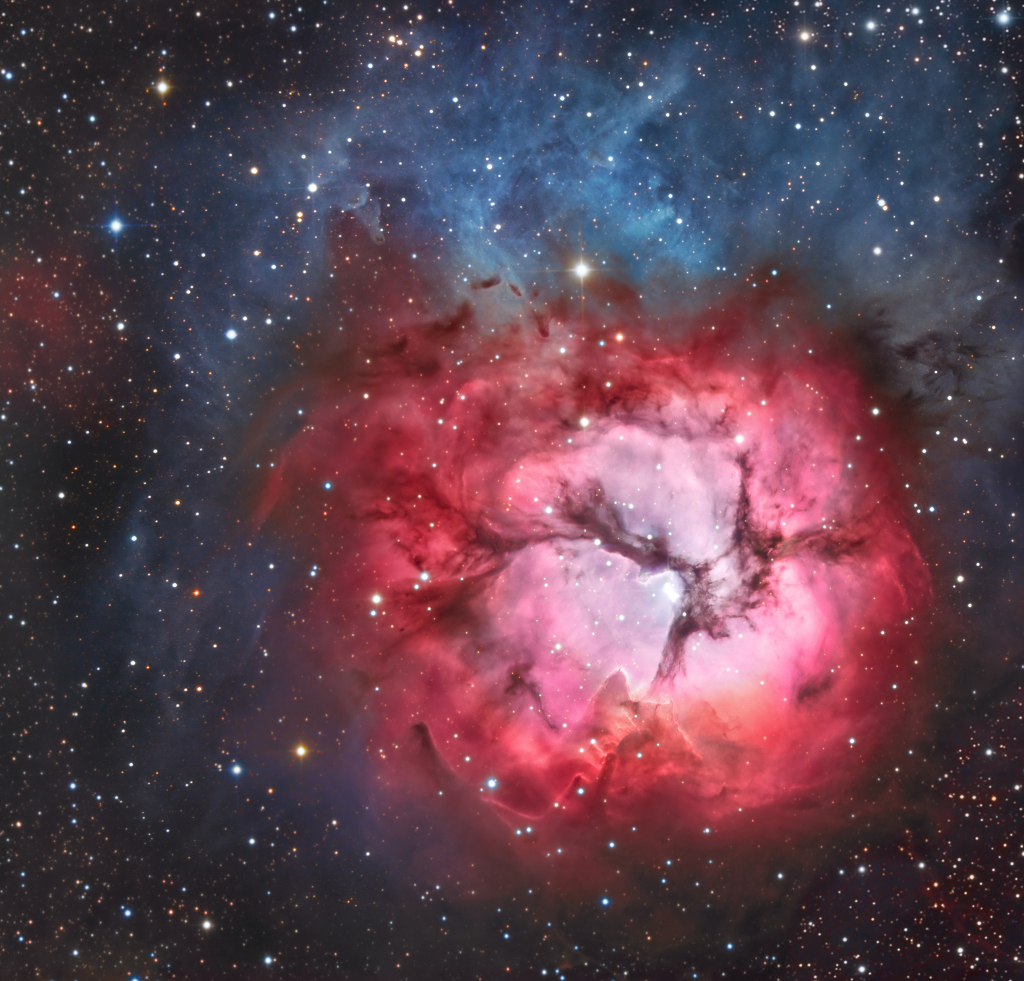
The beautiful Trifid Nebula is a cosmic study in contrasts. Also known as M20, it lies about 5,000 light-years away toward the nebula rich constellation Sagittarius. A star forming region in the plane of our galaxy, the Trifid does illustrate three different types of astronomical nebulae; red emission nebulae dominated by light from hydrogen atoms, blue reflection nebulae produced by dust reflecting starlight, and dark nebulae where dense dust clouds appear in silhouette. But the red emission region roughly separated into three parts by obscuring dust lanes is what lends the Trifid its popular name. Pillars and jets sculpted by newborn stars, below and left of the emission nebula's center, appear in famous Hubble Space Telescope close-up images of the region. The Trifid Nebula is about 40 light-years across. Just too faint to be seen by the unaided eye, it almost covers the area of a full moon in planet Earth's sky.
© Mike Selby — used with the credit NASA publishes

1865
Joseph Lister, British surgeon and scientist, performs the first antiseptic surgery.
Joseph Lister ↗

Event text and thumbnails come from Wikipedia and are used under CC BY-SA 4.0. Images are drawn only from Wikimedia Commons, which does not accept non-free content — each thumbnail links to its file page, where its licence and author are recorded.
Launch records are from The Space Devs’ Launch Library 2. Pictures are NASA’s Astronomy Picture of the Day; NASA imagery is generally not subject to copyright, but individual APOD entries are frequently the property of the photographer, and each caption says which applies.
General-audience astronomy and spaceflight — none of it a textbook.
As an Amazon Associate I earn from qualifying purchases. Links here cost you nothing extra.
LISTING
Still the best single argument for why any of this matters, and it leaves the arithmetic in. For a reader who wants the science, not just the awe.
LISTING
The case for leaving Earth, written by someone unsentimental about how hard that is. Suits readers who want the argument rather than the poster.
LISTING
Hard-SF problem solving in The Martian's key — for anyone who liked the engineering more than the peril. The only novel on this list.
BROWSE opens an Amazon search, not a specific recommendation.
LINKS AMAZON.COM