Launches
ON RECORD23MISSIONS
20 of them reached orbit. The earliest was 1960, the most recent 2026.
ARCHIVE // DAY OF YEAR
23 orbital launches flew on July 29, the earliest of them in 1960, and 20 reached orbit. Wikipedia records 5 spaceflight and astronomy events on July 29. Below are the pictures NASA published on July 29 in 5 different years — each one taken or released on this exact date.
23MISSIONS
20 of them reached orbit. The earliest was 1960, the most recent 2026.
5ENTRIES
Spaceflight and astronomy entries from Wikipedia's record of this date, oldest first — from 1851 onward.
5IMAGES
NASA's Astronomy Picture of the Day for July 29, one per year. Some are public domain and some belong to the photographer — each says which.
NASA’s Astronomy Picture of the Day, for this calendar date in each of the last several years.

2025
Is the Helix Nebula looking at you? No, not in any biological sense, but it does look quite like an eye. The Helix Nebula is so named because it also appears that you are looking down the axis of a helix. In actuality, it is now understood to have a surprisingly complex geometry, including radial filaments and extended outer loops. The Helix Nebula (aka NGC 7293) is one of brightest and closest examples of a planetary nebula, a gas cloud created at the end of the life of a Sun-like star. The remnant central stellar core, destined to become a white dwarf star, glows in light so energetic it causes the previously expelled gas to fluoresce. The featured picture, taken in red, green, and blue but highlighted by light emitted primarily by hydrogen was created from 12 hours of exposure through a personal telescope located in Greece. A close-up of the inner edge of the Helix Nebula shows complex gas knots the origin of which are still being researched. Portal Universe: Random APOD Generator
© George Chatzifrantzis — used with the credit NASA publishes
2024
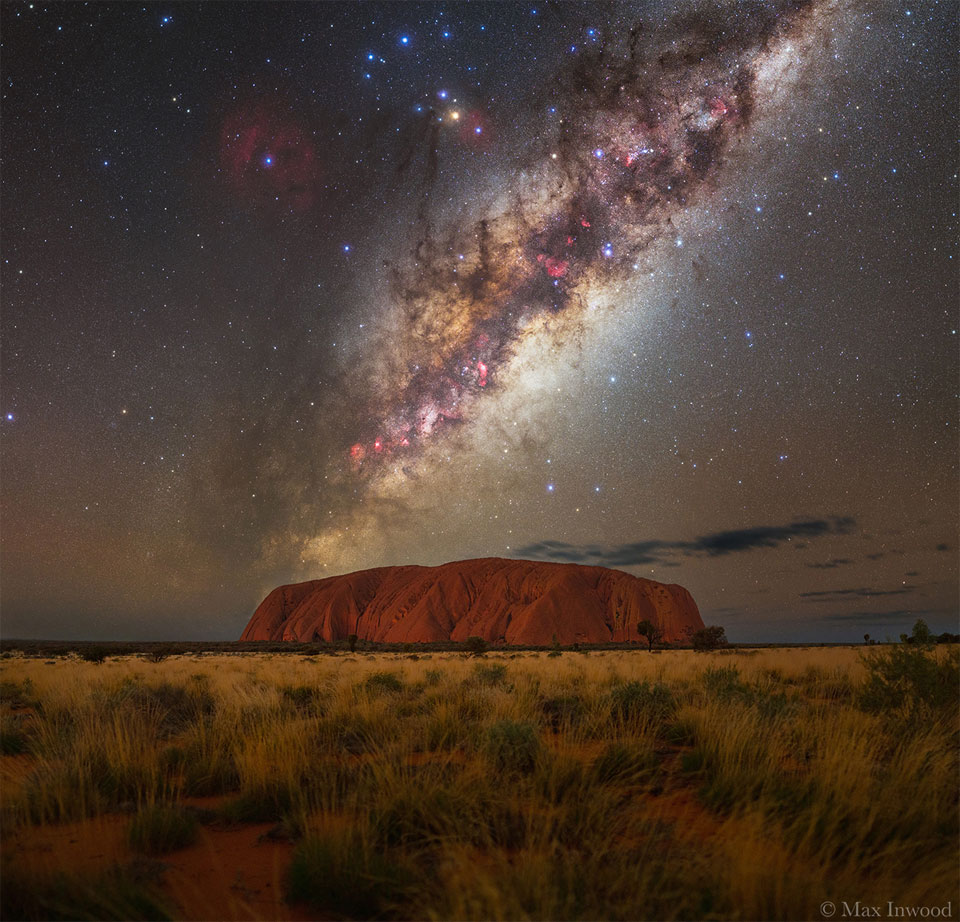
What's happening above Uluru? A United Nations World Heritage Site, Uluru is an extraordinary 350-meter high mountain in central Australia that rises sharply from nearly flat surroundings. Composed of sandstone, Uluru has slowly formed over the past 300 million years as softer rock eroded away. The Uluru region has been a home to humans for over 22,000 years. Recorded last month, the starry sky above Uluru includes the central band of our Milky Way galaxy, complete with complex dark filaments of dust, bright red emission nebulas, and billions of stars.
© Max Inwood — used with the credit NASA publishes
2023
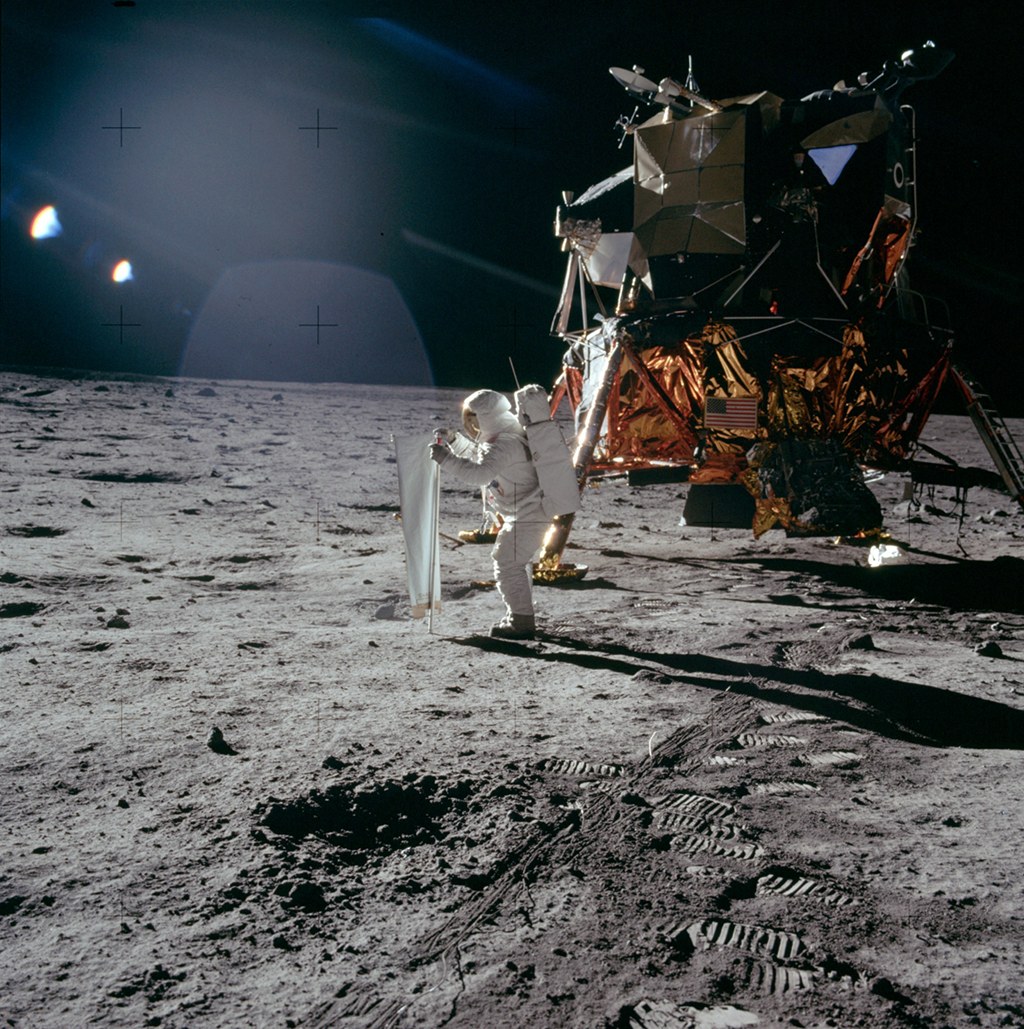
Bright sunlight glints as long dark shadows mark this image of the surface of the Moon. It was taken fifty-four years ago, July 20, 1969, by Apollo 11 astronaut Neil Armstrong, the first to walk on the lunar surface. Pictured is the mission's lunar module, the Eagle, and spacesuited lunar module pilot Buzz Aldrin. Aldrin is unfurling a long sheet of foil also known as the Solar Wind Composition Experiment. Exposed facing the Sun, the foil trapped particles streaming outward in the solar wind, catching a sample of material from the Sun itself. Along with moon rocks and lunar soil samples, the solar wind collector was returned for analysis in earthbound laboratories.
NASA · public domain
2022
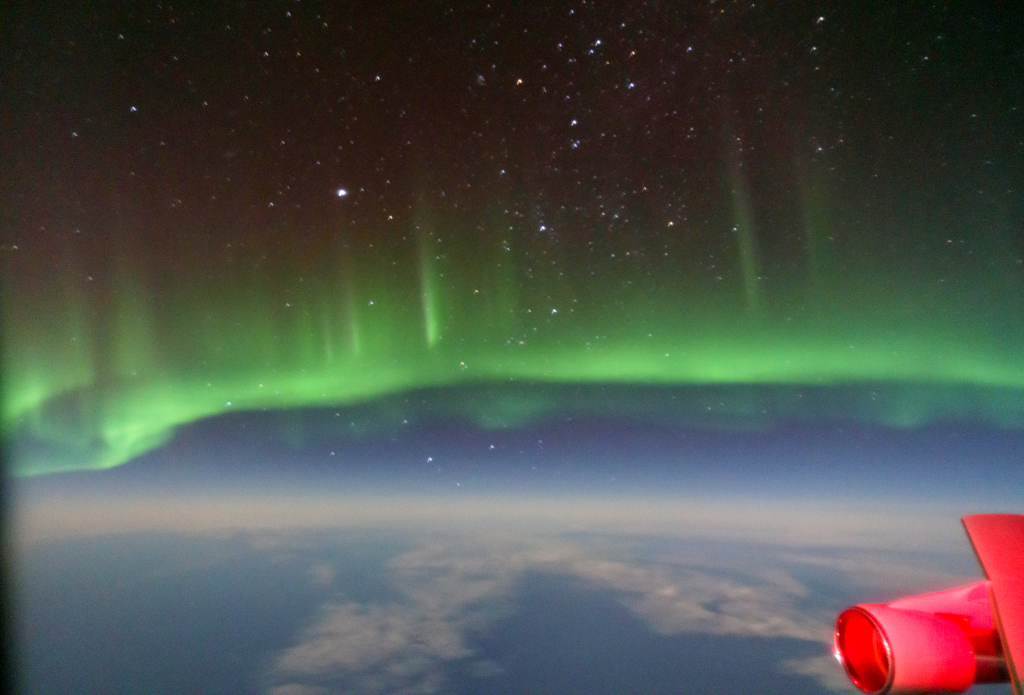
SOFIA, the Stratospheric Observatory for Infrared Astronomy, is a Boeing 747SP aircraft modified to carry a large reflecting telescope into the stratosphere. The ability of the airborne facility to climb above about 99 percent of Earth's infrared-blocking atmosphere has allowed researchers to observe from almost anywhere over the planet. On a science mission flying deep into the southern auroral oval, astronomer Ian Griffin, director of New Zealand’s Otago Museum, captured this view from the observatory's south facing starboard side on July 17. Bright star Canopus shines in the southern night above curtains of aurora australis, or southern lights. The plane was flying far south of New Zealand at the time at roughly 62 degrees southern latitude. Unfortunately, after a landing at Christchurch severe weather damaged SOFIA requiring repairs and the cancellation of the remainder of its final southern hemisphere deployment.
© Ian Griffin — used with the credit NASA publishes
2021
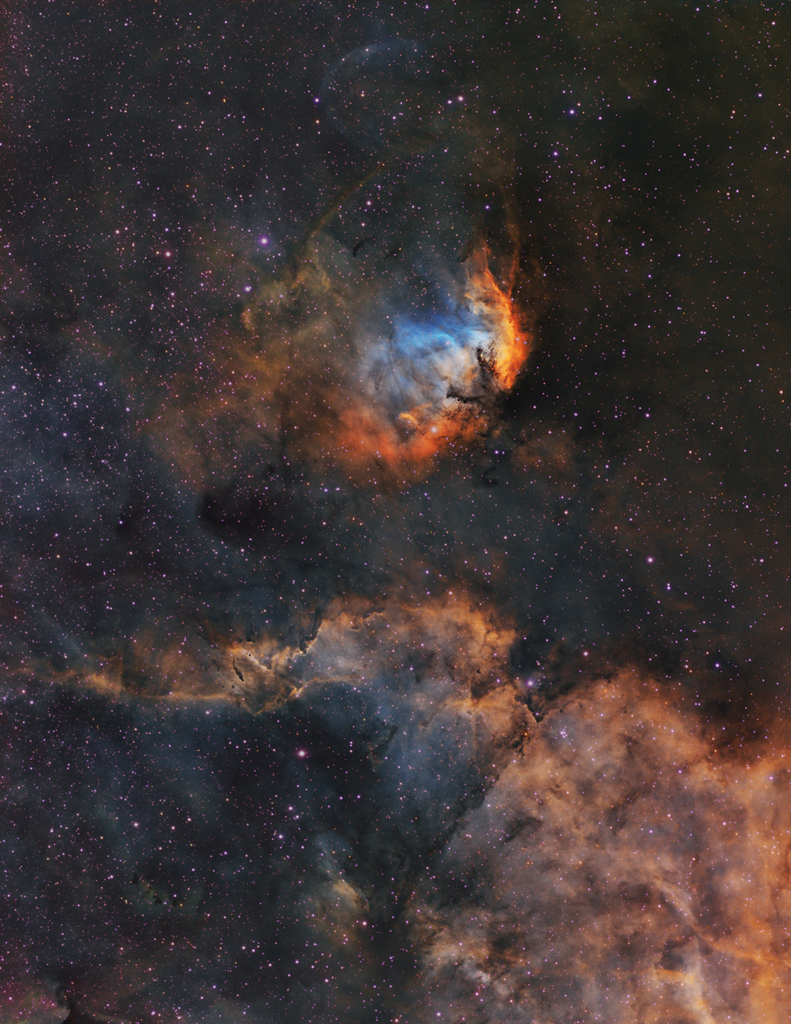
This tall telescopic field of view looks out along the plane of our Milky Way Galaxy toward the nebula rich constellation Cygnus the Swan. Popularly called the Tulip Nebula, the brightest glowing cloud of interstellar gas and dust above center is also found in the 1959 catalog by astronomer Stewart Sharpless as Sh2-101. Nearly 70 light-years across the complex and beautiful Tulip Nebula blossoms about 8,000 light-years away, shown in a Hubble palette image that maps the glow of the nebula's sulfur, hydrogen, and oxygen ions into red, green, and blue colors. Ultraviolet radiation from young energetic stars at the edge of the Cygnus OB3 association, including O star HDE 227018, ionizes the atoms and powers the emission from the Tulip Nebula. Also in the field of view is microquasar Cygnus X-1, one of the strongest X-ray sources in planet Earth's sky. Driven by powerful jets from a black hole accretion disk, its fainter bluish curved shock front is only just visible though, directly above the cosmic Tulip's petals near the top of the frame.
© Carlos Uriarte — used with the credit NASA publishes


1958
U.S. President Dwight D. Eisenhower signs into law the National Aeronautics and Space Act, which creates the National Aeronautics and Space Administration (NASA).
Dwight D. Eisenhower ↗
1985
Space Shuttle Challenger launches on STS-51-F. The shuttle ends up in a lower orbit than planned due to an engine failure during ascent.
Space Shuttle Challenger ↗

2021
The International Space Station temporarily spins out of control, moving the ISS 45 degrees out of attitude, following an engine malfunction of Russian module Nauka.
International Space Station ↗Event text and thumbnails come from Wikipedia and are used under CC BY-SA 4.0. Images are drawn only from Wikimedia Commons, which does not accept non-free content — each thumbnail links to its file page, where its licence and author are recorded.
Launch records are from The Space Devs’ Launch Library 2. Pictures are NASA’s Astronomy Picture of the Day; NASA imagery is generally not subject to copyright, but individual APOD entries are frequently the property of the photographer, and each caption says which applies.
General-audience astronomy and spaceflight — none of it a textbook.
As an Amazon Associate I earn from qualifying purchases. Links here cost you nothing extra.
LISTING
Still the best single argument for why any of this matters, and it leaves the arithmetic in. For a reader who wants the science, not just the awe.
LISTING
The case for leaving Earth, written by someone unsentimental about how hard that is. Suits readers who want the argument rather than the poster.
LISTING
Hard-SF problem solving in The Martian's key — for anyone who liked the engineering more than the peril. The only novel on this list.
BROWSE opens an Amazon search, not a specific recommendation.
LINKS AMAZON.COM