Launches
ON RECORD22MISSIONS
20 of them reached orbit. The earliest was 1958, the most recent 2026.
ARCHIVE // DAY OF YEAR
22 orbital launches flew on March 26, the earliest of them in 1958, and 20 reached orbit. Wikipedia records 2 spaceflight and astronomy events on March 26. Below are the pictures NASA published on March 26 in 5 different years — each one taken or released on this exact date.
22MISSIONS
20 of them reached orbit. The earliest was 1958, the most recent 2026.
2ENTRIES
Spaceflight and astronomy entries from Wikipedia's record of this date, oldest first — from 1954 onward.
5IMAGES
NASA's Astronomy Picture of the Day for March 26, one per year. Some are public domain and some belong to the photographer — each says which.
NASA’s Astronomy Picture of the Day, for this calendar date in each of the last several years.
2026
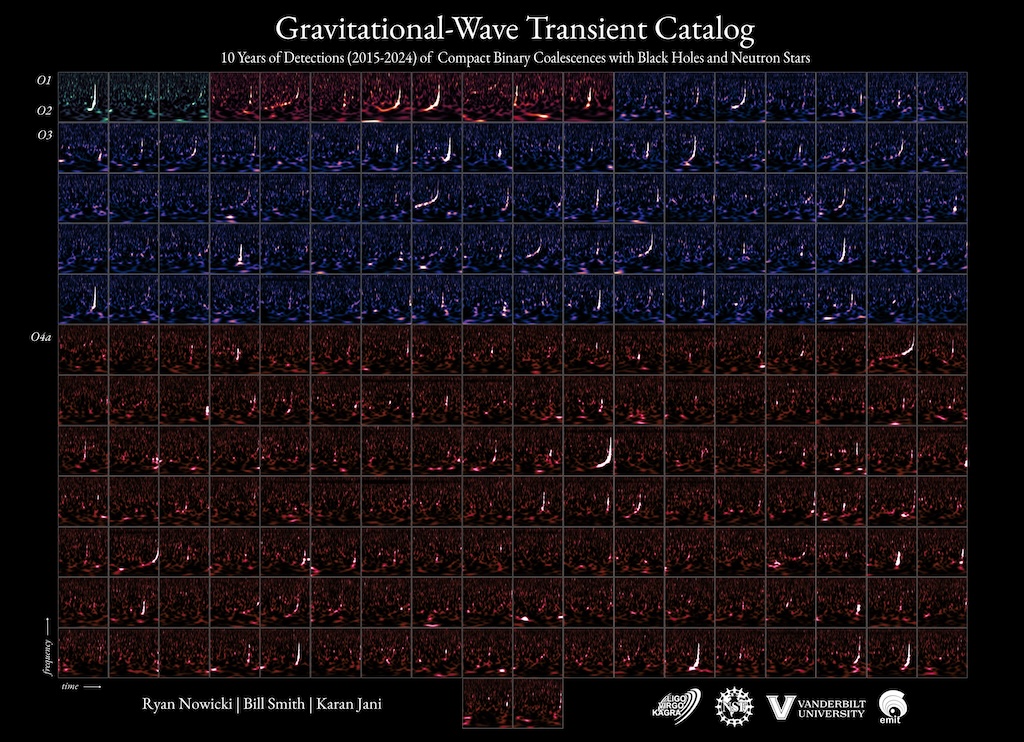
What is the sound of two black holes merging in deep space? Sound waves don't propagate in vacuum, but gravitational waves do. In 2015 we were able to "hear" them for the first time and confirm one of Albert Einstein's theoretical predictions. Each square on the grid of the featured image represents one of the gravitational wave detections announced so far by the LIGO-VIRGO-KAGRA Collaboration. These plots show how the binary pair accelerates in their orbit around each other towards merger: the rising frequency effect is called a "chirp". Although there are significantly more neutron stars than black holes, most of the detections are binary black hole mergers. That happens because black holes are heavier and their signals are louder and can be seen farther away, resulting in more detections. These events are rare, and we don't expect to see one close by in our Galaxy any time soon. But they are happening continuously throughout the cosmos.
NASA · public domain
2025
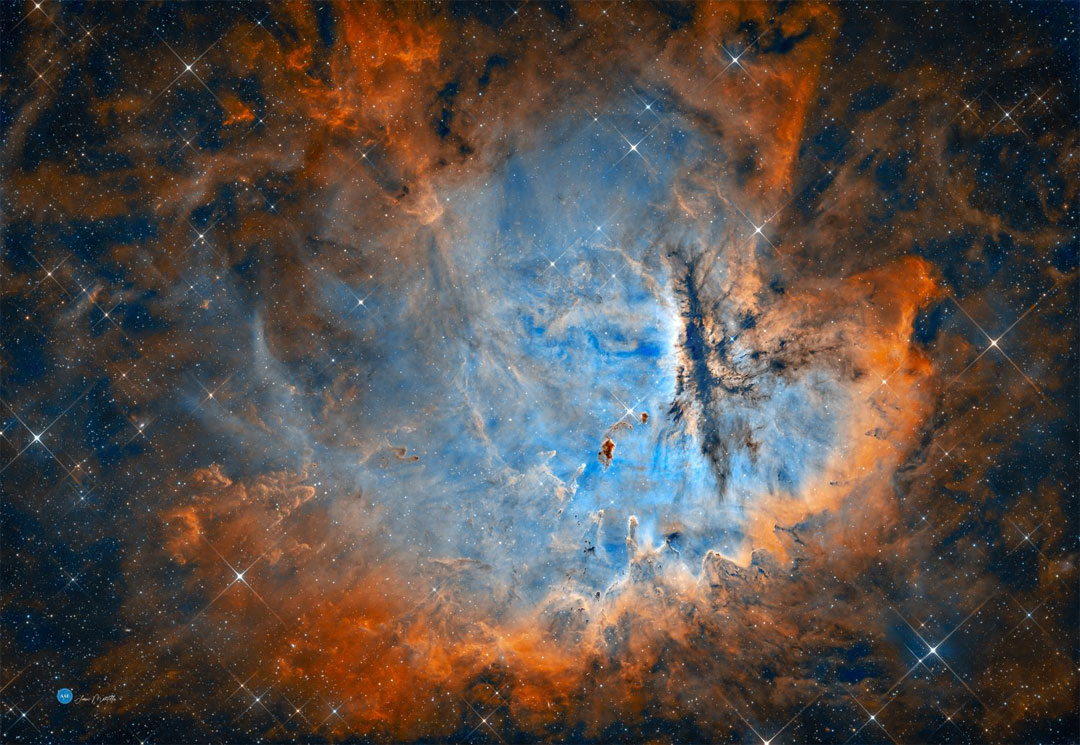
You'd think the Pacman Nebula would be eating stars, but actually it is forming them. Within the nebula, a cluster's young, massive stars are powering the pervasive nebular glow. The eye-catching shapes looming in the featured portrait of NGC 281 are sculpted dusty columns and dense Bok globules seen in silhouette, eroded by intense, energetic winds and radiation from the hot cluster stars. If they survive long enough, the dusty structures could also be sites of future star formation. Playfully called the Pacman Nebula because of its overall shape, NGC 281 is about 10,000 light-years away in the constellation Cassiopeia. This sharp composite image was made through narrow-band filters in Spain in mid 2024. It combines emissions from the nebula's hydrogen and oxygen atoms to synthesize red, green, and blue colors. The scene spans well over 80 light-years at the estimated distance of NGC 281.
© Juan Montilla (AAE) — used with the credit NASA publishes
2024
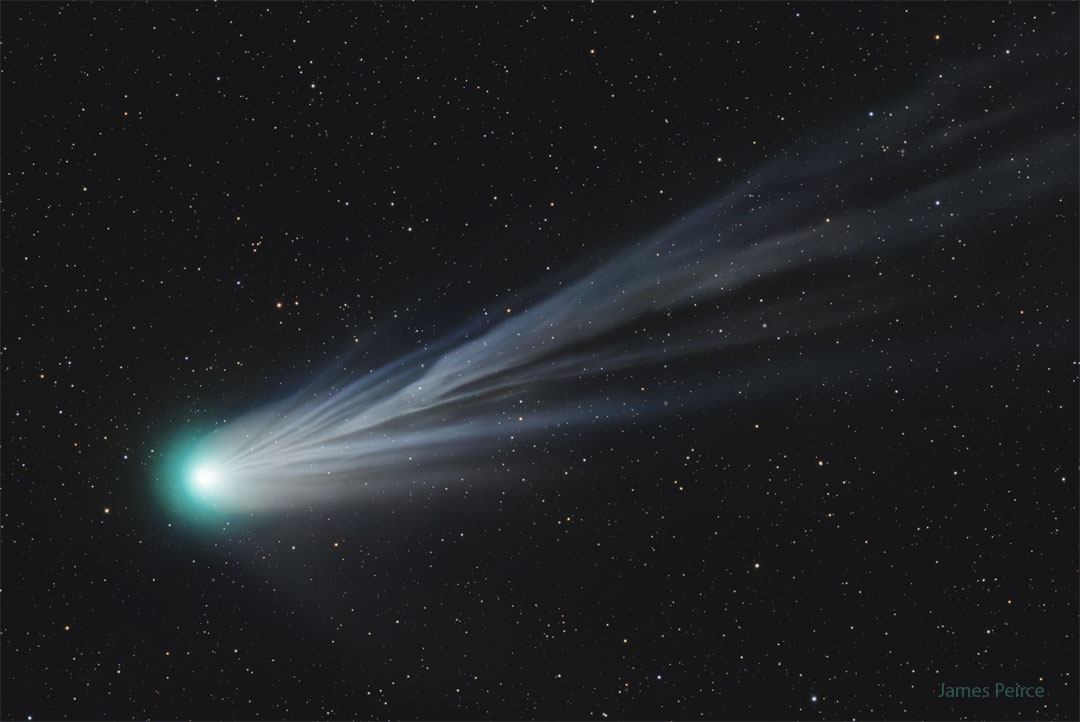
Comet Pons-Brooks has quite a tail to tell. First discovered in 1385, this erupting dirty snowball loops back into our inner Solar System every 71 years and, this time, is starting to put on a show for deep camera exposures. In the featured picture, the light blue stream is the ion tail which consists of charged molecules pushed away from the comet's nucleus by the solar wind. The ion tail, shaped by the Sun's wind and the comet's core's rotation, always points away from the Sun. Comet 12P/Pons–Brooks is now visible with binoculars in the early evening sky toward the northwest, moving perceptibly from night to night. The frequently flaring comet is expected to continue to brighten, on the average, and may even become visible with the unaided eye -- during the day -- to those in the path of totality of the coming solar eclipse on April 8.
NASA · public domain
2022
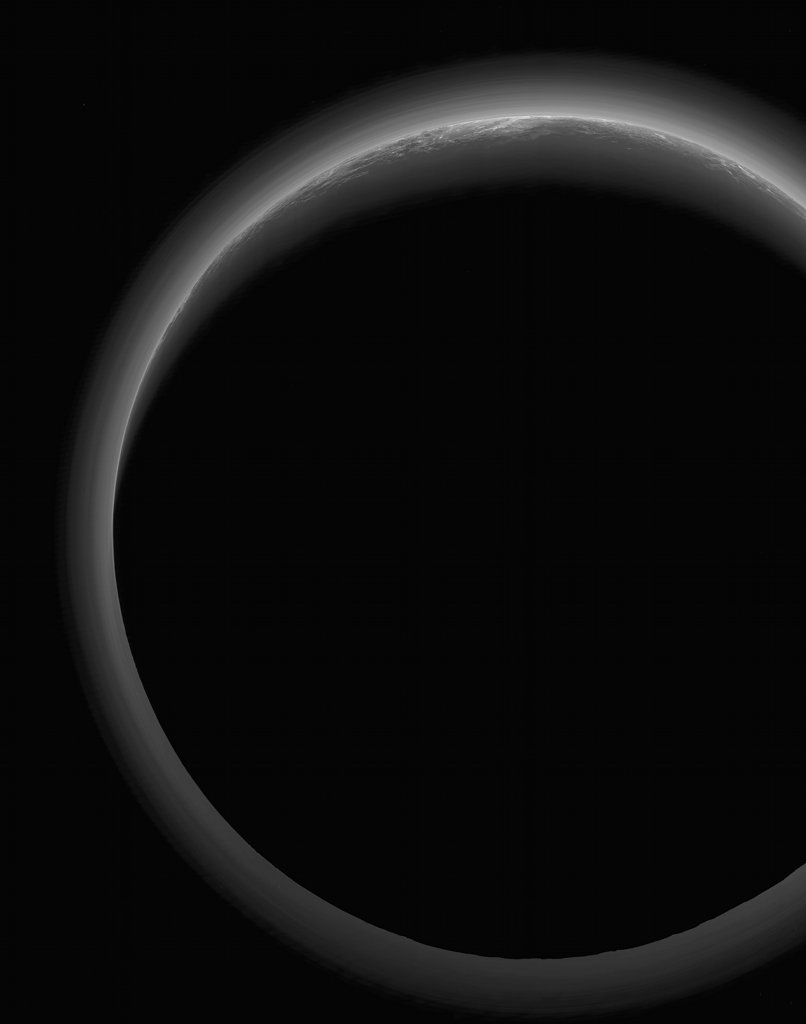
The night side of Pluto spans this shadowy scene. In the stunning spacebased perspective the Sun is 4.9 billion kilometers (almost 4.5 light-hours) behind the dim and distant world. It was captured by far flung New Horizons in July of 2015 when the spacecraft was at a range of some 21,000 kilometers from Pluto, about 19 minutes after its closest approach. A denizen of the Kuiper Belt in dramatic silhouette, the image also reveals Pluto's tenuous, surprisingly complex layers of hazy atmosphere. Near the top of the frame the crescent twilight landscape includes southern areas of nitrogen ice plains now formally known as Sputnik Planitia and rugged mountains of water-ice in the Norgay Montes.
NASA · public domain
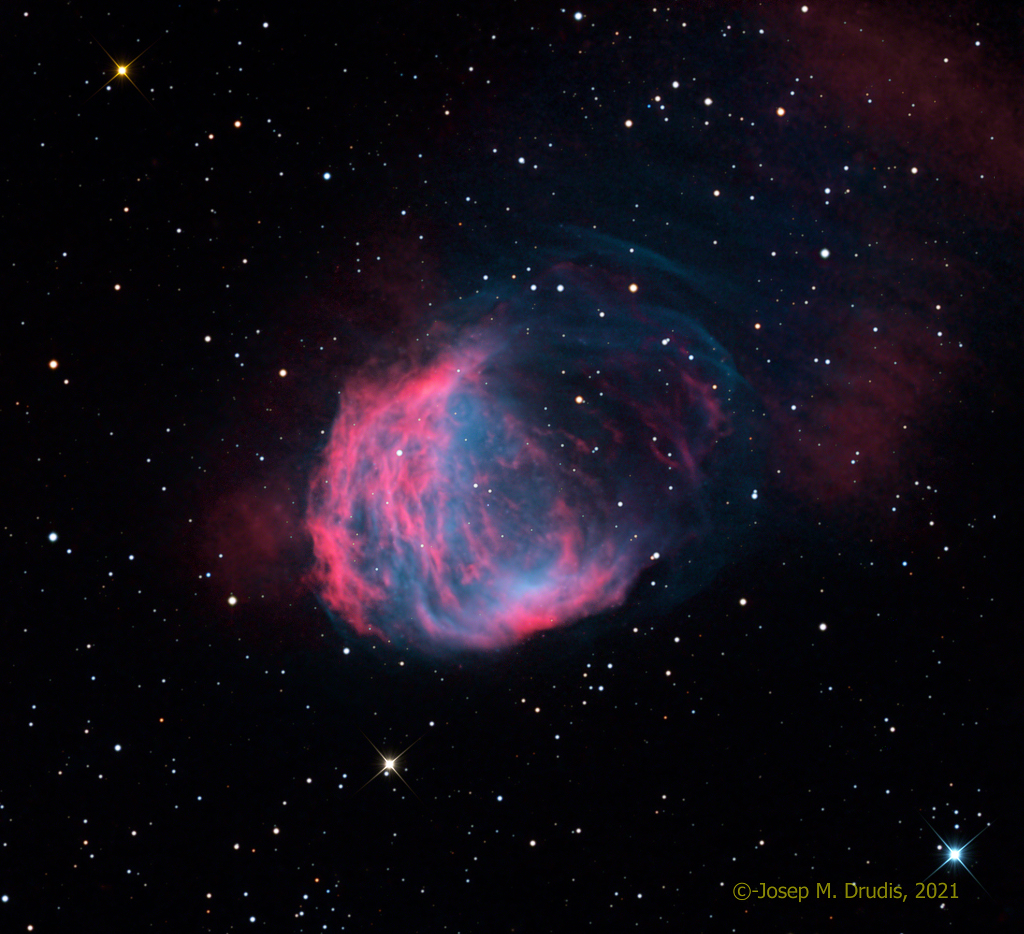
2021
Braided and serpentine filaments of glowing gas suggest this nebula's popular name, The Medusa Nebula. Also known as Abell 21, this Medusa is an old planetary nebula some 1,500 light-years away in the constellation Gemini. Like its mythological namesake, the nebula is associated with a dramatic transformation. The planetary nebula phase represents a final stage in the evolution of low mass stars like the sun as they transform themselves from red giants to hot white dwarf stars and in the process shrug off their outer layers. Ultraviolet radiation from the hot star powers the nebular glow. The Medusa's transforming star is the faint one near the center of the overall bright crescent shape. In this deep telescopic view, fainter filaments clearly extend above and right of the bright crescent region. The Medusa Nebula is estimated to be over 4 light-years across.
© Josep Drudis — used with the credit NASA publishes
1954
Nuclear weapons testing: The Romeo shot of Operation Castle is detonated at Bikini Atoll. Yield: 11 megatons.
Nuclear weapons testing ↗General-audience astronomy and spaceflight — none of it a textbook.
As an Amazon Associate I earn from qualifying purchases. Links here cost you nothing extra.
LISTING
Still the best single argument for why any of this matters, and it leaves the arithmetic in. For a reader who wants the science, not just the awe.
LISTING
The case for leaving Earth, written by someone unsentimental about how hard that is. Suits readers who want the argument rather than the poster.
LISTING
Hard-SF problem solving in The Martian's key — for anyone who liked the engineering more than the peril. The only novel on this list.
BROWSE opens an Amazon search, not a specific recommendation.
LINKS AMAZON.COM
Event text and thumbnails come from Wikipedia and are used under CC BY-SA 4.0. Images are drawn only from Wikimedia Commons, which does not accept non-free content — each thumbnail links to its file page, where its licence and author are recorded.
Launch records are from The Space Devs’ Launch Library 2. Pictures are NASA’s Astronomy Picture of the Day; NASA imagery is generally not subject to copyright, but individual APOD entries are frequently the property of the photographer, and each caption says which applies.