Launches
ON RECORD29MISSIONS
28 of them reached orbit. The earliest was 1967, the most recent 2026.
ARCHIVE // DAY OF YEAR
29 orbital launches flew on March 22, the earliest of them in 1967, and 28 reached orbit. Wikipedia records 6 spaceflight and astronomy events on March 22. Below are the pictures NASA published on March 22 in 4 different years — each one taken or released on this exact date.
29MISSIONS
28 of them reached orbit. The earliest was 1967, the most recent 2026.
6ENTRIES
Spaceflight and astronomy entries from Wikipedia's record of this date, oldest first — from 1982 onward.
4IMAGES
NASA's Astronomy Picture of the Day for March 22, one per year. Some are public domain and some belong to the photographer — each says which.
NASA’s Astronomy Picture of the Day, for this calendar date in each of the last several years.
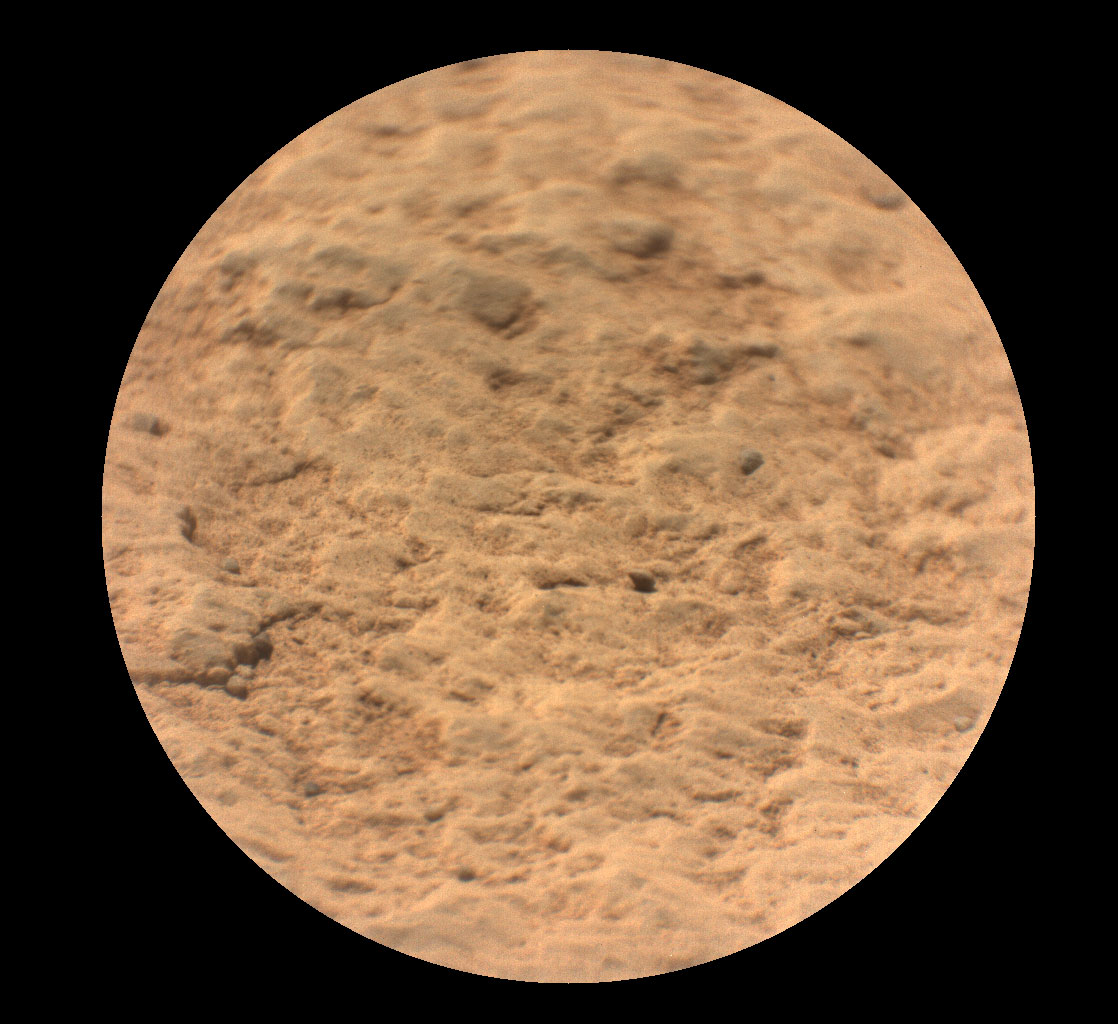
2025
What's the sound of one laser zapping? There's no need to consult a Zen master to find out, just listen to the first acoustic recording of laser shots on Mars. On Mars Rover Perseverance mission sol 12 (March 2, 2021) the SuperCam instrument atop the rover's mast zapped a rock dubbed Ma'az 30 times from a range of about 3.1 meters. Its microphone recorded the soft staccato popping sounds of the rapid series of SuperCam laser zaps. Shockwaves created in the thin Martian atmosphere as bits of rock are vaporized by the laser shots make the popping sounds, sounds that offer clues to the physical structure of the target. This SuperCam close-up of the Ma'az target region is 6 centimeters (2.3 inches) across. Ma'az means Mars in the Navajo language.
NASA · public domain
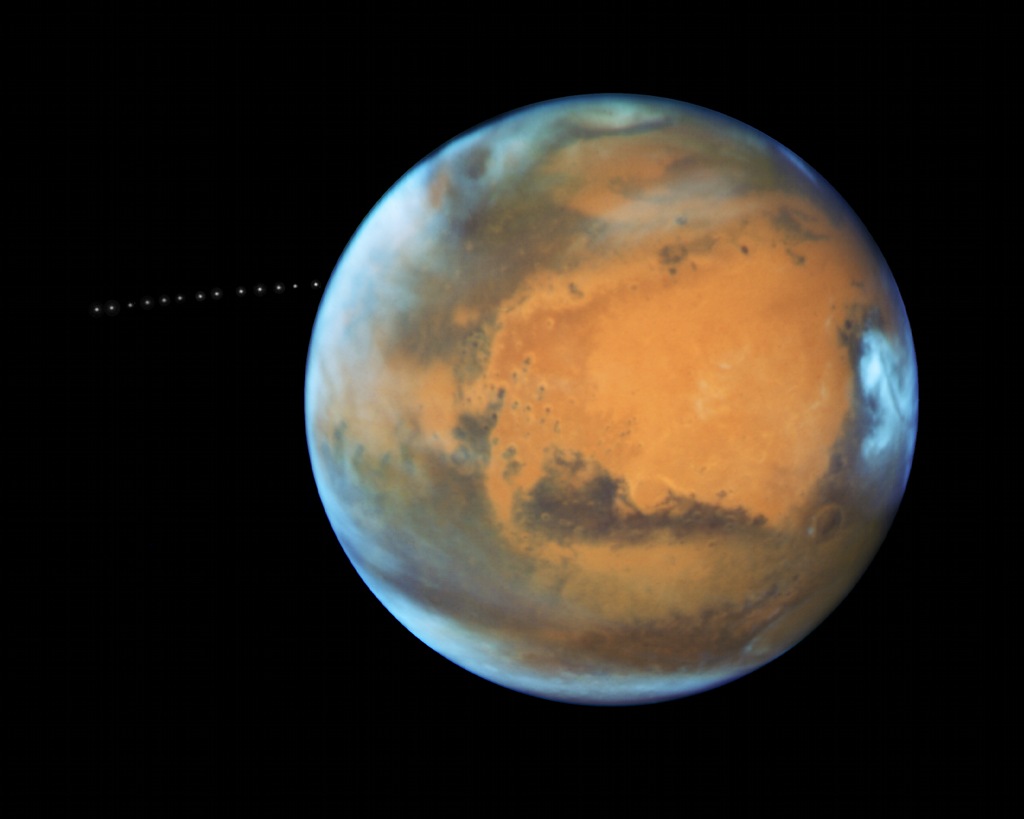
2024
A tiny moon with a scary name, Phobos emerges from behind the Red Planet in this timelapse sequence from the Earth-orbiting Hubble Space Telescope. Over 22 minutes the 13 separate exposures were captured near the 2016 closest approach of Mars to planet Earth. Martians have to look to the west to watch Phobos rise, though. The small moon is closer to its parent planet than any other moon in the Solar System, about 3,700 miles (6,000 kilometers) above the Martian surface. It completes one orbit in just 7 hours and 39 minutes. That's faster than a Mars rotation, which corresponds to about 24 hours and 40 minutes. As a result, seen from the surface of Mars speeding Phobos rises above the western horizon 2 times in a Martian day. Still, Phobos is doomed.
NASA · public domain
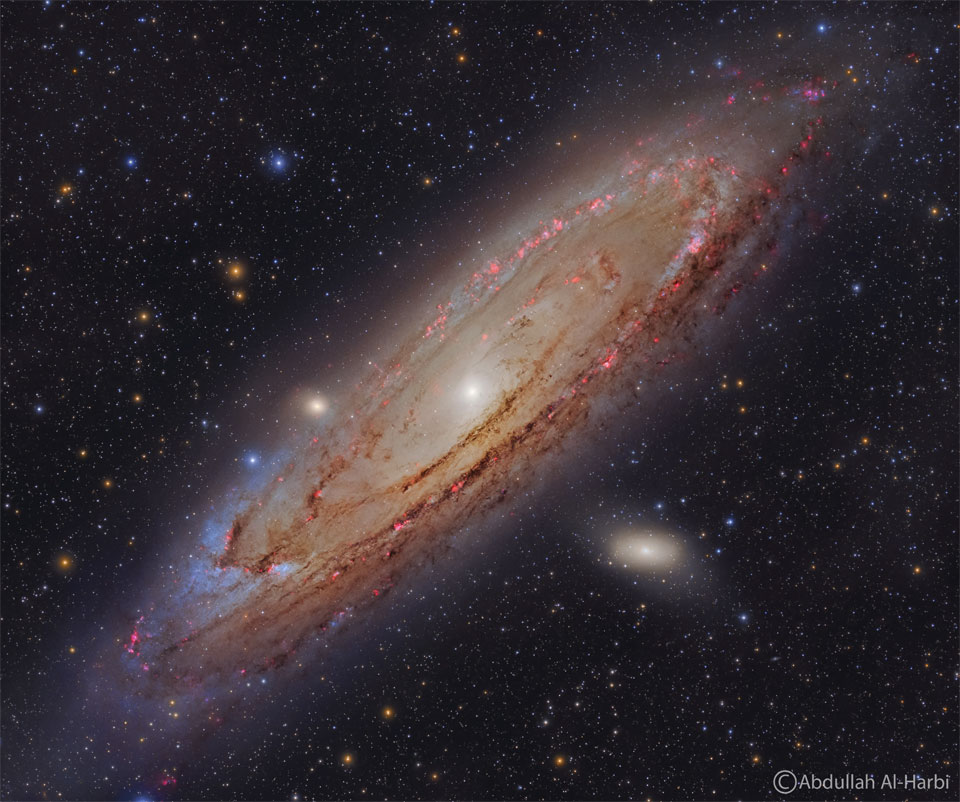
2023
How far can you see? The most distant object easily visible to the unaided eye is M31, the great Andromeda Galaxy, over two million light-years away. Without a telescope, even this immense spiral galaxy appears as an unremarkable, faint, nebulous cloud in the constellation Andromeda. But a bright white nucleus, dark winding dust lanes, luminous blue spiral arms, and bright red emission nebulas are recorded in this stunning fifteen-hour telescopic digital mosaic of our closest major galactic neighbor. But how do we know this spiral nebula is really so far away? This question was central to the famous Shapley-Curtis debate of 1920. M31's great distance was determined in the 1920s by observations that resolved individual stars that changed their brightness in a way that gave up their true distance. The result proved that Andromeda is just like our Milky Way Galaxy -- a conclusion making the rest of the universe much more vast than had ever been previously imagined.
© Abdullah Al-Harbi — used with the credit NASA publishes
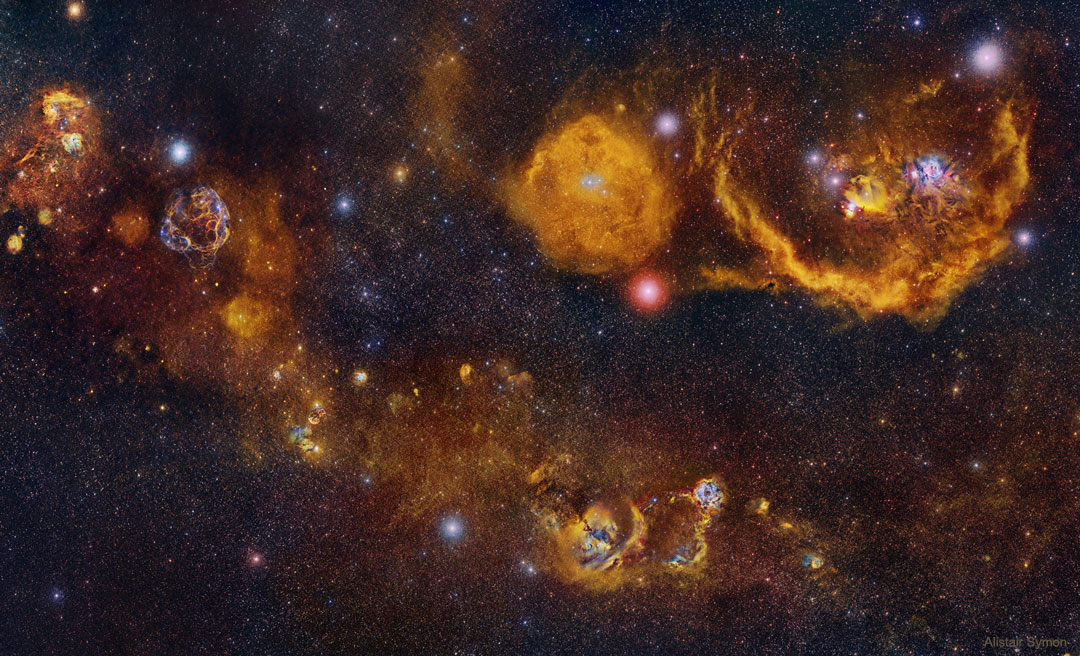
2021
What's up in the sky from Auriga to Orion? Many of the famous stars and nebulas in this region were captured on 34 separate images, taking over 430 hours of exposure, and digitally combined to reveal the featured image. Starting on the far upper left, toward the constellation of Auriga (the Chariot driver), is the picturesque Flaming Star Nebula (IC 405). Continuing down along the bright arc of our Milky Way Galaxy, from left to right crossing the constellations of the Twins and the Bull, notable appearing nebulas include the Tadpole, Simeis 147, Monkey Head, Jellyfish, Cone and Rosette nebulas. In the upper right quadrant of the image, toward the constellation of Orion (the hunter), you can see Sh2-264, the half-circle of Barnard's Loop, and the Horsehead and Orion nebulas. Famous stars in and around Orion include, from left to right, orange Betelgeuse (just right of the image center), blue Bellatrix (just above it), the Orion belt stars of Mintaka, Alnilam, and Alnitak, while bright Rigel appears on the far upper right. This stretch of sky won't be remaining up in the night very long -- it will be setting continually earlier in the evening as mid-year approaches.
© Alistair Symon — used with the credit NASA publishes
1982
NASA's Space Shuttle Columbia is launched from the Kennedy Space Center on its third mission, STS-3.
NASA ↗1995
Russian cosmonaut Valeri Polyakov returned from the space station Mir aboard Soyuz TM-20 after 437 days in space, setting a record for the longest spaceflight.
Astronaut ↗1995
Cosmonaut Valeri Polyakov returns to earth after setting a record of 438 days in space.
Astronaut ↗General-audience astronomy and spaceflight — none of it a textbook.
As an Amazon Associate I earn from qualifying purchases. Links here cost you nothing extra.
LISTING
Still the best single argument for why any of this matters, and it leaves the arithmetic in. For a reader who wants the science, not just the awe.
LISTING
The case for leaving Earth, written by someone unsentimental about how hard that is. Suits readers who want the argument rather than the poster.
LISTING
Hard-SF problem solving in The Martian's key — for anyone who liked the engineering more than the peril. The only novel on this list.
BROWSE opens an Amazon search, not a specific recommendation.
LINKS AMAZON.COM
Event text and thumbnails come from Wikipedia and are used under CC BY-SA 4.0. Images are drawn only from Wikimedia Commons, which does not accept non-free content — each thumbnail links to its file page, where its licence and author are recorded.
Launch records are from The Space Devs’ Launch Library 2. Pictures are NASA’s Astronomy Picture of the Day; NASA imagery is generally not subject to copyright, but individual APOD entries are frequently the property of the photographer, and each caption says which applies.