Launches
ON RECORD24MISSIONS
24 of them reached orbit. The earliest was 1962, the most recent 2026.
ARCHIVE // DAY OF YEAR
24 orbital launches flew on February 27, the earliest of them in 1962, and 24 reached orbit. Below are the pictures NASA published on February 27 in 6 different years — each one taken or released on this exact date.
24MISSIONS
24 of them reached orbit. The earliest was 1962, the most recent 2026.
0ENTRIES
Wikipedia records no spaceflight or astronomy event on this date.
6IMAGES
NASA's Astronomy Picture of the Day for February 27, one per year. Some are public domain and some belong to the photographer — each says which.
NASA’s Astronomy Picture of the Day, for this calendar date in each of the last several years.

2026
Normally faint and elusive, the Jellyfish Nebula is caught in this alluring telescopic field of view. Floating in the interstellar sea, the nebula is anchored right and left by two bright stars, Mu and Eta Geminorum, at the foot of the celestial twins. The Jellyfish Nebula itself is right of center, seen as a brighter arcing ridge of emission with dangling tentacles. In fact, this cosmic jellyfish is part of bubble-shaped supernova remnant IC 443, the expanding debris cloud from a massive star that exploded. Light from the explosion first reached planet Earth over 30,000 years ago. Like its cousin in astrophysical waters the Crab Nebula supernova remnant, the Jellyfish Nebula is known to harbor a neutron star, the ultradense remnant of the collapsed stellar core. An emission nebula cataloged as Sharpless 249 fills the field at the upper left. The Jellyfish Nebula is about 5,000 light-years away. At that distance, this image would be about 300 light-years across.
© Katelyn Beecroft — used with the credit NASA publishes

2025
Framed in this single, starry, telescopic field of view are two open star clusters, M35 and NGC 2158. Located within the boundaries of the constellation Gemini, they do appear to be side by side. Its stars concentrated toward the upper right, M35 is relatively nearby, though. M35 (also cataloged as NGC 2168) is a mere 2800 light-years distant, with 400 or so stars spread out over a volume about 30 light-years across. Bright blue stars frequently distinguish younger open clusters like M35, whose age is estimated at 150 million years. At lower left, NGC 2158 is about four times more distant than M35 and much more compact, shining with the more yellowish light of a population of stars over 10 times older. In general, open star clusters are found along the plane of our Milky Way Galaxy. Loosely gravitationally bound, their member stars tend to be dispersed over billions of years as the open star clusters orbit the galactic center.
© Evan Tsai — used with the credit NASA publishes
2024
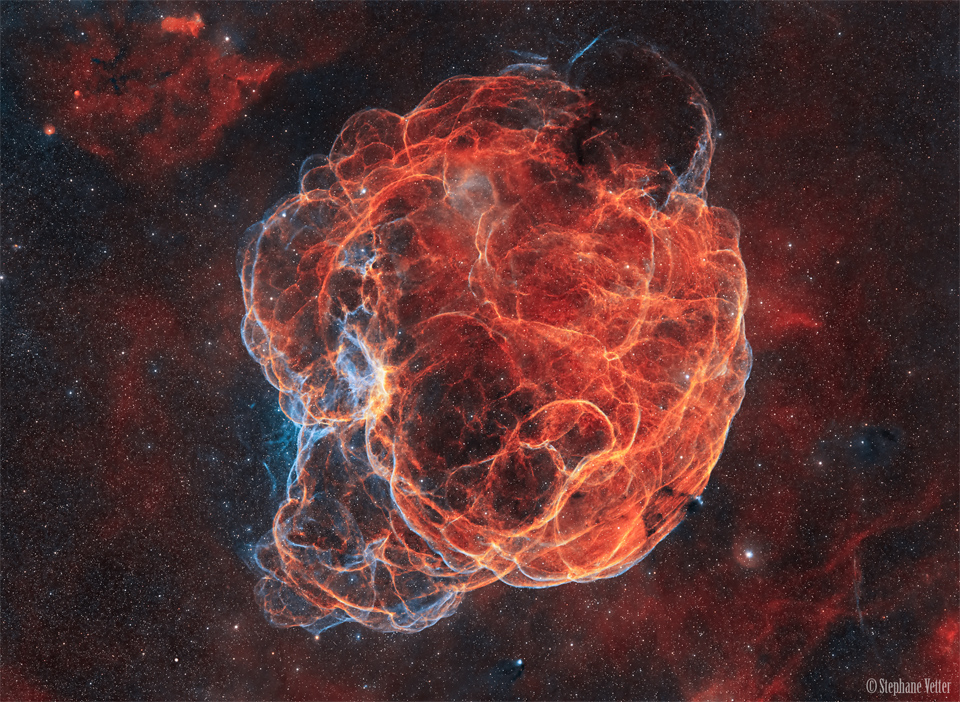
It's easy to get lost following the intricate, looping, and twisting filaments of supernova remnant Simeis 147. Also cataloged as Sharpless 2-240, the filamentary nebula goes by the popular nickname the Spaghetti Nebula. Seen toward the boundary of the constellations of the Bull (Taurus) and the Charioteer (Auriga), the impressive gas structure covers nearly 3 degrees on the sky, equivalent to 6 full moons. That's about 150 light-years at the stellar debris cloud's estimated distance of 3,000 light-years. This composite image includes data taken through narrow-band filters isolating emission from hydrogen (red) and oxygen (blue) glowing gas. The supernova remnant has an estimated age of about 40,000 years, meaning light from this massive stellar explosion first reached the Earth when woolly mammoths roamed free. Besides the expanding remnant, this cosmic catastrophe left behind a pulsar, a spinning neutron star that is the remnant of the original star's core.
© Stéphane Vetter (Nuits sacrées) — used with the credit NASA publishes
2023
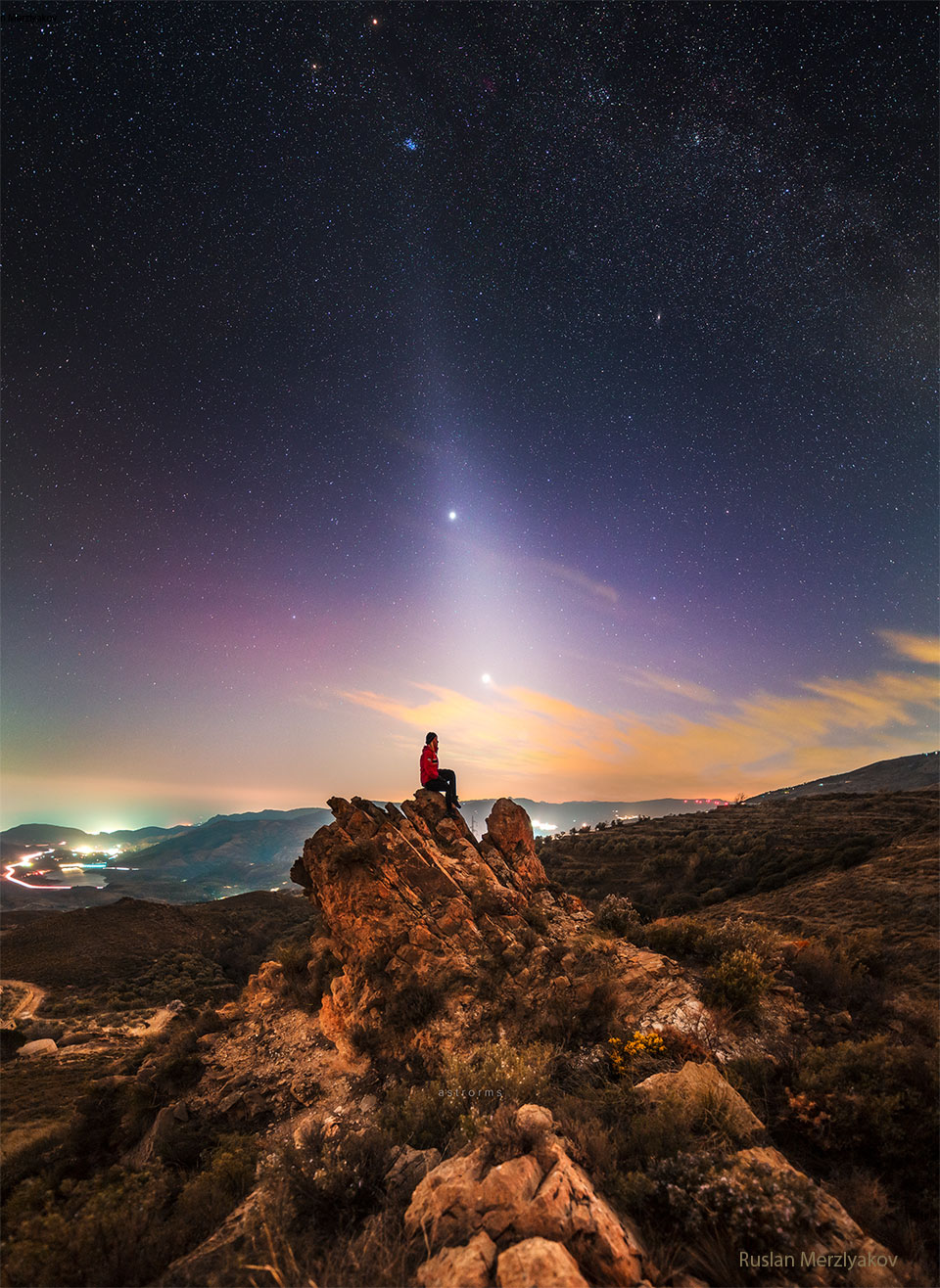
What's causing that unusual ray of light extending from the horizon? Dust orbiting the Sun. At certain times of the year, a band of sun-reflecting dust from the inner Solar System appears prominently after sunset or before sunrise and is called zodiacal light. The dust was emitted mostly from faint Jupiter-family comets and slowly spirals into the Sun. The featured HDR image, acquired in mid-February from the Sierra Nevada National Park in Spain, captures the glowing band of zodiacal light going right in front of the bright evening planets Jupiter (upper) and Venus (lower). Emitted from well behind the zodiacal light is a dark night sky that prominently includes the Pleiades star cluster. Jupiter and Venus are slowly switching places in the evening sky, and just in the next few days nearing their closest angular approach.
© Ruslan Merzlyakov (astrorms) — used with the credit NASA publishes
2022
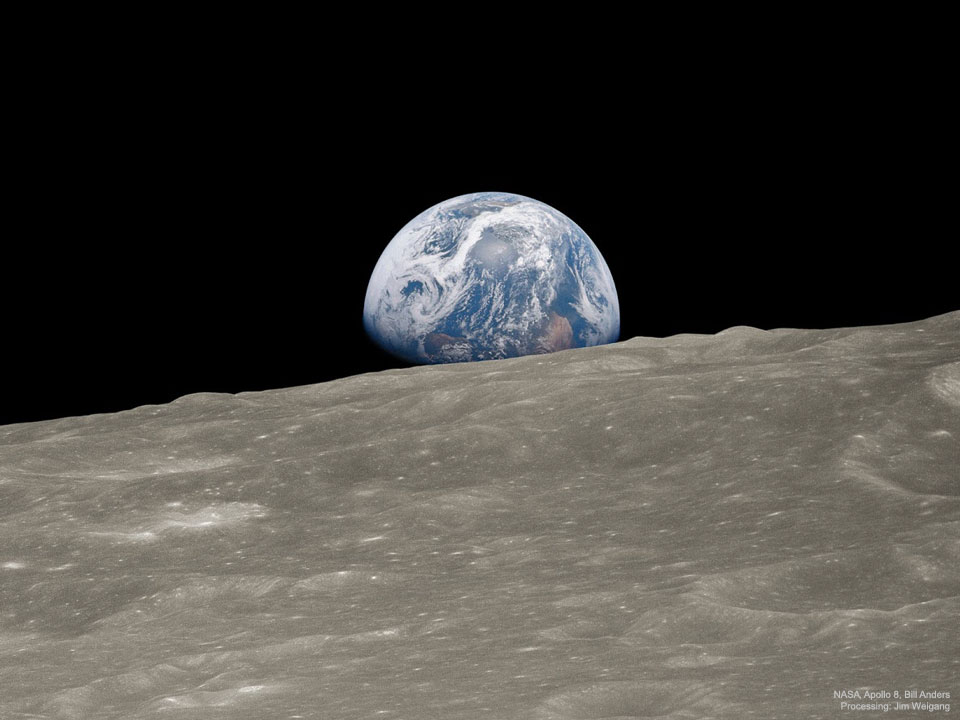
"Oh my God! Look at that picture over there! Here's the Earth coming up. Wow is that pretty!" Soon after that pronouncement, about 53 years ago, one of the most famous images ever taken was snapped from the orbit of the Moon. Now known as "Earthrise", the iconic image shows the Earth rising above the limb of the Moon, as taken by the crew of Apollo 8. But the well-known Earthrise image was actually the second image taken of the Earth rising above the lunar limb -- it was just the first in color. With modern digital technology, however, the real first Earthrise image -- originally in black and white -- has now been remastered to have the combined resolution and color of the first three images. Behold! The featured image is a close-up of the picture that Apollo 8 astronaut Bill Anders was talking about. Thanks to modern technology and human ingenuity, now we can all see it. (Historical note: A different historic black & white image of the Earth setting behind the lunar limb was taken by the robotic Lunar Orbiter 1 two years earlier.)
NASA · public domain

2021
Seen from orbit a day after a dramatic arrival on the martian surface, the Perseverance landing site is identified in this high-resolution view from the Mars Reconnaissance Orbiter. The orbiter's camera image also reveals the location of the Mars 2020 mission descent stage, heat shield, and parachute and back shell that delivered Perseverance to the surface of Mars. Each annotated inset box spans 200 meters (650 feet) across the floor of Jezero Crater. Perseverance is located at the center of the pattern created by rocket exhaust as the descent stage hovered and lowered the rover to the surface. Following the sky crane maneuver, the descent stage itself flew away to crash at a safe distance from the rover, its final resting place indicated by a dark V-shaped debris pattern. Falling to the surface nearby after their separation in the landing sequence, heat shield, parachute and back shell locations are marked in the high-resolution image from Mars orbit.
NASA · public domain
General-audience astronomy and spaceflight — none of it a textbook.
As an Amazon Associate I earn from qualifying purchases. Links here cost you nothing extra.
LISTING
Still the best single argument for why any of this matters, and it leaves the arithmetic in. For a reader who wants the science, not just the awe.
LISTING
The case for leaving Earth, written by someone unsentimental about how hard that is. Suits readers who want the argument rather than the poster.
LISTING
Hard-SF problem solving in The Martian's key — for anyone who liked the engineering more than the peril. The only novel on this list.
BROWSE opens an Amazon search, not a specific recommendation.
LINKS AMAZON.COM
Event text and thumbnails come from Wikipedia and are used under CC BY-SA 4.0. Images are drawn only from Wikimedia Commons, which does not accept non-free content — each thumbnail links to its file page, where its licence and author are recorded.
Launch records are from The Space Devs’ Launch Library 2. Pictures are NASA’s Astronomy Picture of the Day; NASA imagery is generally not subject to copyright, but individual APOD entries are frequently the property of the photographer, and each caption says which applies.