Launches
ON RECORD18MISSIONS
16 of them reached orbit. The earliest was 1961, the most recent 2026.
ARCHIVE // DAY OF YEAR
18 orbital launches flew on February 16, the earliest of them in 1961, and 16 reached orbit. Wikipedia records 1 spaceflight and astronomy event on February 16. Below are the pictures NASA published on February 16 in 6 different years — each one taken or released on this exact date.
18MISSIONS
16 of them reached orbit. The earliest was 1961, the most recent 2026.
1ENTRY
Spaceflight and astronomy entries from Wikipedia's record of this date, oldest first — from 1961 onward.
6IMAGES
NASA's Astronomy Picture of the Day for February 16, one per year. Some are public domain and some belong to the photographer — each says which.
NASA’s Astronomy Picture of the Day, for this calendar date in each of the last several years.
2026
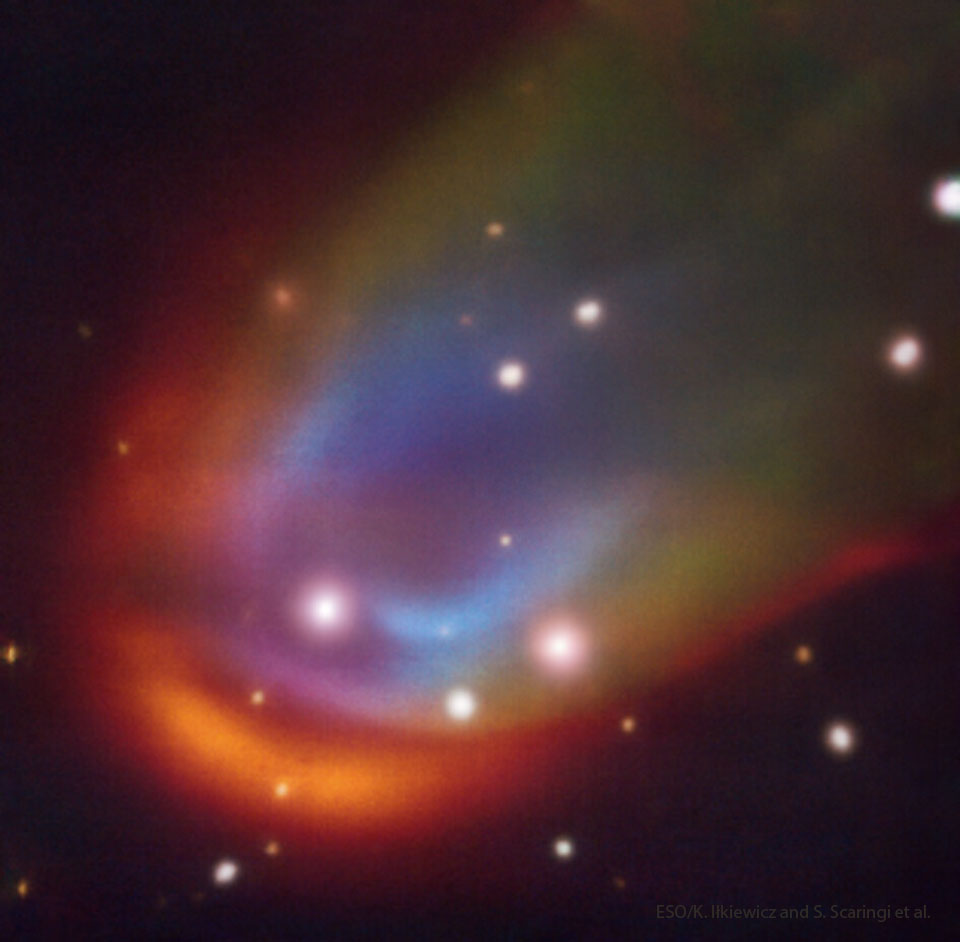
How is RXJ0528+2838 creating such shock waves? A recently discovered white dwarf star, the farther left of the two largest white spots, RXJ0528+2838, was found 730 light-years away from Earth. Most stars, when done fusing nuclei in their cores for energy, become red giant stars, the cores of which live on as faint dense white dwarfs that slowly cool down for the rest of time. White dwarfs are so dense that the only thing that stops them from collapsing further is quantum mechanics. In about 5 billion years, our Sun will become a white dwarf, too. The featured image, obtained with the European Southern Observatory’s Very Large Telescope, shows unexplained bow shocks around RXJ0528+2838, similar to the bow wave of water around a fast-moving ship. Astronomers don’t yet know what is powering these shocks, which have existed for at least 1,000 years. The red, green and blue colors represent trace amounts of glowing hydrogen, nitrogen and oxygen gas. Open Science: Browse 3,900+ codes in the Astrophysics Source Code Library
NASA · public domain

2025
Here comes Jupiter. NASA's robotic spacecraft Juno is continuing on its highly elongated orbits around our Solar System's largest planet. The featured video is from perijove 11 in early 2018, the eleventh time Juno passed near Jupiter since it arrived in mid-2016. This time-lapse, color-enhanced movie covers about four hours and morphs between 36 JunoCam images. The video begins with Jupiter rising as Juno approaches from the north. As Juno reaches its closest view -- from about 3,500 kilometers over Jupiter's cloud tops -- the spacecraft captures the great planet in tremendous detail. Juno passes light zones and dark belts of clouds that circle the planet, as well as numerous swirling circular storms, many of which are larger than hurricanes on Earth. After the perijove, Jupiter recedes into the distance, then displaying the unusual clouds that appear over Jupiter's south. To get desired science data, Juno swoops so close to Jupiter that its instruments are exposed to very high levels of radiation.
NASA · public domain
2024
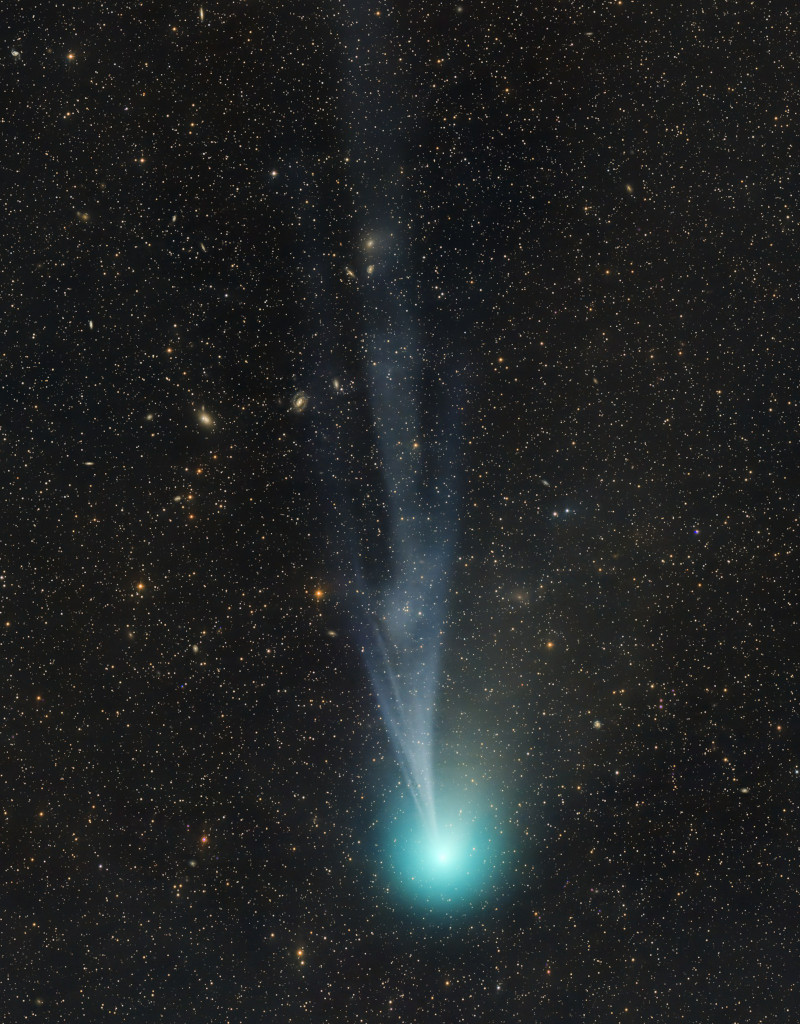
Heading for its next perihelion passage on April 21, Comet 12P/Pons-Brooks is growing brighter. The greenish coma of this periodic Halley-type comet has become relatively easy to observe in small telescopes. But the bluish ion tail now streaming from the active comet's coma and buffeted by the solar wind, is faint and difficult to follow. Still, in this image stacked exposures made on the night of February 11 reveal the fainter tail's detailed structures. The frame spans over two degrees across a background of faint stars and background galaxies toward the northern constellation Lacerta. Of course Comet 12P's April 21 perihelion passage will be only two weeks after the April 8 total solar eclipse, putting the comet in planet Earth's sky along with a totally eclipsed Sun.
© Dan Bartlett — used with the credit NASA publishes
2023
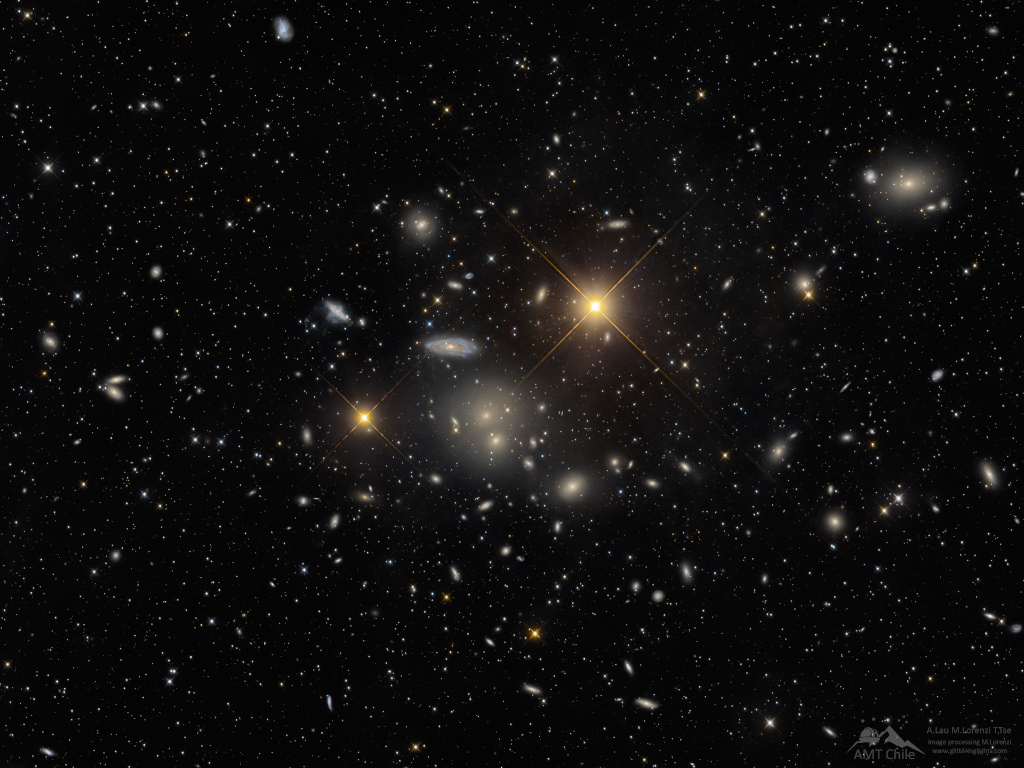
Once upon a midnight dreary, while I pondered weak and weary, O'er volumes of astronomy and forgotten lore, I stumbled upon this snapshot, cosmic and eerie, A sight that filled my heart with awe and more. Two stars, like sentinels, anchored the foreground, Of our Milky Way galaxy, a sight to behold, Beyond them, a cluster of Hydra, galaxies abound, 100 million light-years away, a story to be told. Three large galaxies, ellipticals and a spiral blue, Dominant and grand, each 150,000 light-years wide, But it was the overlapping pair that caught my view, Cataloged as NGC 3314, a sight I cannot hide. Abell 1060, the Hydra galaxy cluster's name, One of three large galaxy clusters close to our Milky Way, A universe bound by gravity, a celestial game, Where clusters align over larger scales, I cannot sway. At a distance of 100 million light-years, this snapshot's size, 1.3 million light-years across, a cosmic delight, A momentary glimpse into the universe's guise, But even this shall fade, and be nevermore in sight.
© Marco Lorenzi — used with the credit NASA publishes
2022
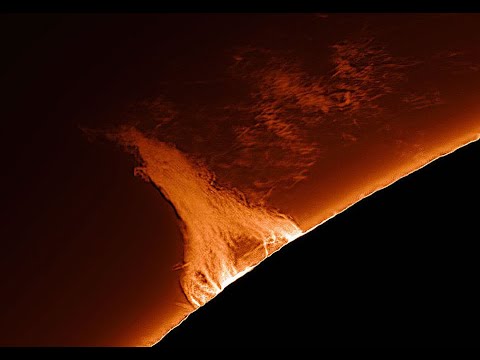
What's that on the Sun? Although it may look like a flowing version of the Eiffel Tower, it is a solar prominence that is actually much bigger -- about the height of Jupiter. The huge prominence emerged about ten days ago, hovered over the Sun's surface for about two days, and then erupted -- throwing a coronal mass ejection (CME) into the Solar System. The featured video, captured from the astrophotographer's backyard in Hendersonville, Tennessee, USA, shows an hour time-lapse played both forwards and backwards. That CME did not impact the Earth, but our Sun had unleashed other recent CMEs that not only triggered Earthly auroras, but puffed out the Earth's atmosphere enough to cause just-launched Starlink satellites to fall back. Activity on the Sun, including sunspots, prominences, CMEs and flares, continues to increase as the Sun evolves away from a deep minimum in its 11-year magnetic cycle. Birthday Surprise: What picture did APOD feature on your birthday? (post 1995)
© Hawk Wolinski — used with the credit NASA publishes

2021
How hard is it to land safely on Mars? So hard that many more attempts have failed than succeeded. The next attempt will be on Thursday. The main problem is that the Martian atmosphere is too thick to ignore -- or it will melt your spacecraft. On the other hand, the atmosphere is too thin to rely on parachutes -- or your spacecraft will crash land. Therefore, as outlined in the featured video, the Perseverance lander will lose much of its high speed by deploying a huge parachute, but then switch to rockets, and finally, assuming everything goes right, culminate with a hovering Sky Crane that will slowly lower the car-sized Perseverance rover to the surface with ropes. It may sound crazy, but the Curiosity rover was placed on Mars using a similar method in 2012. From atmospheric entry to surface touch-down takes about seven minutes, all coordinated by an onboard computer because Mars is too far away for rapid interactive communication. During this time, humans on Earth will simply wait to hear if the landing was successful. Last week, UAE's Hope spacecraft successfully began orbiting Mars, followed a day later by the Chinese Tianwen-1 mission, which will likely schedule a landing of its own rover sometime in the next few months. News: NASA Perseverance Coverage
NASA · public domain
General-audience astronomy and spaceflight — none of it a textbook.
As an Amazon Associate I earn from qualifying purchases. Links here cost you nothing extra.
LISTING
Still the best single argument for why any of this matters, and it leaves the arithmetic in. For a reader who wants the science, not just the awe.
LISTING
The case for leaving Earth, written by someone unsentimental about how hard that is. Suits readers who want the argument rather than the poster.
LISTING
Hard-SF problem solving in The Martian's key — for anyone who liked the engineering more than the peril. The only novel on this list.
BROWSE opens an Amazon search, not a specific recommendation.
LINKS AMAZON.COM
Event text and thumbnails come from Wikipedia and are used under CC BY-SA 4.0. Images are drawn only from Wikimedia Commons, which does not accept non-free content — each thumbnail links to its file page, where its licence and author are recorded.
Launch records are from The Space Devs’ Launch Library 2. Pictures are NASA’s Astronomy Picture of the Day; NASA imagery is generally not subject to copyright, but individual APOD entries are frequently the property of the photographer, and each caption says which applies.