Launches
ON RECORD22MISSIONS
18 of them reached orbit. The earliest was 1964, the most recent 2026.
MARKED ON THIS DATE
2004 · 22 years ago today
Opportunity lands at Meridiani
Opportunity bounced to a stop inside a small crater on Meridiani Planum and found rock laid down in water.
read moreARCHIVE // DAY OF YEAR
22 orbital launches flew on January 25, the earliest of them in 1964, and 18 reached orbit. Wikipedia records 7 spaceflight and astronomy events on January 25. Below are the pictures NASA published on January 25 in 5 different years — each one taken or released on this exact date.
22MISSIONS
18 of them reached orbit. The earliest was 1964, the most recent 2026.
7ENTRIES
Spaceflight and astronomy entries from Wikipedia's record of this date, oldest first — from 1993 onward.
5IMAGES
NASA's Astronomy Picture of the Day for January 25, one per year. Some are public domain and some belong to the photographer — each says which.
NASA’s Astronomy Picture of the Day, for this calendar date in each of the last several years.
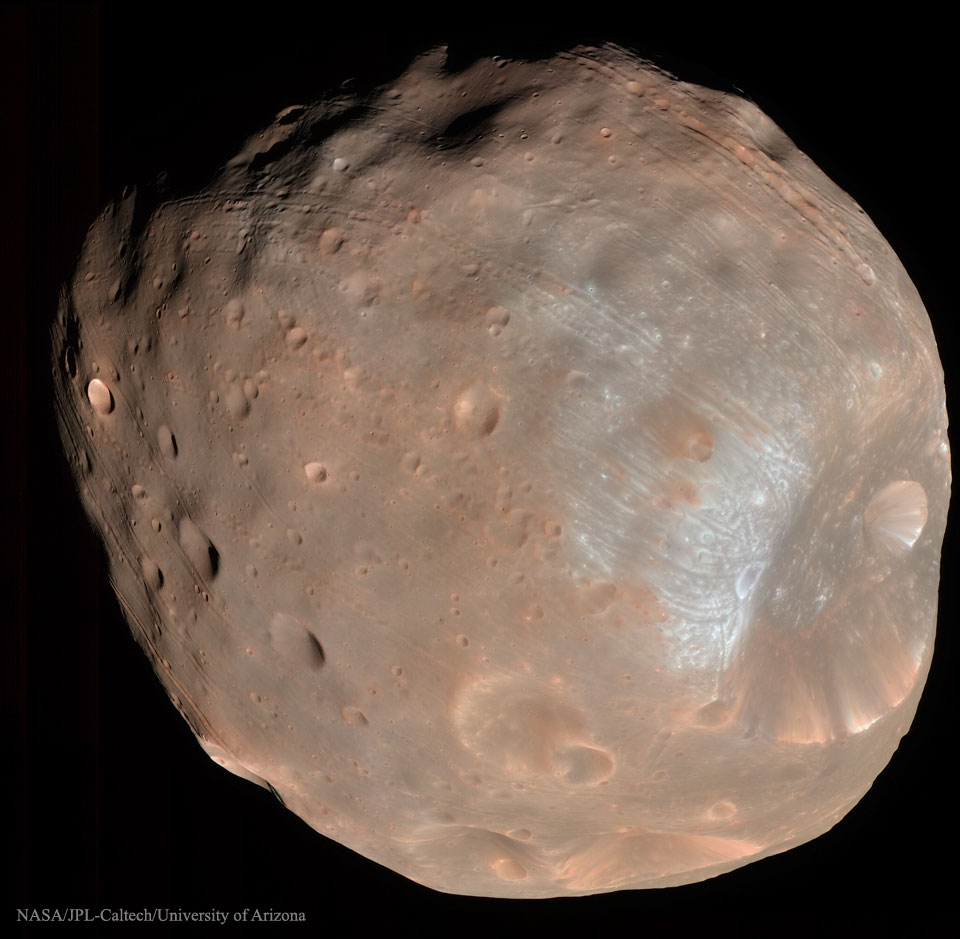
2026
This moon is doomed. Mars, the red planet named for the Roman god of war, has two tiny moons, Phobos and Deimos, whose names are derived from the Greek for Fear and Panic. These Martian moons may well be captured asteroids originating in the main asteroid belt between Mars and Jupiter or perhaps from even more distant reaches of our Solar System. The larger moon, Phobos, is indeed seen to be a cratered, asteroid-like object in this stunning color image from the robotic Mars Reconnaissance Orbiter, which can image objects as small as 10 meters. But Phobos orbits so close to Mars - about 5,800 kilometers above the surface compared to 400,000 kilometers for our Moon - that gravitational tidal forces are dragging it down. In perhaps 50 million years, Phobos is expected to disintegrate into a ring of debris.
NASA · public domain

2025
Clouds of stardust drift through this deep skyscape, across the Perseus molecular cloud some 850 light-years away. Dusty nebulae reflecting light from embedded young stars stand out in the nearly 4 degree wide field of view. With a characteristic bluish color reflection nebula NGC 1333 is prominent near center. Hints of contrasting red emission from Herbig-Haro objects, the jets and shocked glowing gas emanating from recently formed stars, are scattered across the dusty expanse. While many stars are forming in the molecular cloud, most are obscured at visible wavelengths by the pervasive dust. The chaotic environment surrounding NGC 1333 may be similar to one in which our own Sun formed over 4.5 billion years ago. At the estimated distance of the Perseus molecular cloud, this cosmic scene would span about 80 light-years. Growing Gallery: Comet ATLAS (G3)
© Jeff Schilling — used with the credit NASA publishes
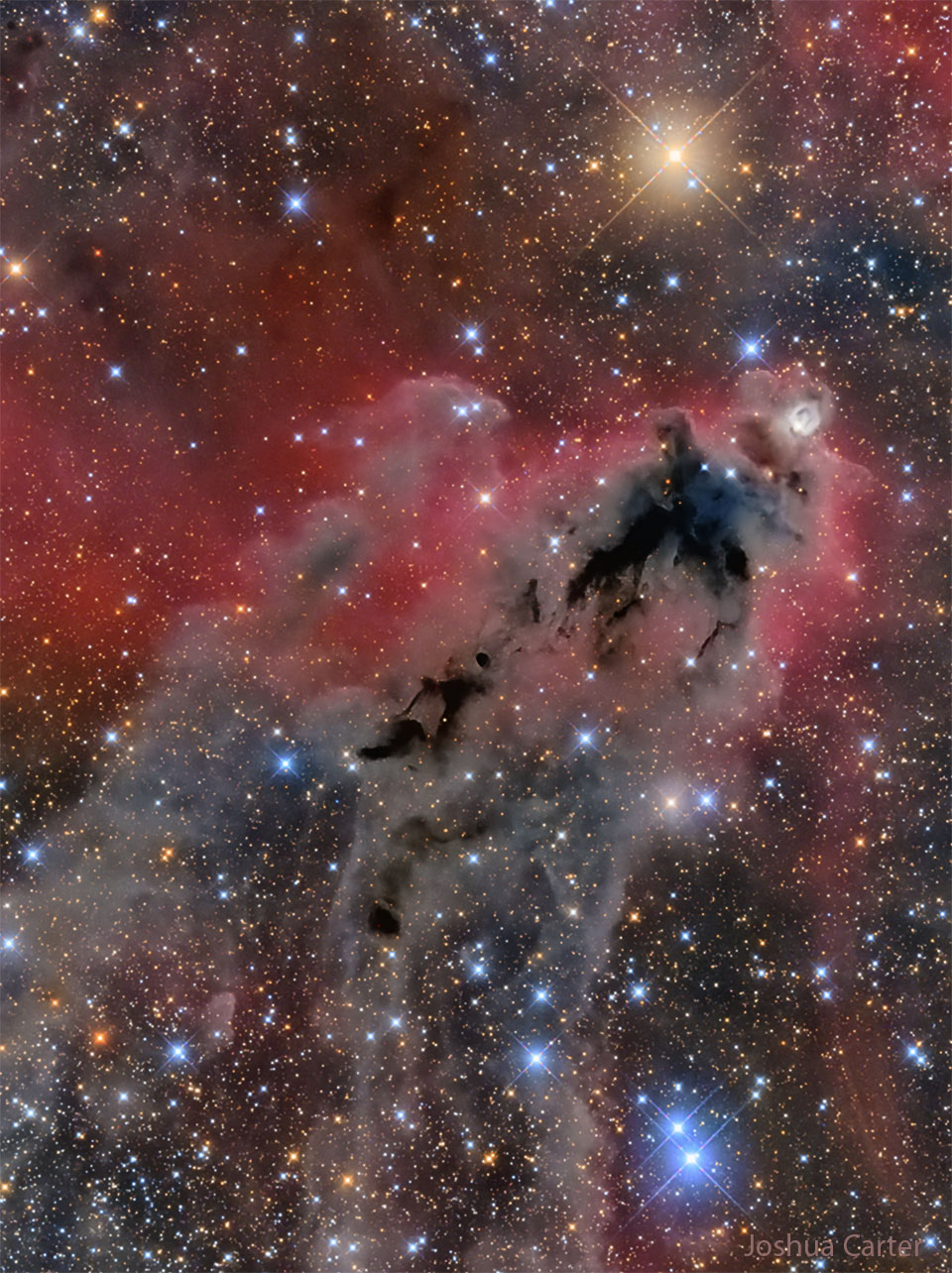
2023
To some, the dark shape looks like a mythical boogeyman. Scientifically, Lynds' Dark Nebula (LDN) 1622 appears against a faint background of glowing hydrogen gas only visible in long telescopic exposures of the region. In contrast, the brighter reflection nebula vdB 62 is more easily seen just above and to the right of center in the featured image. LDN 1622 lies near the plane of our Milky Way Galaxy, close on the sky to Barnard's Loop, a large cloud surrounding the rich complex of emission nebulae found in the Belt and Sword of Orion. With swept-back outlines, the obscuring dust of LDN 1622 is thought to lie at a similar distance, perhaps 1,500 light-years away. At that distance, this 2-degree wide field of view would span about 60 light-years. Young stars do lie hidden within the dark expanse and have been revealed in Spitzer Space Telescope infrared images.
© Joshua Carter — used with the credit NASA publishes
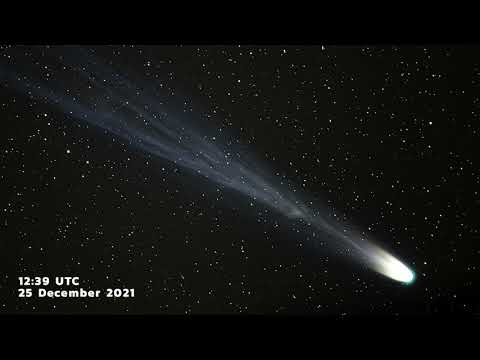
2022
Which direction is this comet heading? Judging by the tail, one might imagine that Comet Leonard is traveling towards the bottom right, but a full 3D analysis shows it traveling almost directly away from the camera. With this perspective, the dust tail is trailed towards the camera and can only be seen as a short yellow-white glow near the head of the comet. The bluish ion tail, however, is made up of escaping ions that are forced directly away from the Sun by the solar wind -- but channeled along the Sun's magnetic field lines. The Sun's magnetic field is quite complex, however, and occasionally solar magnetic reconnection will break the ion tail into knots that are pushed away from the Sun. One such knot is visible in the featured one-hour time-lapse video captured in late December from Thailand. Comet Leonard is now fading as it heads out of our Solar System. Gallery: Notable images submitted to APOD of Comet Leonard in 2021
© Matipon Tangmatitham (NARIT); Text: Matipon Tangmatitham — used with the credit NASA publishes
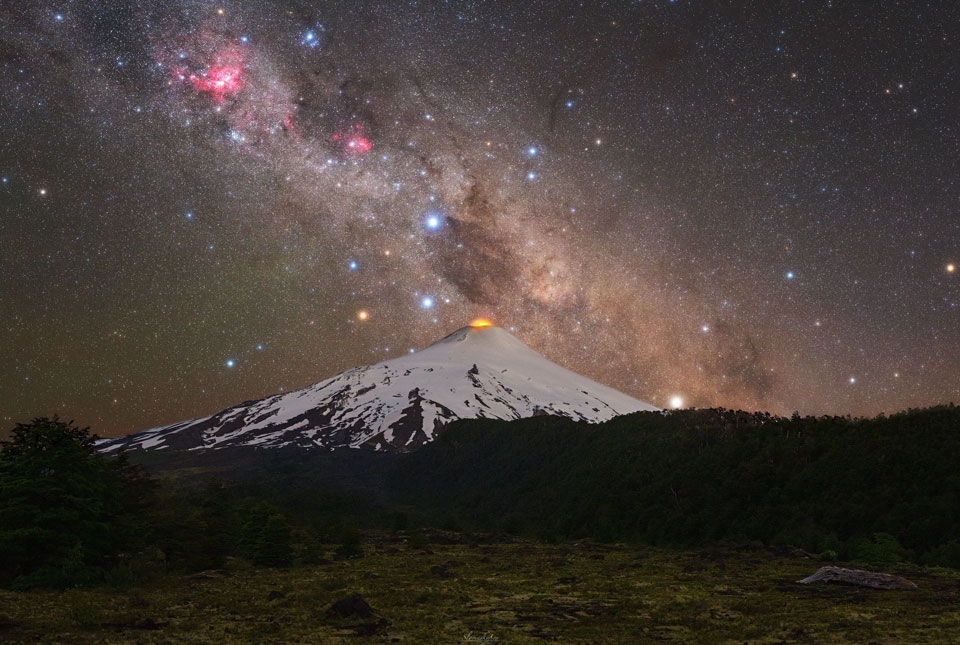
2021
Have you ever seen the Southern Cross? This famous four-star icon is best seen from Earth's Southern Hemisphere. The featured image was taken last month in Chile and captures the Southern Cross just to the left of erupting Villarrica, one of the most active volcanos in our Solar System. Connecting the reddest Southern Cross star Gacrux through the brightest star Acrux points near the most southern location in the sky: the South Celestial Pole (SCP), around which all southern stars appear to spin as the Earth turns. In modern times, no bright star resides near the SCP, unlike in the north where bright Polaris now appears near the NCP. Extending the Gacrux - Acrux line still further (from about four to about seven times their angular separation) leads near the Small Magellanic Cloud, a bright satellite galaxy of our Milky Way Galaxy. The Southern Cross asterism dominates the Crux constellation, a deeper array of stars that includes four Cepheid variable stars visible to the unaided eye. Just above the volcano in the image, and looking like a dark plume, is the Coalsack Nebula, while the large red star-forming Carina Nebula is visible on the upper left. Portal Universe: Random APOD Generator
© Tomáš Slovinský — used with the credit NASA publishes

1993
Pakistani national Mir Aimal Kansi shot five people outside the Central Intelligence Agency headquarters in Langley, Virginia, killing two.
Mir Aimal Kansi ↗1995
A team of Norwegian and American scientists launched a Black Brant XII sounding rocket, which was mistaken by Russian forces for a Trident missile.
Black Brant (rocket) ↗1995
The Norwegian rocket incident: Russia almost launches a nuclear attack after it mistakes Black Brant XII, a Norwegian research rocket, for a US Trident missile.
Norwegian rocket incident ↗2004
Mars Exploration Rover Opportunity landed on Mars and rolled into Eagle crater, a small crater on the Meridiani Planum.
Mars Exploration Rover ↗2006
Three independent observing campaigns announced the discovery of OGLE-2005-BLG-390Lb, a super-Earth 21,500 ± 3,300 light-years away from Earth near the center of the Milky Way.
OGLE-2005-BLG-390Lb ↗2018
An Ariane 5 rocket is launched carrying SES-14, Al Yah 3, and NASA's Global-scale Observations of the Limb and Disk, but the satellites end up in the wrong orbit.
Ariane 5 ↗General-audience astronomy and spaceflight — none of it a textbook.
As an Amazon Associate I earn from qualifying purchases. Links here cost you nothing extra.
LISTING
Still the best single argument for why any of this matters, and it leaves the arithmetic in. For a reader who wants the science, not just the awe.
LISTING
The case for leaving Earth, written by someone unsentimental about how hard that is. Suits readers who want the argument rather than the poster.
LISTING
Hard-SF problem solving in The Martian's key — for anyone who liked the engineering more than the peril. The only novel on this list.
BROWSE opens an Amazon search, not a specific recommendation.
LINKS AMAZON.COM
Event text and thumbnails come from Wikipedia and are used under CC BY-SA 4.0. Images are drawn only from Wikimedia Commons, which does not accept non-free content — each thumbnail links to its file page, where its licence and author are recorded.
Launch records are from The Space Devs’ Launch Library 2. Pictures are NASA’s Astronomy Picture of the Day; NASA imagery is generally not subject to copyright, but individual APOD entries are frequently the property of the photographer, and each caption says which applies.