Launches
ON RECORD16MISSIONS
15 of them reached orbit. The earliest was 1970, the most recent 2026.
ARCHIVE // DAY OF YEAR
16 orbital launches flew on January 9, the earliest of them in 1970, and 15 reached orbit. Wikipedia records 3 spaceflight and astronomy events on January 9. Below are the pictures NASA published on January 9 in 4 different years — each one taken or released on this exact date.
16MISSIONS
15 of them reached orbit. The earliest was 1970, the most recent 2026.
3ENTRIES
Spaceflight and astronomy entries from Wikipedia's record of this date, oldest first — from 1962 onward.
4IMAGES
NASA's Astronomy Picture of the Day for January 9, one per year. Some are public domain and some belong to the photographer — each says which.
NASA’s Astronomy Picture of the Day, for this calendar date in each of the last several years.

2026
Both Moon and Sun create beautiful ice halos in planet Earth's sky. In fact, the two brightest celestial beacons are each surrounded by a complex of ice halos in these photos of the sky above Chamonix-Mont-Blanc in France. The panels were recorded one night (left) and the following day at the end of December 2025. Similar ice halos appear in moonlight and sunlight because they are all formed through the geometry of flat, hexagonal ice crystals. The ice crystals reflect and refract light as they flutter in the cold atmosphere above the mountain resort. In the pictures both Moon and Sun are surrounded by a more commonly seen 22 degree circular halo. Bright and sometimes colorful patches at the intersections of the 22 degree circular halos with the indicated parselenic and parhelic arcs are also known as Moon dogs and Sun dogs. (Editor's note: Annotations updated by Marcella Pace)
© ice halos — used with the credit NASA publishes

2025
The colorful, spiky stars are in the foreground of this image taken with a small telescope on planet Earth. They lie well within our own Milky Way Galaxy. But the two eye-catching galaxies in the frame lie far beyond the Milky Way, at a distance of over 300 million light-years. The galaxies' twisted and distorted appearance is due to mutual gravitational tides as the pair engage in close encounters. Cataloged as Arp 273 (also as UGC 1810), these galaxies do look peculiar, but interacting galaxies are now understood to be common in the universe. Closer to home, the large spiral Andromeda Galaxy is known to be some 2 million light-years away and inexorably approaching the Milky Way. In fact the far away peculiar galaxies of Arp 273 may offer an analog of the far future encounter of Andromeda and Milky Way. Repeated galaxy encounters on a cosmic timescale ultimately result in a merger into a single galaxy of stars. From our perspective, the bright cores of the Arp 273 galaxies are separated by only a little over 100,000 light-years.
© Dave Doctor — used with the credit NASA publishes
2023
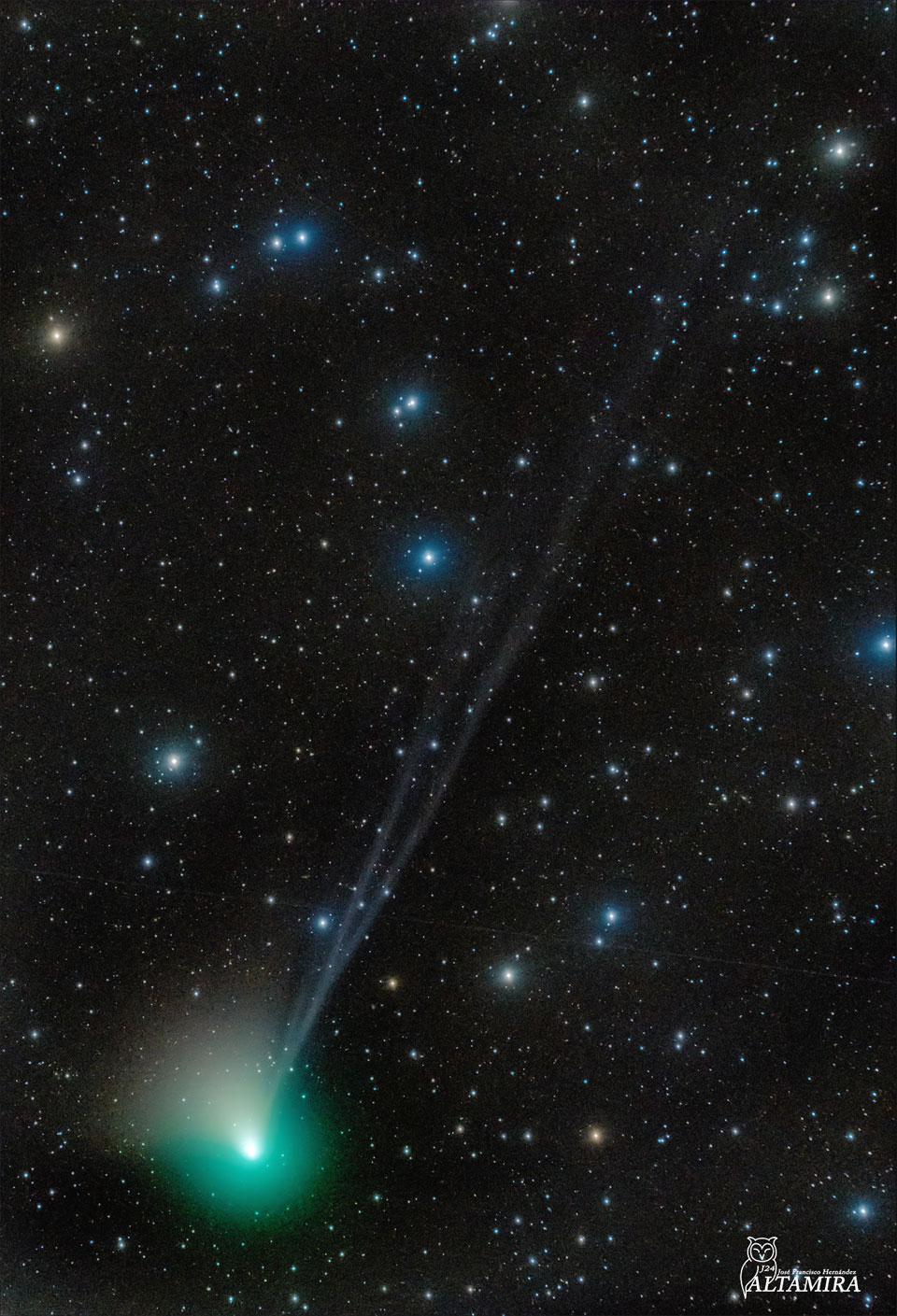
Comet ZTF may become visible to the unaided eye. Discovered early last year, this massive snowball has been brightening as it approaches the Sun and the Earth. C/2022 E3 (ZTF) will be closest to the Sun later this week, at which time it may become visible even without binoculars to northern observers with a clear and dark sky. As they near the Sun, comet brightnesses are notoriously hard to predict, though. In the featured image taken last week in front of a picturesque star field, three blue ion tails extend to the upper right, likely the result of a variable solar wind on ions ejected by the icy comet nucleus. The comet's white dust tail is visible to the upper left and much shorter. The green glow is the comet's coma, caused by glowing carbon gas. Comet ZTF is expected to pass nearest the Earth in early February, after which it should dim dramatically. Discovery + Outreach: Graduate student research position open for APOD
© Jose Francisco Hernández — used with the credit NASA publishes
2021
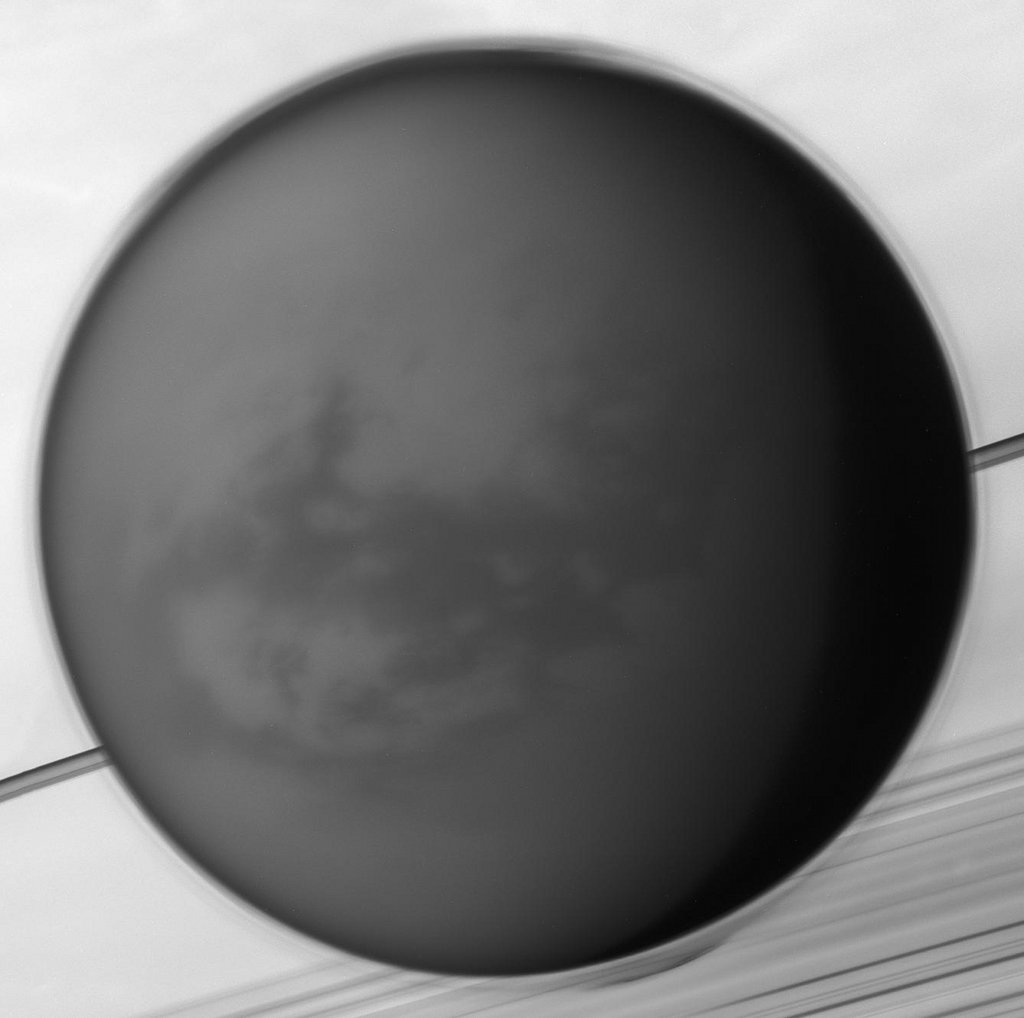
Like Earth's moon, Saturn's largest moon Titan is locked in synchronous rotation. This mosaic of images recorded by the Cassini spacecraft in May of 2012 shows its anti-Saturn side, the side always facing away from the ringed gas giant. The only moon in the solar system with a dense atmosphere, Titan is the only solar system world besides Earth known to have standing bodies of liquid on its surface and an earthlike cycle of liquid rain and evaporation. Its high altitude layer of atmospheric haze is evident in the Cassini view of the 5,000 kilometer diameter moon over Saturn's rings and cloud tops. Near center is the dark dune-filled region known as Shangri-La. The Cassini-delivered Huygens probe rests below and left of center, after the most distant landing for a spacecraft from Earth.
NASA · public domain
1962
Apollo program: NASA announces plans to build the C-5 rocket launch vehicle, then known as the "Advanced Saturn", to carry human beings to the Moon.
Apollo program ↗1992
Radio astronomers Aleksander Wolszczan and Dale Frail announced the discovery of two pulsar planets orbiting PSR B1257+12 (depicted), the first confirmed detection of exoplanets.
Aleksander Wolszczan ↗1992
The first discoveries of extrasolar planets are announced by astronomers Aleksander Wolszczan and Dale Frail. They discovered two planets orbiting the pulsar PSR 1257+12.
Exoplanet ↗General-audience astronomy and spaceflight — none of it a textbook.
As an Amazon Associate I earn from qualifying purchases. Links here cost you nothing extra.
LISTING
Still the best single argument for why any of this matters, and it leaves the arithmetic in. For a reader who wants the science, not just the awe.
LISTING
The case for leaving Earth, written by someone unsentimental about how hard that is. Suits readers who want the argument rather than the poster.
LISTING
Hard-SF problem solving in The Martian's key — for anyone who liked the engineering more than the peril. The only novel on this list.
BROWSE opens an Amazon search, not a specific recommendation.
LINKS AMAZON.COM
Event text and thumbnails come from Wikipedia and are used under CC BY-SA 4.0. Images are drawn only from Wikimedia Commons, which does not accept non-free content — each thumbnail links to its file page, where its licence and author are recorded.
Launch records are from The Space Devs’ Launch Library 2. Pictures are NASA’s Astronomy Picture of the Day; NASA imagery is generally not subject to copyright, but individual APOD entries are frequently the property of the photographer, and each caption says which applies.