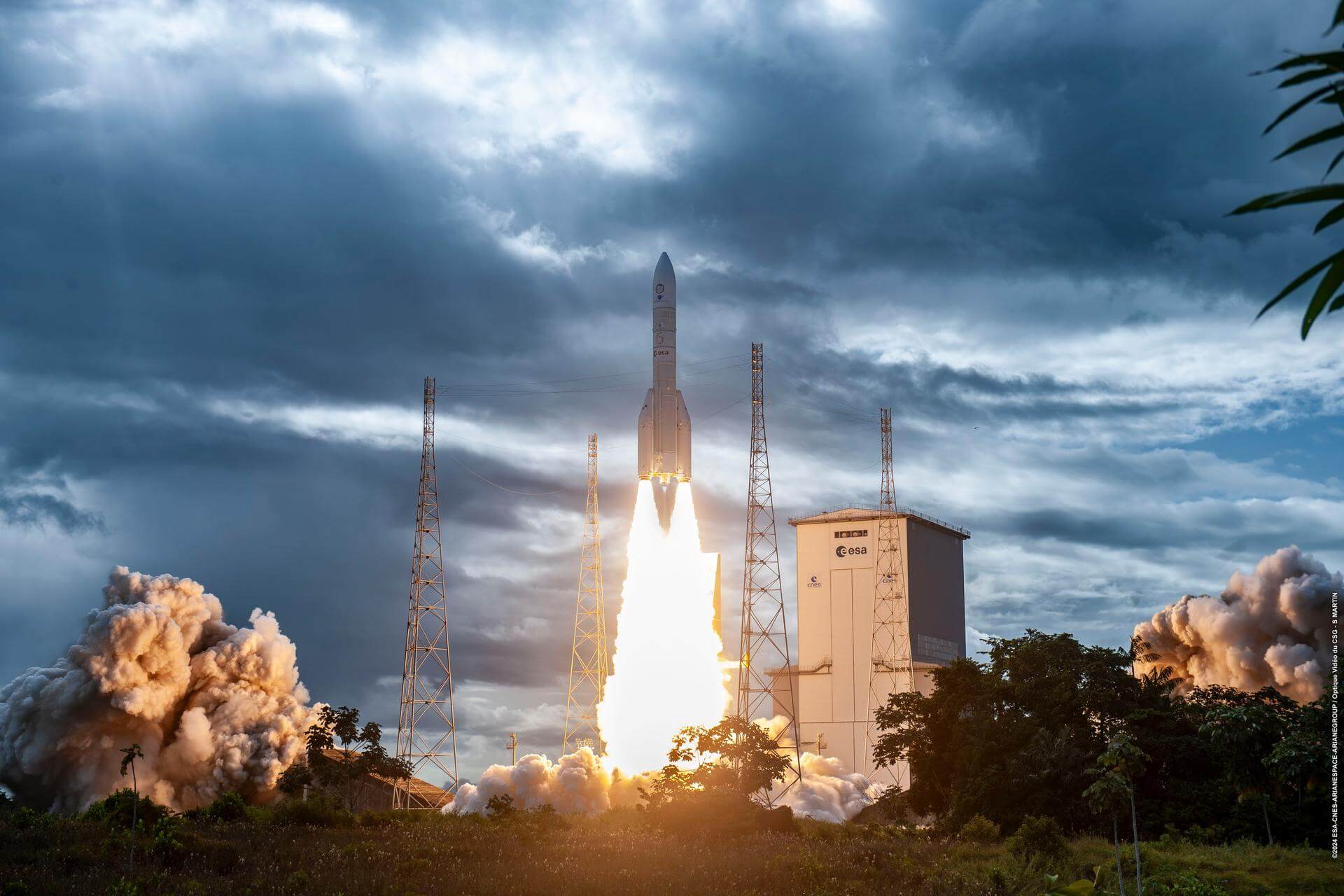
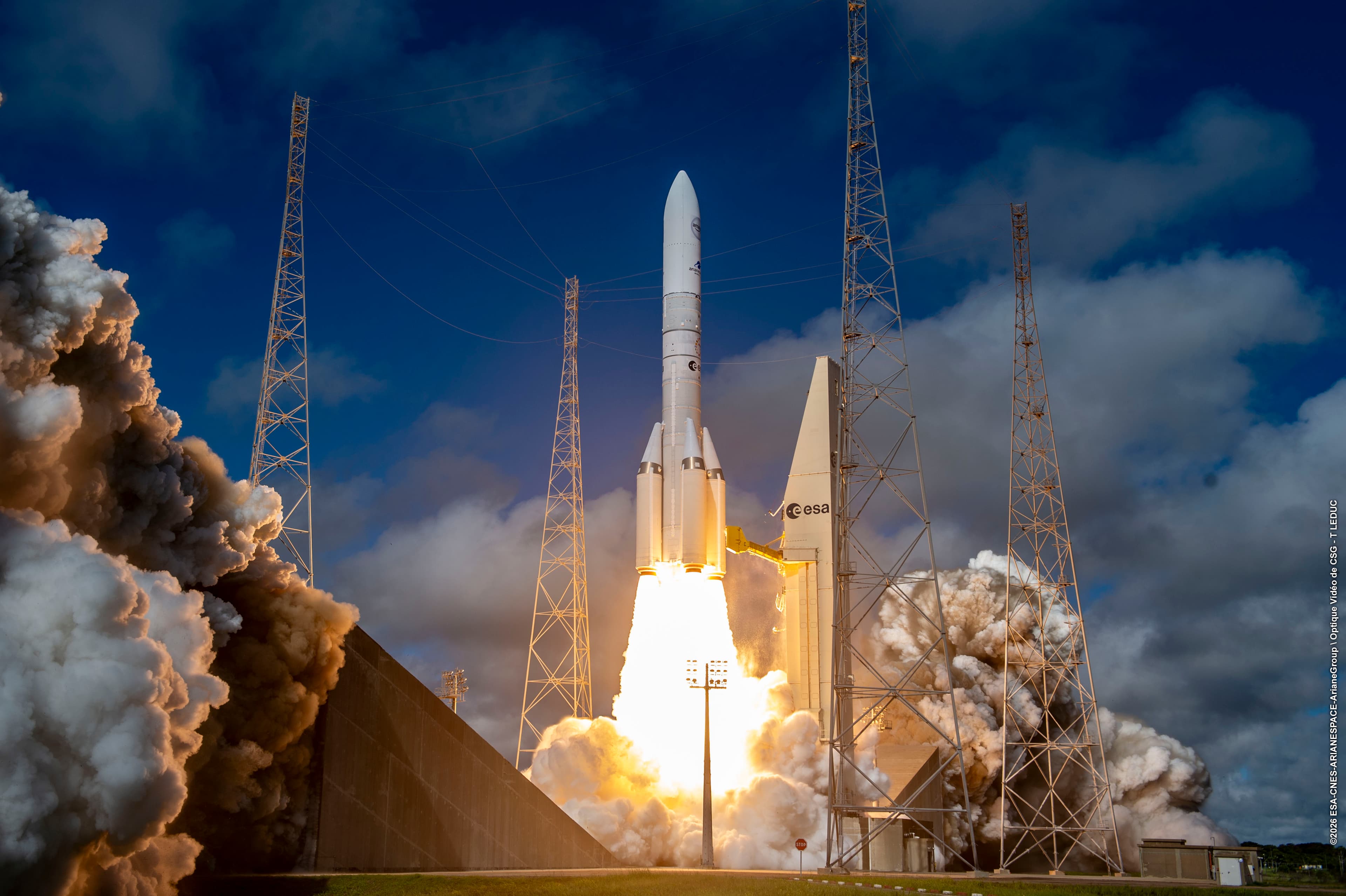
The next Arianespace launch is Ariane 64 Block 2 | Amazon Leo (LE-04), flown by Arianespace from Ariane Launch Area 4, Guiana Space Centre, French Guiana, lifting off no earlier than 2026-10-07 00:00:00Z. 2 Arianespace launches are currently on the manifest below, each with a live countdown, its pad, its vehicle and a plain statement of how firm the date actually is. This one is filed as a target date rather than a confirmed T-0, so expect it to move.
Amazon Leo, formerly known as Project Kuiper, is a mega constellation of satellites in Low Earth Orbit that will offer broadband internet access, this constellation will be managed by Kuiper Systems LLC, a subsidiary of Amazon. This constellation is planned to be composed of 3,276 satellites. The satellites are projected to be placed in 98 orbital planes in three orbital layers, one at 590 km, 610 km and 630 km altitude.
35-40 satellites will be carried on each Ariane 6 launch.
ESTIMATED TIME REMAININGNET ±1 DAY
T-··:··:··2026-10-07 00:00:00Z
The date is firm, the clock is not. Expect a time of day to be published closer in.
PAD
Ariane Launch Area 4 · Guiana Space Centre, French Guiana
The operator has not published how firm this date is. Treat it as provisional.
PAD
Ariane Launch Area 4 · Guiana Space Centre, French Guiana
VEHICLE
Ariane 62
ORBIT
MEO
WINDOW
INSTANTANEOUS
OPEN MISSION BRIEF
Questions about the schedule
FAQ / 01
BRIEF
How accurate are launch times?
It depends on how precisely the operator has filed the flight, and every launch on this page is labelled with that precision. A launch marked T-0 SET is accurate to the minute or better and is worth setting an alarm for. One marked NET ±1 DAY, ±1 WEEK or coarser is a placeholder: the date will move. As a rule, times firm up inside the final 48 hours, and the last unknown is usually weather.
FAQ / 02
BRIEF
Why do launches slip?
Four reasons cover almost all of it: weather at the pad or in the booster recovery zone, a range conflict with another user of the same airspace or sea lane, a failed check on the vehicle or the payload during the count, and orbital mechanics. A rendezvous with the International Space Station has a window measured in seconds, so missing it costs a full day. Slips of hours to weeks are routine and rarely mean anything is wrong.
FAQ / 03
BRIEF
Which agencies and operators are covered?
All of them. SpaceX, United Launch Alliance, Rocket Lab, Arianespace, Blue Origin and Firefly; the state programmes CASC, Roscosmos, ISRO and JAXA; and the newer Chinese commercial operators such as Galactic Energy and LandSpace. The manifest comes from Launch Library 2, which tracks orbital launches worldwide, and this page lists whatever is scheduled with no editorial filter.
FAQ / 04
BRIEF
How often does this manifest update?
Delta-V re-reads the upstream launch manifest every fifteen minutes and re-renders this page with it, so a scrub, a new target date or a fresh T-0 appears here within about a quarter of an hour of the operator filing it. The countdowns do not wait on that: each one ticks live in your browser against the published launch time, down to the second inside the final hour.
Launch data from The Space Devs Launch Library 2. Times are UTC and are No Earlier Than values: an operator can move a launch at any point, and frequently does.
 ArianespaceFrance